Differential operators for vectors and scalars must incorporate the geometry of the coordinate system used.
The gradient of scalar function F, the divergence and curl of vector field f, and the Laplacian of F appear in Cartesian (x, y, z), cylindrical (r, θ, z), and spherical (ρ, θ, φ) coordinates with their respective unit vectors and scale factors such as 1/r and 1/(ρ sin θ).
These formulas support calculations in real-world scenarios such as determining fluid flow patterns inside cylindrical tubes for process engineering and electric potential distributions from spherical charges in electrostatics.
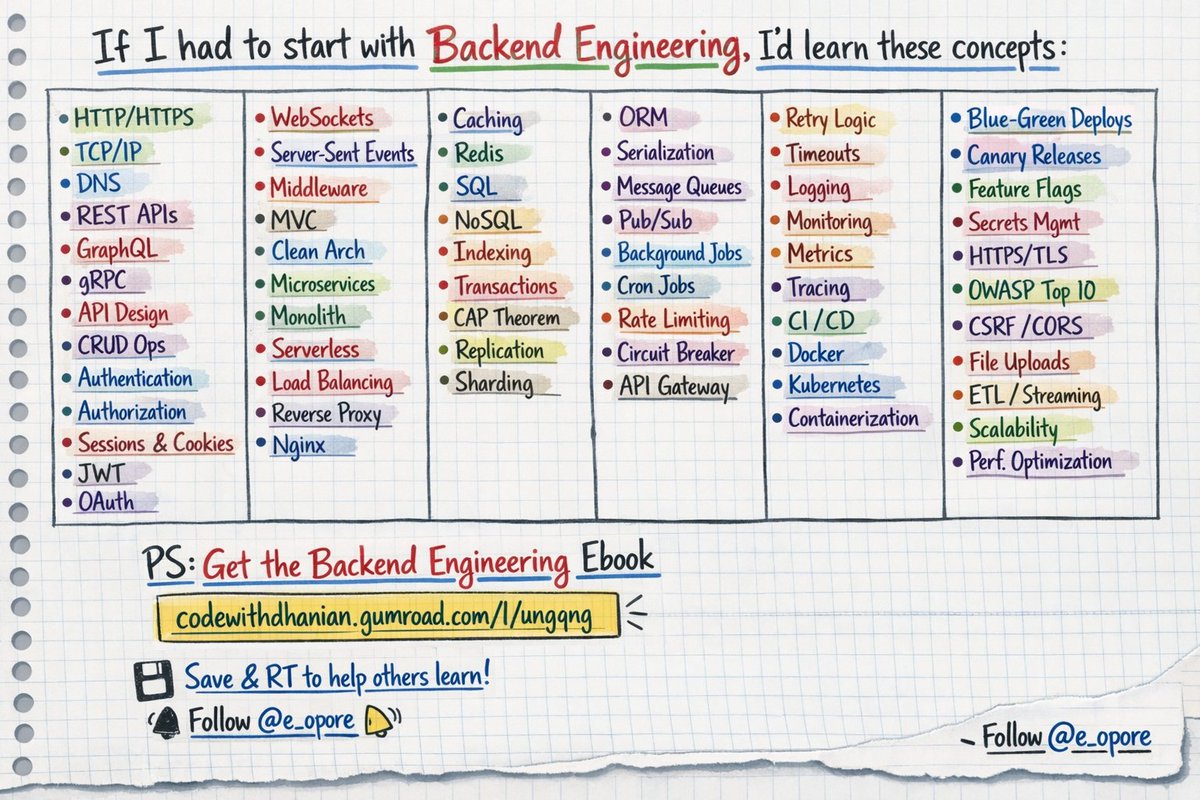
Backend Engineering Mastery Guide
If it is handling requests → APIs
If it is designing APIs → REST / GraphQL
If it is server-side development → Node.js / Java / Go
If it is database management → PostgreSQL / MySQL
If it is NoSQL data → MongoDB
If it is authentication → JWT / OAuth
If it is authorization → RBAC / Permissions
If it is caching → Redis
If it is background jobs → Queues & Workers
If it is messaging systems → Kafka / RabbitMQ
If it is file storage → S3
If it is scalability → Load Balancers
If it is performance → Query Optimization
If it is monitoring → Prometheus / Grafana
If it is logging → ELK Stack
If it is containerization → Docker
If it is orchestration → Kubernetes
If it is deployment → CI/CD Pipelines
If it is system reliability → Fault Tolerance + Resilience
If it is mastering backend engineering → build → scale → monitor → improve → repeat
Grab the Backend Engineering ebook: https://t.co/t9mqUuRbjx
MASTERING SYSTEM DESIGN CHECKLIST FOR 2026
1 → Understand what system design is and why it matters
2 → Learn how large-scale systems differ from small apps
3 → Understand client-server architecture deeply
4 → Learn how the internet works (DNS → TCP → HTTP → HTTPS)
5 → Understand latency, throughput, and bandwidth
6 → Learn how requests flow through a system
7 → Understand stateless vs stateful architectures
8 → Design a simple scalable web application
9 → Learn how to break problems into components
10 → Think in systems, not just code
11 → Master API design (REST, GraphQL)
12 → Design clean and consistent endpoints
13 → Handle versioning and backward compatibility
14 → Understand authentication (JWT, OAuth, sessions)
15 → Implement authorization and access control
16 → Design rate limiting and throttling
17 → Handle errors and retries gracefully
18 → Use API gateways effectively
19 → Document APIs properly
20 → Secure APIs from common attacks
21 → Master database fundamentals
22 → Choose between SQL and NoSQL wisely
23 → Design scalable database schemas
24 → Understand indexing and query optimization
25 → Learn replication and sharding
26 → Handle transactions and consistency
27 → Understand CAP theorem
28 → Implement caching (Redis, Memcached)
29 → Design data partitioning strategies
30 → Optimize read vs write performance
31 → Learn load balancing strategies
32 → Understand horizontal vs vertical scaling
33 → Use CDNs for content delivery
34 → Learn message queues (Kafka, RabbitMQ, SQS)
35 → Build event-driven systems
36 → Implement background workers and jobs
37 → Design fault-tolerant systems
38 → Handle system failures gracefully
39 → Use circuit breakers and retries
40 → Design for high availability
41 → Understand microservices architecture
42 → Learn service communication patterns
43 → Implement service discovery
44 → Monitor systems (logs, metrics, tracing)
45 → Use centralized logging systems
46 → Learn containerization (Docker)
47 → Understand orchestration (Kubernetes basics)
48 → Design multi-region systems
49 → Practice real-world system design problems
50 → Communicate your design clearly in interviews
Grab the System Design Ebook:
https://t.co/WIMretQFPE
System Design Talks 24 - Real Time Communication
[FAANG(Uber) SDE2 Interview]
Problem?
THOUSANDS of drivers are sending their GPS coordinates every second & THOUSANDS of riders need to see that car move smoothly on their map.
Do you use polling or WebSockets?
Learn system design with these 35 concepts:
1. Event-driven architecture: https://t.co/5vgAD2wJ61
2. gRPC: https://t.co/2shjriQa9k
3. Database types: https://t.co/yqHPxZJgDA
4. CAP theorem: https://t.co/FUNrQ6lsyH
5. Microservices: https://t.co/7W3w38s5nF
6. Sync vs Async: https://t.co/kgLTkRzsye
PS - if you want a structured path, get our FREE 142-page System Design Handbook when you join our free weekly newsletter → https://t.co/WTV0H4kkp2
7. ACID vs BASE: https://t.co/l2mdVSNLqT
8. Rate limiting: https://t.co/BHbpQdzRbK
9. JWT: https://t.co/7IsbabOMCB
10. Hashing vs encryption vs tokenization: https://t.co/yskm0i5Kc7
11. Idempotency: https://t.co/sGY9AEYIYF
12. Network protocols: https://t.co/PppArCVi80
13. Observability: https://t.co/H1ewSTKg0g
14. SSO (single sign-on): https://t.co/J5e6g0h30z
15. Change Data Capture (CDC): https://t.co/fpZnlYPzmD
16. REST APIs: https://t.co/OfsXzycxBf
17. CI/CD pipelines: https://t.co/jqxmbzfXwf
18. System design quality attributes: https://t.co/ozKy29UbBn
19. Bloom Filters: https://t.co/60hAzAOZFS
20. Health checks vs heartbeats: https://t.co/Cb05qsG5al
21. API gateway vs load balancer vs reverse proxy: https://t.co/FiODhLn3HJ
22. HTTPS: https://t.co/Y9H19Bo5me
23. Load balancing algorithms: https://t.co/kPbIWqmkDI
24. Database caching: https://t.co/GPQelMXSj6
25. API protocols: https://t.co/XUNY6sbyKx
26. CDN: https://t.co/lPKsBWuLfU
27. API Gateway: https://t.co/9teLLY7OY8
28. Message Queues: https://t.co/e5FyPqYMaT
29. Password storage & hashing: https://t.co/UHghcigQ0e
30. Service Discovery: https://t.co/Hs4ZchDhRV
31. Pub/Sub: https://t.co/bT6uWiev1J
32. Connection pooling: https://t.co/JV2OWUrBYP
33. Forward proxy vs reverse proxy: https://t.co/d0nywsmG27
34. Consistent hashing: https://t.co/6QjQq2LHtn
35. SQL vs NoSQL:https://t.co/J78gAicVVb
What else should be on the list?
What concepts would you like me to cover?
——
👋 PS: Get our free 142-page System Design Handbook when you join our free weekly newsletter.
Join 32,000+ engineers → https://t.co/zEtu3LZ8CU
——
♻️ Repost to help others learn system design.
➕ Follow LUC to become good at system design.


![avrldotdev's tweet photo. System Design Talks 24 - Real Time Communication
[FAANG(Uber) SDE2 Interview]
Problem?
THOUSANDS of drivers are sending their GPS coordinates every second & THOUSANDS of riders need to see that car move smoothly on their map.
Do you use polling or WebSockets? https://t.co/4WjaXscOvC](https://pbs.twimg.com/media/HFdCKgdaIAAijQ6.jpg)