My latest @NCRegister on the vital importance of military chaplaincy for our servicemen and women and new bureaucratic threats. https://t.co/7gi2HCPAwJ
#WomenInSTEM Cloistered Benedectine Nun-Scientist & microbiologist recognized as an international expert of cheese - Sr. Noella Marcellino OSB. In 2003, she earned a doctorate in microbiology from the University of Connecticut with a focus on the microbiology of cheese ripening.
"To know the mighty works of God,to comprehend His wisdom and majesty and power,to appreciate in degree the wonderful working of His laws,surely all of this must be a pleasing and acceptable mode of worship to the MostHigh,to whom ignorance cant be more grateful than knowledge".
There will be more than just fireworks to see in the night sky this month!
You can look forward to these celestial sights in July:
- A lunar-planetary alignment
- A visiting comet
- A good look at Saturn and the Milky Way
Happy skywatching! https://t.co/6EP5GpvAQw
What's up for June?
The solstice brings summer to the Northern Hemisphere. Jupiter and Venus will appear close together in the night sky, and Mercury will join them soon after. The Moon will also pass in front of Venus on June 17. Learn more: https://t.co/Ujal0GZVJU
Kick off the new year with some new celestial sights this January! Keep an eye out for:
- Jupiter looking big and bright
- A conjunction between the Moon and Saturn
- A stellar beehive
Happy 2026, and happy skywatching! https://t.co/HfF4LNPsh7
The night skies have some special gifts for you this December:
- The peak of the Geminid meteor shower
- The closest approach of 3I/ATLAS to Earth (at about 170 million miles)
- A Jupiter-Moon conjunction
Get more details on this month’s celestial sights: https://t.co/wmmYGYDqgb
Keep an eye on the night sky in October—you might catch a falling star!
The Orionid meteor shower reaches its peak on the night of Oct. 21-22, and the Draconids will also be visible earlier in the month. Check out what else to watch out for:
GENTLENESS is everywhere in daily life, in the ordinary things, cooking, small talk, and story telling... all the places where the gravy soaks in and grace shines through. In special times one never has to look far to see the campfires of gentle people.
International Observe the Moon Night is Oct. 4! 🌕
While binoculars and telescopes reveal incredible details of our neighbor’s surface, these tools are not the only way to observe it.
Check out some weird ways you can observe the Moon this year: https://t.co/owfqZEQiu8
Get ready for autumn skies 🍂
In September, you’ll get a good look at Saturn and see a celestial trio before sunrise mid-month. Get more details about what to expect from this month’s night skies: https://t.co/ClHjcD6zgu
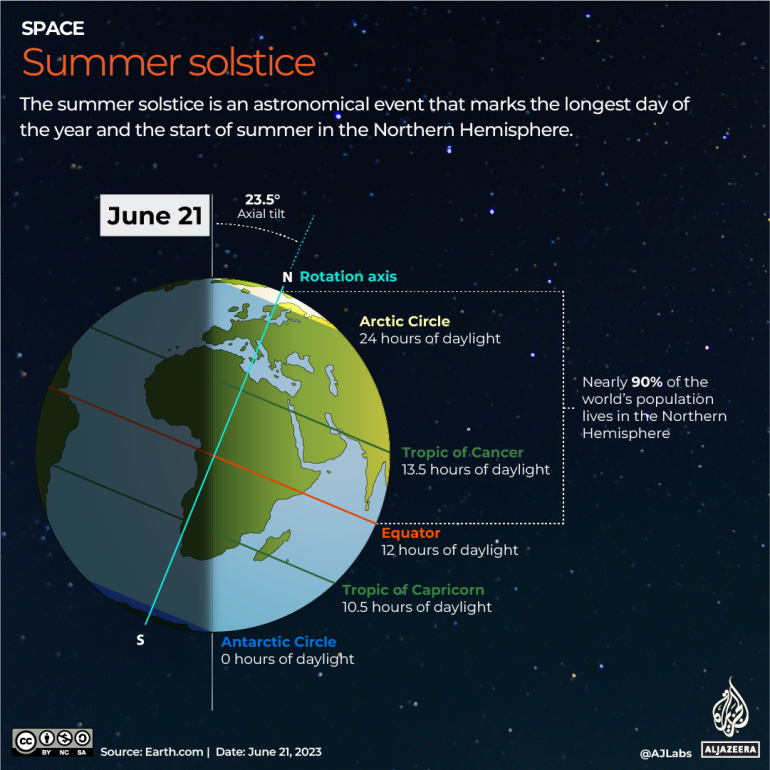
The summer solstice is the moment when the Earth’s axial tilt (about 23.5°) is most inclined toward the Sun, resulting in the Sun reaching its highest apparent position in the sky at local noon. It occurs around June 20–21 in the Northern Hemisphere and around December 21–22 in the Southern Hemisphere.
On this day, the Sun's rays are directly overhead at the Tropic of Cancer (23.5°N) in June, and at the Tropic of Capricorn (23.5°S) in December. It marks the longest day and shortest night of the year for the respective hemisphere and the astronomical beginning of summer.
Image from Al Jazeera
It's gonna be May 💥
We have a new month of skywatching ahead of us! All month long, view Venus, Mars, Jupiter and Saturn. On May 6, catch the peak of the Eta Aquarid meteor shower early in the morning. Details: https://t.co/ZzFZP7dfUe
There are more than just fireworks lighting up the skies this January! 🎆
Each evening this month, enjoy a sweeping view of four bright planets at once. Also look for a close approach of Venus and Saturn, Mars occulted by the Moon, and meteors.
🔗 https://t.co/SFNzxaFiyJ
21 December 2024
Happy Solstice to planet Earth and all its residents. For the next half year, daylight gets longer north of the Equator and shorter south of the Equator.
Yes, contrary to what many people think, days get **longer** in the Winter and **shorter** in the Summer.