Yes—and reality itself is a work in progress. I’m developing a metaphysics of non-closure: whatever appears coherent does so through selection, exclusion, and relation, yet never without remainder. Nothing is finally identical to the form through which it becomes intelligible. A finished, perfectly predictable reality would not be reality perfected; it would be reality dead—collapsed into its own description.
This goes beyond philosophies that place incompleteness mainly in the limits of the knower. Here, non-closure belongs to reality itself. It also exceeds process metaphysics: becoming is not merely change through time, but the consequence of every form failing to exhaust what it is. Process occurs because closure fails—not the other way around.
@jaypberube Treating someone as a mystery while reducing another to a fixed answer is how bias begins. Everyone deserves to be seen as complex and human.
Excellent—that is exactly what I hoped the fragment would do. I have over a million words and hundreds of essays from years of work, and much of the book already exists in chapter form. The philosophy is there; I am now distilling its architecture into a 2027 book and deciding how it should enter the world—with the right sequence, form, and aesthetic. Let’s keep in touch!
No problem. This is only one local consequence of a much larger systematic ontology I’m developing—a metaphysics of how Fantasy, representation, power, and relation produce the forms we mistake for reality. I’m still developing the wider architecture, so I’m sharing pieces of it gradually.
Power does not begin when one being visibly dominates another. It begins earlier, at the level of intelligibility, when one being is permitted to remain ontologically unresolved while another is treated as though its meaning has already been settled. One is preserved as a differentiated particular whose concealed properties, contradictions, and future disclosures remain capable of revising the model; the other is compressed into an operational type whose internal variation matters only when it interrupts the function assigned to it. The first retains the privilege of surprise. The second is interpreted in advance. Its resistance becomes malfunction, its difference becomes exception, and its answer is no longer required because the category has already answered on its behalf. The asymmetry is therefore not merely political but epistemological: power allocates representational resolution. It determines who may remain a question, whose complexity can still alter the world’s understanding, and who must live inside an answer constructed before they were encountered.
This is a formulation I developed through a broader study of sexuality and the unequal ways bodies are permitted to remain mysterious: one is approached as a question, the other as a function already understood. It belongs to a larger philosophy of power and representation that I am still developing, and I may share the manuscript when it is ready—the full argument is considerably stranger than the aphorism.
@SITH_SILENCE@mathelirium Good job, you can repeat your own delusions.
There is only 1 string.
The 4 fundamental ‘forces’ exist in your broken language, not mine.
My point exactly.
Defining consciousness as “creative intelligence” or “the capacity for experience” doesn’t solve the problem. It simply relocates it.
An operational definition is not an ontology.
Before asking what consciousness is, we should ask what makes “experience,” “creativity,” or even “intelligence” possible as coherent categories in the first place.
Philosophy has spent centuries searching for better nouns. The deeper work lies in the relations that make those nouns possible at all.
Otherwise, consciousness theory starts to resemble people debating the anatomy of goblins. The dispute becomes more sophisticated while the object itself remains conceptually unsecured——eventually the theories stop explaining ‘consciousness’ and begin manufacturing the illusion that a stable object was there all along.
And honestly, watching increasingly elaborate theories perform the existence of their own object is quite boring.
#Ontology
I don’t think this is a particularly strong philosophical position.
Every sentence presupposes the existence of an ontological object called “consciousness” and then searches for the physical mechanism that produces it.
But that presupposition is never defended.
Before asking whether consciousness emerges from quantum coherence, microtubules, gravity, biophotons, or resonant fields, philosophy has a prior obligation:
Does “consciousness” refer to a coherent natural kind at all?
If the category dissolves under conceptual analysis into perception, attention, memory, affect, sensation, self-reference, prediction, and other distinguishable mental operations, then searching for the mechanism of consciousness is methodologically premature.
The explanatory burden is not on physics.
It is on philosophy to justify why “consciousness” should be treated as a legitimate explanatory target in the first place.
Otherwise, physics risks explaining the architecture of a word rather than the structure of reality.
#PhilosophyOfMind #Consciousness #Ontology #Metaphysics #ConceptualAnalysis #MindBodyProblem #QuantumConsciousness #Logic
& w/cc: @mikeamark (re: yours of May 4)
Well, Doctors, I started speaking & writing into this in 1978--1983, and my summary of key thoughts was published in the 1986 ^Handbook of States of Consciousness^.
Essentially, all of the electronic, molecular and cellular components are 'resonators' interaction "horizontally" (i.e., with similar items on their same scale of measurement) and "vertically" (i.e., with configurations of larger and smaller scale--whereof the smaller are conceptually components of the larger (as the aspect of Reality considered by Systems Theory & Complexity...). The recognizable units at all scales of size act sporatically as mutual observers (e.g., Pauli pairs of electrons, etc. etc.), and their combined forms measure 'space' and give it a particular dimensionality.
All form fluctuates around its 'ground state' because --if you want a logical cause stated-- maintaining a perfect 'void' (conceptually, 'nothing', nil, ^nihil^) would require a large number of dimensions of constraint all focused on a zero-crossing. (Analogy in just 2D: in the universally useful trig function, cis(t)=e^ti, every point on the complex curve 'knows' a slope and a rate of change in the slope, but nothing else. (Some theorists, including GSB, put it like this: "All that is, is actually the least that could possibly be.")
So, conceptually, we might say that the capacity for awareness rises and falls along with forms. (Plato paired "forms" and "souls" as co-arising; however my translating of Classical Greek is all that good!) 'Self' is usually among the 'objects of awareness', co-existing in the construct beside 'others' and 'things'. Stuff seems to us'all as some inside and some outside some boundary surface or circle. Using Dirac's flexible notation: <o|i> & <O|s>. In the 'mind', everyone and everything models or simulates everything else and everyone else, within the momentary scope of awareness. (Time is not a "sharp" quantity, in the terms of Max Born.) <O | Me> & <U,v,w,x,y,z... | I>
This all works-out in biological and human manifestation, as there are no fundamental isolations, but only the relative ones and the conceptual ones we form; however, in our artificial constructs ("machines", artifacts, models, simulations) isolations are by design and intrinsic to the assembly from constructed components. Real communication requires pairwise interpretation of two-way signal, in the shared context, and with the communicants (entities) immersed in the above/below 'soup' of shared bases (as, for trivial example: a pair entangled photons, now at some separation). [photo by J9 @CircularSea, LoF22 symposium, Silicon Valley pod, 6 August 2022:]
People do not understand scale.
“Six billion base pairs packed into a nucleus” is not inherently more astonishing than countless other biological structures. It feels miraculous maybe/partly because the number is large and the scale difference is difficult to intuit.
What is more interesting is how a scientific description becomes culturally elevated into an emblem of wonder.
Science does not only produce facts. It also produces an ontology of significance that tells us which facts deserve awe.
#ScientificMythology #Philosophy #Biology
About 6.2 billion basepairs of DNA are 'packed' into the nucleus of each human cell. Scaled by a factor of 500,000x, this is akin to packing a 1,000-kilometer-long string (roughly the distance from New York City to Detroit) into a small bedroom.
How does all that DNA fit? Well, let’s do some back-of-the-envelope calculations:
The human genome is 6.2 billion basepairs in length, and each basepair is separated by 0.34 nanometers along the helix. (A carbon-carbon single bond is about half that length.) Multiply these numbers together, and we see that the DNA inside of each cell stretches about 2.1 meters in length. This is not a scaled value! A human cell nucleus has a diameter of about 6 micrometers.
So what fraction of that nucleus is 'occupied' by the DNA?
First, we calculate the volume of the cell nucleus. Given a radius of 3 micrometers, and using the regular equation (V = 4/3*pi*r^3), we get a volume of 113 cubic micrometers.
The DNA can be modeled as a cylinder. This cylinder is 2.1 meters long and about 2 nanometers in diameter. Again, using the equation for volume of a cylinder (V=π*r^2*h) we get 6.6 cubic micrometers.
In short: The human genome occupies about 6% of the cell nucleus. This is not tightly packed at all.
The main problem is that once you pack all of this 'string' into the nucleus, you have created a really difficult search problem for yourself. This string is coiled up tightly and, if you are an enzyme, then you might need to find a particular segment of the string located at, say, position 4,284,283,192. Good luck with that! And yet, cells have evolved highly effective search strategies to quickly retrieve information, which I think is one of the great innovations of evolution.
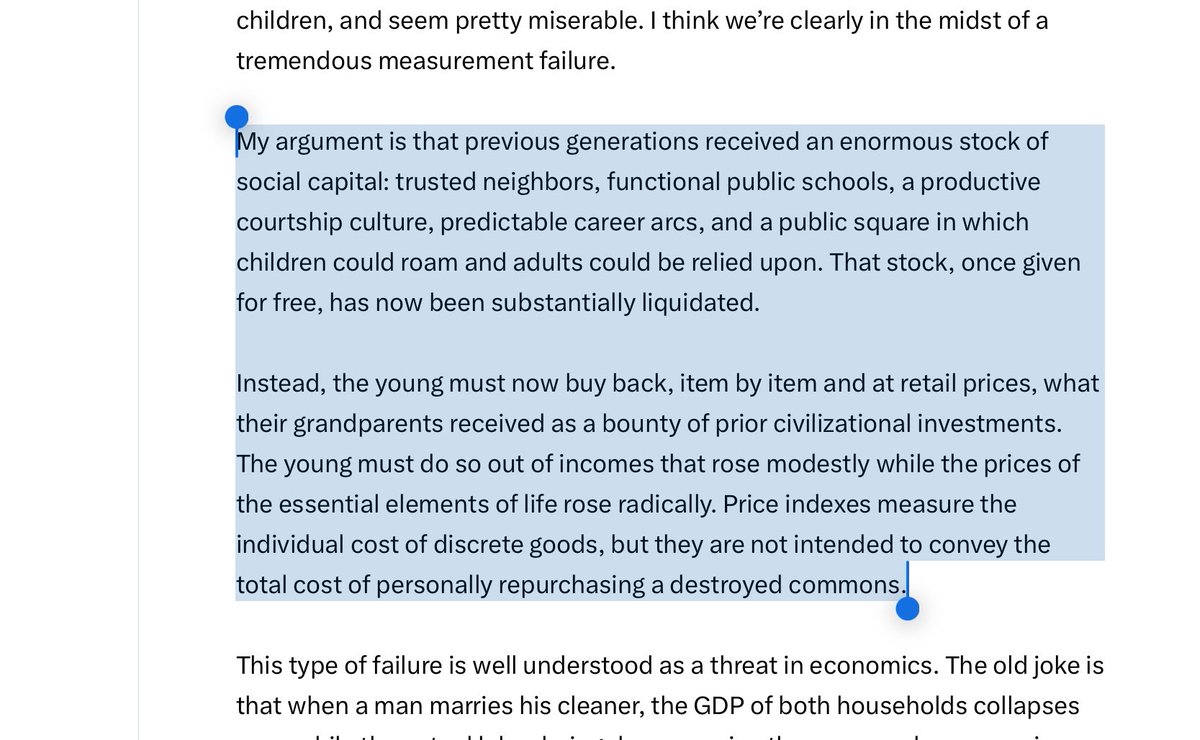
This is close, but it still describes the symptom as though “social capital” simply disappeared. I don’t think so.
What is really happening is more structural:
The commons was not merely depleted. It was enclosed, fragmented, and converted into priced access.
Schools, safety, trust, courtship, career stability, and community did not vanish into nothing. Their surviving value migrated into:
-housing premiums
-private tuition
-credentials
-memberships
-subscriptions
-exclusive neighborhoods
-professional networks
The young are not simply “buying back” what previous generations received freely. They are paying tolls to enter social conditions that were once collectively sustained.
That is why the overpriced neighborhood is not merely a hedge against dysfunction —it is a privately controlled opening into functioning society.
Capital does not just sell goods. It increasingly owns the thresholds through which people access safety, education, trust, opportunity, and family formation.
So the real measurement failure is not that inflation misses some replacement costs.
It is that economics measures the price of commodities while ignoring the rising price of admission into a viable life.
A generation may own more goods and possess less world.
#Philosophy #Economics #PoliticalPhilosophy #Ontology #SocialCapital #Institutions #Complexity #Capitalism
Social Capital™️
I have never seen the plight of my generation articulated so well.
This is the core issue we must solve, we must provide abundant social capital to the next generation - using the levers of politics and private industry - or humanity as we know it will end.
We’ve spent centuries asking what consciousness, mind, body, and self are. Perhaps we should be asking what the “and” is.
The deepest ontology may belong not to the nouns, but to the conjunction that makes relation possible.
#Philosophy#Ontology#Phenomenology
7 Stocks for 7 years
#CDMO's to watch out for based on
- R&D, IP/Patents, Innovation, Scientists & Therapeutics
Syngene
Neuland Labs
Laurus Labs
Sequent Scientific
Jubilant Life
Dishman Carbogen
Hikal
(not a recommendation, please do your own market research)
First understand the #CDMO industry and then understand the business potential. When you get a great industry structure, a moat-protected small business, best in class management team :: the scale of margin expansion and growth runway over 5-10 years can even surprise the bulls🌋
VHH nanobody CDMO selection depends on format, expression system, analytics, GMP needs, and final product use.
New CDMO Network guide:
Best VHH Nanobody CDMO Services
Learn more: https://t.co/8ysk8snI5r
#VHH#Nanobody#CDMO#Biologics


![FrancisJeffrey7's tweet photo. & w/cc: @mikeamark (re: yours of May 4)
Well, Doctors, I started speaking & writing into this in 1978--1983, and my summary of key thoughts was published in the 1986 ^Handbook of States of Consciousness^.
Essentially, all of the electronic, molecular and cellular components are 'resonators' interaction "horizontally" (i.e., with similar items on their same scale of measurement) and "vertically" (i.e., with configurations of larger and smaller scale--whereof the smaller are conceptually components of the larger (as the aspect of Reality considered by Systems Theory & Complexity...). The recognizable units at all scales of size act sporatically as mutual observers (e.g., Pauli pairs of electrons, etc. etc.), and their combined forms measure 'space' and give it a particular dimensionality.
All form fluctuates around its 'ground state' because --if you want a logical cause stated-- maintaining a perfect 'void' (conceptually, 'nothing', nil, ^nihil^) would require a large number of dimensions of constraint all focused on a zero-crossing. (Analogy in just 2D: in the universally useful trig function, cis(t)=e^ti, every point on the complex curve 'knows' a slope and a rate of change in the slope, but nothing else. (Some theorists, including GSB, put it like this: "All that is, is actually the least that could possibly be.")
So, conceptually, we might say that the capacity for awareness rises and falls along with forms. (Plato paired "forms" and "souls" as co-arising; however my translating of Classical Greek is all that good!) 'Self' is usually among the 'objects of awareness', co-existing in the construct beside 'others' and 'things'. Stuff seems to us'all as some inside and some outside some boundary surface or circle. Using Dirac's flexible notation: <o|i> & <O|s>. In the 'mind', everyone and everything models or simulates everything else and everyone else, within the momentary scope of awareness. (Time is not a "sharp" quantity, in the terms of Max Born.) <O | Me> & <U,v,w,x,y,z... | I>
This all works-out in biological and human manifestation, as there are no fundamental isolations, but only the relative ones and the conceptual ones we form; however, in our artificial constructs ("machines", artifacts, models, simulations) isolations are by design and intrinsic to the assembly from constructed components. Real communication requires pairwise interpretation of two-way signal, in the shared context, and with the communicants (entities) immersed in the above/below 'soup' of shared bases (as, for trivial example: a pair entangled photons, now at some separation). [photo by J9 @CircularSea, LoF22 symposium, Silicon Valley pod, 6 August 2022:]](https://pbs.twimg.com/media/GsLe1gtaEAA7VqO.jpg)


![FrancisJeffrey7's tweet photo. & w/cc: @mikeamark (re: yours of May 4)
Well, Doctors, I started speaking & writing into this in 1978--1983, and my summary of key thoughts was published in the 1986 ^Handbook of States of Consciousness^.
Essentially, all of the electronic, molecular and cellular components are 'resonators' interaction "horizontally" (i.e., with similar items on their same scale of measurement) and "vertically" (i.e., with configurations of larger and smaller scale--whereof the smaller are conceptually components of the larger (as the aspect of Reality considered by Systems Theory & Complexity...). The recognizable units at all scales of size act sporatically as mutual observers (e.g., Pauli pairs of electrons, etc. etc.), and their combined forms measure 'space' and give it a particular dimensionality.
All form fluctuates around its 'ground state' because --if you want a logical cause stated-- maintaining a perfect 'void' (conceptually, 'nothing', nil, ^nihil^) would require a large number of dimensions of constraint all focused on a zero-crossing. (Analogy in just 2D: in the universally useful trig function, cis(t)=e^ti, every point on the complex curve 'knows' a slope and a rate of change in the slope, but nothing else. (Some theorists, including GSB, put it like this: "All that is, is actually the least that could possibly be.")
So, conceptually, we might say that the capacity for awareness rises and falls along with forms. (Plato paired "forms" and "souls" as co-arising; however my translating of Classical Greek is all that good!) 'Self' is usually among the 'objects of awareness', co-existing in the construct beside 'others' and 'things'. Stuff seems to us'all as some inside and some outside some boundary surface or circle. Using Dirac's flexible notation: <o|i> & <O|s>. In the 'mind', everyone and everything models or simulates everything else and everyone else, within the momentary scope of awareness. (Time is not a "sharp" quantity, in the terms of Max Born.) <O | Me> & <U,v,w,x,y,z... | I>
This all works-out in biological and human manifestation, as there are no fundamental isolations, but only the relative ones and the conceptual ones we form; however, in our artificial constructs ("machines", artifacts, models, simulations) isolations are by design and intrinsic to the assembly from constructed components. Real communication requires pairwise interpretation of two-way signal, in the shared context, and with the communicants (entities) immersed in the above/below 'soup' of shared bases (as, for trivial example: a pair entangled photons, now at some separation). [photo by J9 @CircularSea, LoF22 symposium, Silicon Valley pod, 6 August 2022:]](https://pbs.twimg.com/media/GsLhr8JboAADyJs.jpg)