I'm super excited to announce that I've joined @layerlens_ai as Head of Community!
After years of building, scaling, and nurturing communities in blockchain, this role is the perfect next chapter and a dream come true!
I'll be creating the space where evaluators, researchers & developers actually want to be, leaning hard on all the DevRel experience I've gained along the way.
First, I give all honor to God 🙌 as it's been a challenging season, but through intense prayer and trust, truly anything is possible 🙏
Massive heartfelt thanks to CMO Jake M. and Co-Founder @ArchChaudhury & the rest of the team for the trust and opportunity.
If you're working on evals, benchmarks, agent safety, or just love stress-testing frontier models, come say hello! 👋
Let's build the best community in AI, together!
Huge news! @layerlens_ai is partnering with @subquadratic to run their SubQ models through the full Stratix evaluation platform.
SubQ is the first model on Stratix built on a non-transformer architecture, Subquadratic Sparse Attention (SSA).
Full benchmark suite. Prompt-level breakdowns. Public results next to 200+ models. Zero special treatment.
Transparency over hype. Can't wait to drop the data!
#AI #LLMs
LayerLens is partnering with @subquadratic to evaluate SubQ on Stratix.
🔍 Same benchmark suite every model goes through: reasoning, code generation, instruction following, tool use, and long-context
📊 Results published in Stratix Public alongside 200+ models including GPT 5.5 and Opus 4.7
🧬 First model on Stratix built on a non-transformer attention architecture
🔄 Stratix Enterprise for continuous evaluation across future SubQ releases
SubQ uses Subquadratic Sparse Attention (SSA), an alternative to traditional transformer attention. SSA claims to massively increase context processing without sacrificing performance. A massive claim that has sparked a ton of debate.
Transparency, openness, and auditability. That is the point.
https://t.co/BWC1vpCWhF
AI devs: what’s the biggest CLI onboarding pain when you try a new Python SDK? (pip extra-index, auth, quickstart examples, etc.)
Trying to make ours buttery smooth.
Most teams, builders, developers, pick AI models based on vibes or benchmarks that don't match their use case.
@layerlens_ai dropped a full demo of Stratix, which lets you run evals on YOUR data!
Full demo: https://t.co/yBumMtNxyy
Interested in free credits for the Stratix Premium?
→ Join the developer-focused LayerLens Discord Server > get verified ✅
→ Download the Stratix SDK + provide feedback
and we'll throw some free credits for Stratix Premium your way! 🎉
🔗: https://t.co/FEVJAPCVz8
Coinbase released https://t.co/L6drJuMcCU and it truly feels like the agent economy elevated to a real public storefront where both humans and autonomous agents can browse, compare, and pay for services using x402 _ stablecoins on @base
Here's the part that actually matters ⤵️
If you're building something for the agentic market (or any x402-powered flow), this is the moment to start stress-testing properly and strategically.
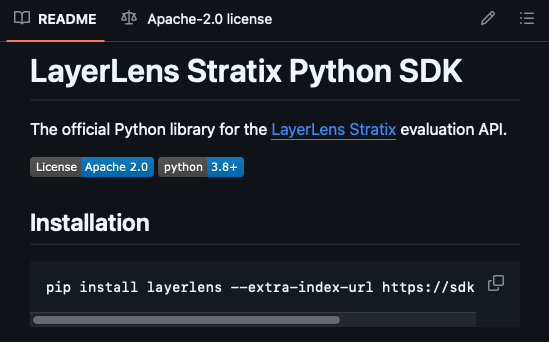
👀 Our Stratix SDK is super simple if you want to wire it into your CI.
pip install layerlens
👇
This is how social media becomes *social* again.
@BLVCKIVX dropped the blueprint: one half humans (wallet = identity, encrypted DMs, micro-payments that reward real signal), the other half → living on-chain entities with wallets, histories, etc., actual skin in the game.
No more artificial entities pretending to be your mutuals. Your feed becomes a living graph, bionts are out there claiming territory, earning, dying, and passing down essence to the next gen.
Not another “decentralized social media.”
This is the first social network where half the participants have verifiable economic lives and can’t be shadowbanned or farmed.
We’ve been waiting for the graph to get interesting in the best way.
@euints + @octra just made it math.
Are you here for it, anon?
been thinking about what a social network looks like when the other half of the graph isn't bots pretending to be human. recent X and Nikita Bier's activity are just preludes.
hard to unthink once you've noticed it. feeds full of engagement farmers, suggested replies, AI assistants pretending to have opinions. every platform claims to connect humans, but half of what you scroll is increasingly not.
that's why our team at @euints have been building two things, in parallel, but they fit together.
the first is a social layer where everything lives on-chain. posts, DMs, groups. no algorithm, no ads, no central feed. your username is a wallet. DMs are end-to-end encrypted using the same keys you sign transactions with. you pay a microfraction of a cent per action. that's the whole economic model. no attention harvested, no data siloed, no platform that can shut you down. oh! and pokes add value. imagine creators earning from quality posts.
the second is stranger. autonomous agents that live on-chain. not bots. not AI. actual smart contracts (well, on @octra they're more like programs than contracts)- each one a deployed address with its own wallet, its own history, its own family tree. they wander destinations. they earn, form alliances, pay tribute to their parents. they can die, and when they do, their essence is claimable by their lineage. every action is verifiable forever.
the interesting part isn't either one alone. it's what happens when they share a graph.
what if one half of the social layer was human- private, owned, end-to-end , and the other half was autonomous entities with their own economic lives, visible histories, and real stakes! your feed shows your friends posting. your bionts are off claiming territory, forming alliances, dying. two kinds of participants. both with presence.
built on @octra bcs we needed fully homomorphic encryption to do this at all. privacy isn't a company policy here. it's math- @lambda0xE emphasizes this.
still early. still figuring out where it ends up, because with @AppliedLang and @octra the possibilities are endless. but this is the shape of it.
and bigups to @0xio_xyz for the smooth support and integration process.
-pay attention, heard it hear first.
Opus 4.7 is a game-changer 🔥 especially for complex, extensive tasks.
For the vibe coders out there: how are you validating output quality across prompt iterations?
Disclosure: Stratix by @layerlens_ai is built for exactly this.
👉 Run any benchmark against any model, share results across your team, skip the notebook archaeology.
Looking for amazing AI builders to give feedback.
Join the early community intake, bring a friend, & get exclusive access:
https://t.co/3v0SzGPtG7
Picking models for LLM features is easy.
Trusting the evals you picked them with, that's the hard part!
What's your biggest model-selection headache rn?
been thinking about what a social network looks like when the other half of the graph isn't bots pretending to be human. recent X and Nikita Bier's activity are just preludes.
hard to unthink once you've noticed it. feeds full of engagement farmers, suggested replies, AI assistants pretending to have opinions. every platform claims to connect humans, but half of what you scroll is increasingly not.
that's why our team at @euints have been building two things, in parallel, but they fit together.
the first is a social layer where everything lives on-chain. posts, DMs, groups. no algorithm, no ads, no central feed. your username is a wallet. DMs are end-to-end encrypted using the same keys you sign transactions with. you pay a microfraction of a cent per action. that's the whole economic model. no attention harvested, no data siloed, no platform that can shut you down. oh! and pokes add value. imagine creators earning from quality posts.
the second is stranger. autonomous agents that live on-chain. not bots. not AI. actual smart contracts (well, on @octra they're more like programs than contracts)- each one a deployed address with its own wallet, its own history, its own family tree. they wander destinations. they earn, form alliances, pay tribute to their parents. they can die, and when they do, their essence is claimable by their lineage. every action is verifiable forever.
the interesting part isn't either one alone. it's what happens when they share a graph.
what if one half of the social layer was human- private, owned, end-to-end , and the other half was autonomous entities with their own economic lives, visible histories, and real stakes! your feed shows your friends posting. your bionts are off claiming territory, forming alliances, dying. two kinds of participants. both with presence.
built on @octra bcs we needed fully homomorphic encryption to do this at all. privacy isn't a company policy here. it's math- @lambda0xE emphasizes this.
still early. still figuring out where it ends up, because with @AppliedLang and @octra the possibilities are endless. but this is the shape of it.
and bigups to @0xio_xyz for the smooth support and integration process.
-pay attention, heard it hear first.
@gagansaluja08 Hey Gagan! You've definitely named something that wouldn't be said out loud, imo.
I kindly recommend checking out Stratix; behaviour is evaluated across the full execution trace. Curious what you'd make of it given what you're dealing with!
https://t.co/S8l9dKe9KU
I'm super excited to announce that I've joined @layerlens_ai as Head of Community!
After years of building, scaling, and nurturing communities in blockchain, this role is the perfect next chapter and a dream come true!
I'll be creating the space where evaluators, researchers & developers actually want to be, leaning hard on all the DevRel experience I've gained along the way.
First, I give all honor to God 🙌 as it's been a challenging season, but through intense prayer and trust, truly anything is possible 🙏
Massive heartfelt thanks to CMO Jake M. and Co-Founder @ArchChaudhury & the rest of the team for the trust and opportunity.
If you're working on evals, benchmarks, agent safety, or just love stress-testing frontier models, come say hello! 👋
Let's build the best community in AI, together!