Asst Professor at @westernoregonu teaching psychology and head of the Evolution of Emotional Communication lab. Proud father of two cats & two dogs. He/they
Hey y'all! Ever wonder how we humans perceive emotion from animal calls? Then have I got a new study for you - and it's being featured at @growkudos! We showed that people are influenced by vocal pitch regardless of experience and evolutionary distance.
https://t.co/CxwCBB931f
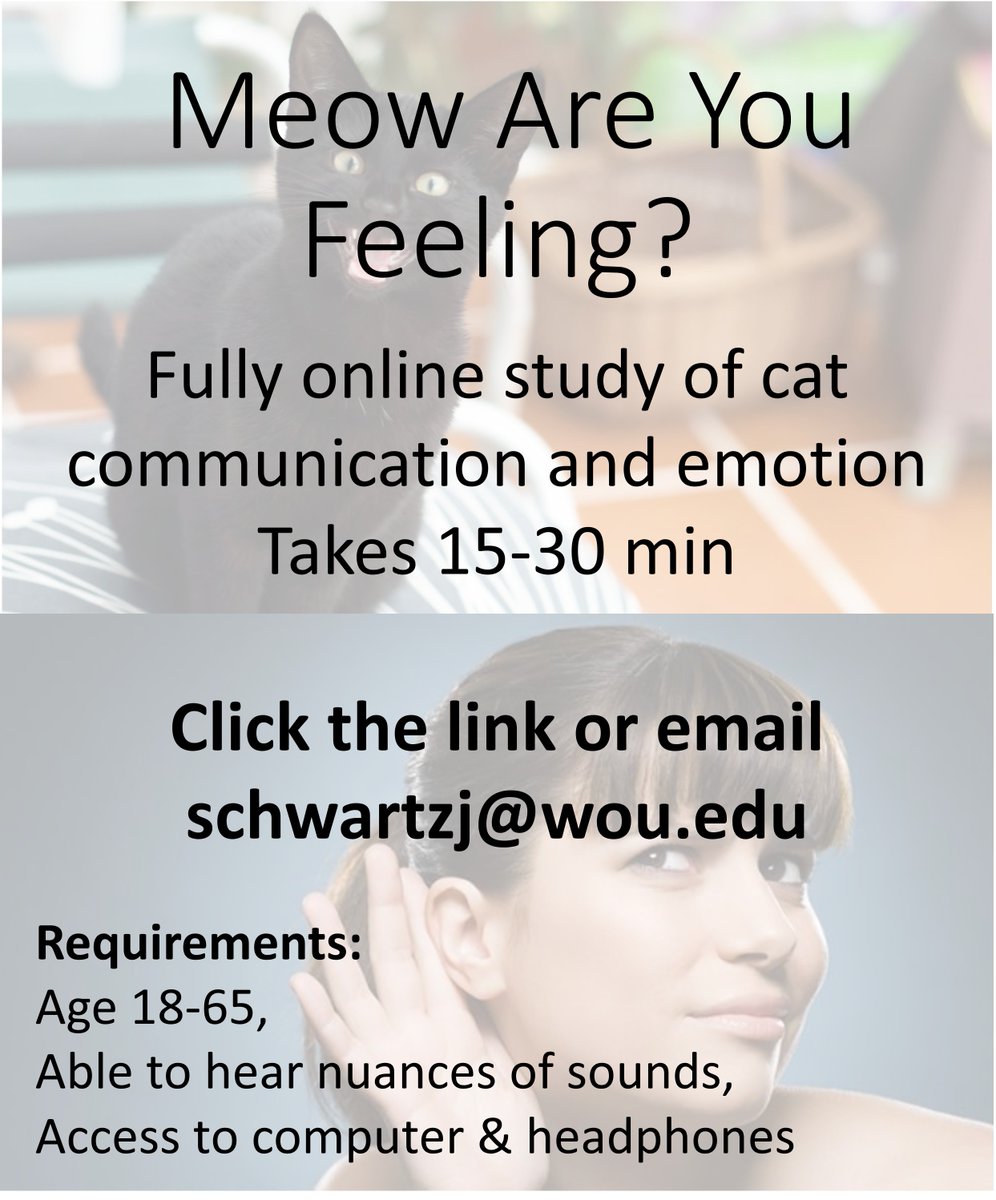
For all its flaws, twitter has been an awesome hub for citizen science. With that said, are you willing to take 15 minutes to participate in our study of human perception of cat sounds FOR SCIENCE?! All you need is a computer and headphones! https://t.co/20j0MvRnYo
Hey Twitter! My lab is studying how humans perceive cat vocalizations and emotion. Are you willing to take about 20 minutes to help us out? All you need is a computer and headphones! Click this link to take our survey - FOR SCIENCE! https://t.co/HMDVnupSHo
Please RT :)
@JJRP3 Honestly, the reason I didn't focus on those kinds of categories for this study is because previous studies have done exactly that! Lemme know if you'd like links to any of those papers.
@nailafukimoto@Yaxin__Liu If you're seeing a blue dot, then it's working as intended! You can click anywhere, not just along an axis. If you want to indicate high arousal and positive valence, click somewhere in the upper right corner. Hope this helps!
@susan_rudin Unfortunately we do ask that you use headphones - it's important to hear all the nuances of the sounds, and speakers often don't capture those. Though I hate that this excluded you! Thank you for sharing!
Hey Twitter! My lab is studying how humans perceive cat vocalizations and emotion. Are you willing to take about 20 minutes to help us out? All you need is a computer and headphones! Click this link to take our survey - FOR SCIENCE! https://t.co/HMDVnupSHo
Please RT :)
@Baba_Lilith@Explanimals That's an excellent question, and your guess is as good as mine! But I am really curious what qualifies as "sad-sounding" - and that's what I'm hoping to get at with this survey :)
WOW I cannot believe how great this community is. Thank you so much to all who have participated in and promoted our current study!
If you're interested in animal emotional communication, you might like our new article, out today in @thePeerJ! Deets here: https://t.co/RbyKY9Lx1T
WOW I cannot believe how great this community is. Thank you so much to all who have participated in and promoted our current study!
If you're interested in animal emotional communication, you might like our new article, out today in @thePeerJ! Deets here: https://t.co/RbyKY9Lx1T
People can often tell how someone is feeling just by their tone of voice. But can you do the same with monkey calls?
We explored these questions in our new #OpenAccess study, just out today in @PeerJLife!
Highlights in 🧵👇
https://t.co/dnmDes2mhD
Hey Twitter! My lab is studying how humans perceive animal emotional communication. Are you willing to take about 15-20 minutes to help us out? All you need is a computer and headphones! Click this link to take our survey - FOR SCIENCE! https://t.co/zMmjqG48GV
Please RT :)
In our monkey listening task, using vocal pitch seemed lead to accurate judgments more often than not. We suggest this is because of similarities in how humans and monkeys communicate emotions, highlighting our shared evolutionary ancestry.
For more: https://t.co/cUAofoFW1t
People can often tell how someone is feeling just by their tone of voice. But can you do the same with monkey calls?
We explored these questions in our new #OpenAccess study, just out today in @PeerJLife!
Highlights in 🧵👇
https://t.co/dnmDes2mhD
In our newly published study, we tested whether humans can tell a high-arousal call from a low-arousal call. We found that they can, and seem to use the pitch and length of calls as cues. Incidentally, humans use the same cues when judging the emotional arousal of human screams!