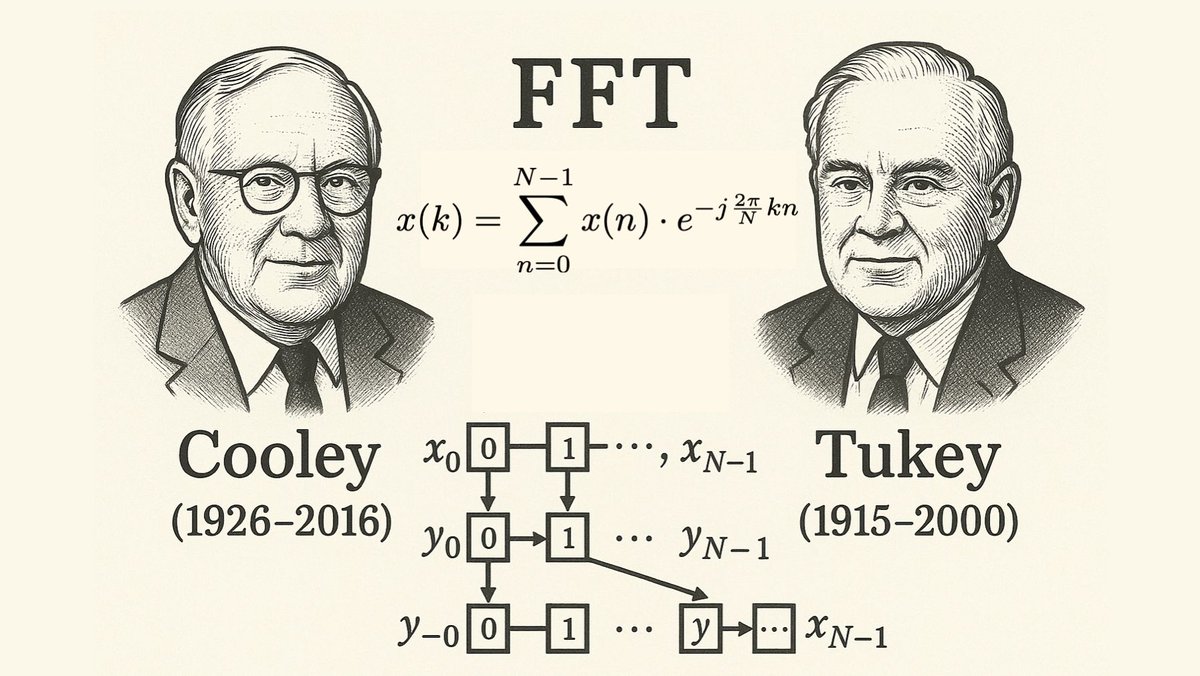
John Tukey the Fast Fourier Transform (FFT) inventor, who coined both "bit" and "software" died exactly 26 years ago today.
The Fast Fourier Transform (FFT), one of the most important algorithms in signal processing and data analysis, was introduced by Tukey & Cooley in 1965.
In 1805, Gauss - studying the orbits of asteroids Pallas and Juno - came up with a method to interpolate their trajectories from discrete samples. What he came up with was mathematically very close to the modern FFT but Gauss never published that work, and didn’t analyze its computational complexity. It predated even Fourier’s 1822 work on heat diffusion - but without the framing or generalization that Cooley & Tukey would bring 160 years later.
In 1965, Cooley & Tukey published their now-famous algorithm that reduced the cost of computing a Discrete Fourier Transform from 𝑂(𝑛²) to 𝑂(𝑛 log𝑛). This leap made real-time signal processing and digital media compression feasible.
From radio telescopes to JPEGs, from audio codecs to quantum mechanics - the FFT is everywhere. It’s one of the most important (and elegant) algorithms of the 20th century - rooted in the genius of Gauss, but brought to life in the computer age.
Long before LaTeX, most mathematical theses relied on hand-inserted symbols.
But in 1968, Dennis Ritchie - creator of C - typeset his entire thesis, subscripts and all, with astonishing accuracy.
How exactly he pulled it off remains a mystery.
Learn more in this week's paper
60 years ago this month, the Fast Fourier Transform (FFT) was introduced by Cooley & Tukey (1965) - one of the most important algorithms in signal processing and data analysis.
In 1805, Gauss - studying the orbits of asteroids Pallas and Juno - came up with a method to interpolate their trajectories from discrete samples. What he came up with was mathematically very close to the modern FFT but Gauss never published that work, and didn’t analyze its computational complexity. It predated even Fourier’s 1822 work on heat diffusion - but without the framing or generalization that Cooley & Tukey would bring 160 years later.
In 1965, Cooley & Tukey published their now-famous algorithm that reduced the cost of computing a Discrete Fourier Transform from 𝑂(𝑛²) to 𝑂(𝑛 log𝑛). This leap made real-time signal processing and digital media compression feasible.
From radio telescopes to JPEGs, from audio codecs to quantum mechanics - the FFT is everywhere. It’s one of the most important (and elegant) algorithms of the 20th century - rooted in the genius of Gauss, but brought to life in the computer age.
In the 1970s, Larry Ellison came across a paper by IBM Research.
It described a new model for organizing data - the relational database model.
That idea became Oracle.
"Lo que mucha gente llama amar consiste en elegir a una mujer y casarse con ella. La eligen, te lo juro, los he visto. Como si se pudiese elegir en el amor, como si no fuera un rayo que te parte los huesos y te deja estaqueado en la mitad del patio. Vos dirás que la eligen porque-la-aman, yo creo que es al revés. A Beatriz no se la elige, a Julieta no se la elige. Vos no elegís la lluvia que te va a calar hasta los huesos cuando salís de un concierto".
"Rayuela", Julio Cortázar
📷Bert Hardy
"In the sciences, the authority of thousands of opinions is not worth as much as one tiny spark of reason in an individual man."
- Galileo Galilei (1564 - 1642)
#12Oct🍉 • Así fue el GOLAZO del venezolano Eduar Bello, en el minuto 84, en el partido contra Brasil, dejando el marcador 1-1. 🇻🇪🇧🇷
¿Que tal este gol? Te leemos 👇🏻
Video: Cortesía