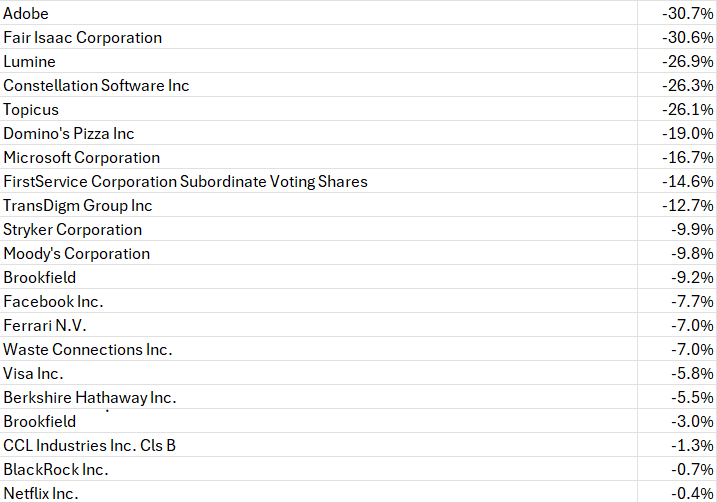
BREAKING: Claude can now map out your retirement better than most people charging $3,000 ever will.
Here are 6 prompts to figure out exactly when and how you can retire.
(Save this before it disappears).
Claude FULL COURSE 1 HOUR
(Build & Automate Anything)
Save this and take a look when you have some free time, you’ll discover a lot of interesting things for yourself
My thoughts on $BRK
People overcomplicate $BRK because they try to value every piece perfectly down to the decimal. They debate price to book, intrinsic value formulas, and build giant spreadsheets modeling every subsidiary. Meanwhile I look at it much more simply. $BRK has roughly $400b in cash and around $300b in stocks.
That’s about $700b right there between cash and equities alone. So when the company is worth around $1t, you’re basically paying roughly $300b for everything else. That includes the railroad, the energy business, insurance operations, manufacturing, distribution, service businesses, and one of the greatest collections of operating assets ever assembled.
And honestly I think people massively underestimate the value of the insurance float. The float is one of the greatest financial assets ever created because $BRK gets access to enormous amounts of capital at extremely attractive economics. Most people do not fully understand how powerful that becomes over decades. That float has quietly fueled one of the greatest compounding machines in financial history.
But the part that fascinates me most is the discipline. Almost every CEO on earth would have cracked by now sitting on $400b of cash. Most management teams would feel pressure to force acquisitions just to appear active. $BRK has basically said if we cannot find something intelligent to buy at scale, we are willing to wait.
People look at the cash and think it’s dead money, but optionality matters. $BRK effectively owns a giant call option on future chaos. When markets panic and liquidity disappears, $BRK becomes one of the only entities on earth capable of writing enormous checks instantly without relying on financing markets. That is a huge strategic advantage.
The other thing people miss is how rare true permanence is in capitalism. Most corporations optimize for optics. CEOs rotate, incentives change, cultures decay, and strategies constantly shift depending on sentiment. $BRK was built differently.
It was designed almost like an anti Wall Street structure where long term thinking itself became the competitive advantage. In many ways that culture may end up being Buffett’s greatest creation, even bigger than the stock portfolio itself. A lot of companies talk about long term thinking. $BRK actually structured the organization around it.
I also think people misunderstand what $BRK really is. They think it’s just “an insurance company that owns stocks.” But $BRK is basically a giant ecosystem of real world economic activity. Railroads, energy infrastructure, manufacturing, freight movement, insurance, distribution, consumer spending, and financial assets all under one umbrella.
In many ways it’s almost like owning a miniature version of the American economy. But unlike an index fund, the capital allocation is centralized under highly disciplined operators. You get diversification without complete chaos along with durability, liquidity, tax efficiency, reinvestment flexibility, and world class balance sheet.
And honestly the most underrated asset may simply be trust. If $BRK calls during a crisis, people pick up the phone. If $BRK wants to buy a family owned business, sellers trust the company will preserve the culture and operate responsibly.
I also think people are underestimating Greg Abel. Nobody is Warren Buffett and nobody ever will be, but that doesn’t mean $BRK suddenly stops being $BRK. Greg already understands the culture, operational discipline, and capital allocation philosophy better than almost anyone alive.
That’s why $BRK almost a forever asset or a savings account on steroids. No, it’s not going to triple overnight and no, it’s not some hyper growth AI stock. But when I look at over $700b between cash and equities, elite operating businesses, insurance float, fortress balance sheet strength, world class reputation, and disciplined reinvestment talent, I have a hard time viewing it as expensive.
🌹
Thoughts on $CELH
2025 was not a clean or simple year for $CELH, but it was an important one, and sometimes those are the most consequential ones. Revenue was $2.5b, up 86% from $1.36b, and that kind of growth at this size changes the look and feel of the business. This is no longer a niche disruptor trying to prove it belongs. It is a scaled platform inside the $PEP system with massive distribution.
If you just glance at GAAP EPS, you see $0.25 versus $0.45, but if you read the footnotes (usually one of the most important parts of of reporting), you’ll notice that there was $327m of distributor termination costs from moving Alani Nu into $PEP and another $60m of acquisition expenses. Adjusted EPS was $1.34 versus $0.70 and adjusted EBITDA came in at ~$620m, more than double last year. Very impressive!
The revenue mix has changed . Alani Nu contributed just over $1b after closing in April. Rockstar added $55m after August. The original $CELH brand generated ALMIST $1.5B and grew 7.5% despite all the moving parts and integration which is very nice execution.
The fourth quarter looked messy, but the details matter. Revenue was approx $729m, up 117%. Alani Nu delivered $370m in the quarter and Rockstar added $45m. $CELH shipments were down 8%, but retail sales were up 13%. Demand is still there, but timing and system transitions made the quarter look worse than it actually was. Over time those things normalize.
Margins dipped to 47 in Q4 while full year gross margin was 50%. On a $2.5b revenue base, every 1% of margin equals $25m of gross profit. If margins move back into the low 50s once integration is complete, that is roughly $125m of additional gross profit without growing revenue at all. That is embedded earnings power due to beautiful economies of scale.
Retail performance looked great, the portfolio grew 22% at retail and now holds roughly 20% share of the US energy category. They drove 33% of the zero sugar category’s growth. One company producing a third of the incremental dollars in the fastest growing segment of energy is quite impressive.
There are risks. Rockstar needs work and Pernod more importantly growth off $2.5b is naturally harder than growth off $1b. Integration always carries execution risk. But none of that seems structural, it feels like the normal friction of scaling.
What makes $CELH more interesting to me is personal. A while back, when $HOOD was offering a transfer bonus, I moved assets over and put the entire bonus into $CELH. It was nothing dramatic amount, about $30k, but that position has more than doubled albeit it’s still by far my smallest holding. It is not a fortune but it is also not something you find lying around on the street.
2025 looked messy because costs were elevated, margins decreased and the EPS did not tell the full story. But revenue nearly doubled, adjusted earnings nearly doubled, the market share expanded and distribution increased significantly.
The business is simply larger and more powerful today than it was a year ago. The only question that matters now is what this platform earns once integration is complete and margins settle. If this is what $CELH looks like in a transition year, I am more interested in what it looks like in a steady one.
🌹
Thoughts on $FICO
Most people writing about $FICO spend their time breaking down the business, the moat, and the incredible economics. It’s all true, and there are already plenty of great deep dives, podcast, etc that explain it better than I could. What matters to me is much simpler, the business and investing lesson.
$FICO is not just a product, it’s a toll bridge model business. Every time credit gets issued, underwritten, priced, or evaluated, they participate in the process. That’s not software in the traditional sense, that’s like infrastructure, and when you are infrastructure your pricing stops being pricing and starts being like a tax on the system.
That’s exactly what made this such an incredible business. For a long time they could raise prices with very little resistance and it flowed almost directly into profits because the model is asset light and possesses elite economics. The move to ~$2000 per share and greater than 60x earnings didn’t happen by accident, it was the result of just how far growth and pricing power could be pushed.
But there’s a level where pricing power stops being a strength and starts becoming a problem. The paradox is that the stronger your pricing power is, the more disciplined you actually need to be with it, because if you’re not something else will step in and impose that discipline for you. $FICO didn’t lose pricing power, they exercised it too aggressively.
Large increases that were easy to track and hard to ignore changed the dynamic. It’s not just how much you charge, it’s how obvious you make it, and once that line gets crossed certain eyes and ears begin to notice.
And political risk is a completely different game. It moves slowly and it unusually doesn’t resolve cleanly in favor of the so called “greedy company” and its shareholders. You’re no longer just asking how much they can charge, you’re asking how much they’re allowed to charge, and when something becomes as embedded and essential as $FICO things probably change.
You can exist, you can be profitable, but you can’t behave like an unconstrained monopolist on something this critical. That’s why the shift is subtle but important. $FICO is moving from being a pure free market compounder into something closer to probably a “meli regulated” business.
The business itself hasn’t broken. The moat is still there, the demand isn’t going anywhere, but the environment around it is no longer forgiving, and that changes the way the whole thing compounds. For a long time the formula was simple, raise prices, expand margins, let the asset light economic model do the work, and it felt almost effortless. And again, that’s why it was priced at a nosebleed valuation.
Now even if pricing power is still strong, it’s under a microscope, and when that happens the compounding doesn’t disappear, it just slows down and becomes less predictable. This isn’t about collapse, it’s probably the end of easy compounding, the kind where everything works in your favor and nobody pushes back.
Situations like this usually take time because nothing forces a quick resolution. It becomes a patience game, a gradual change in expectations, in behavior, in what’s acceptable.
The irony is the biggest risk to $FICO was never competition, it was success taken too far.
🌹