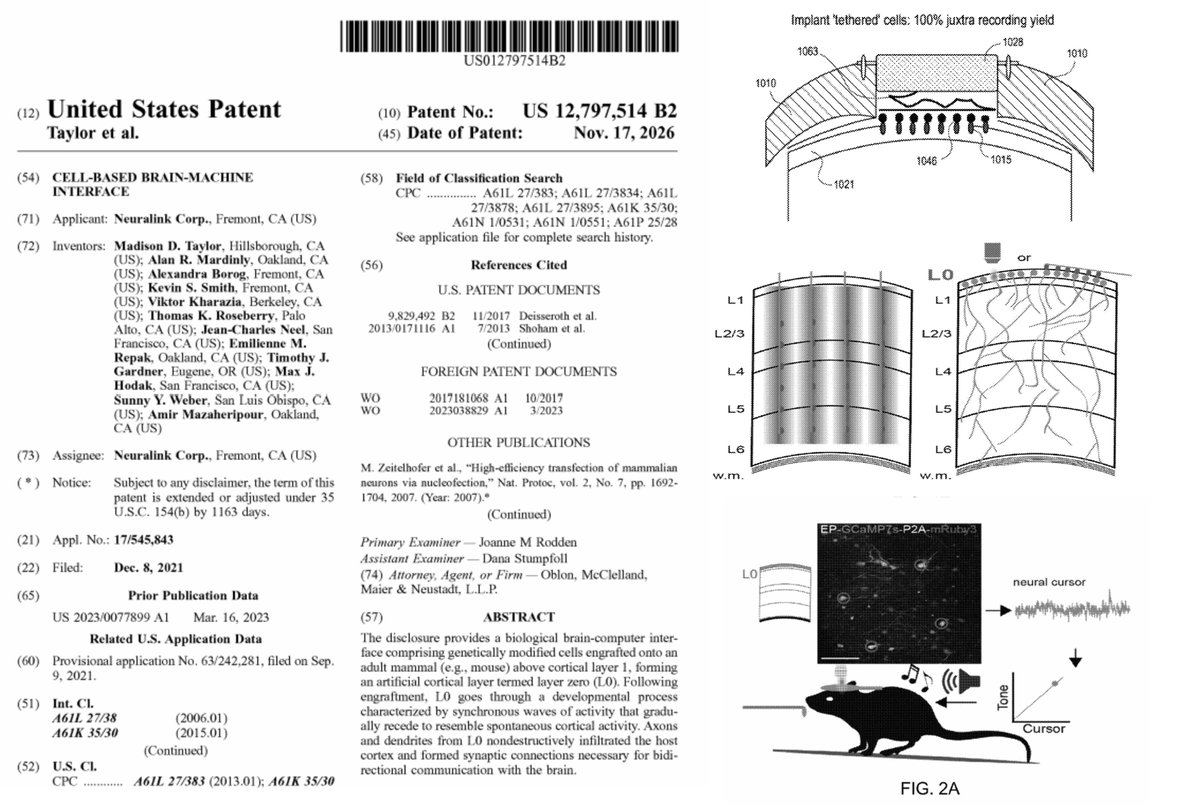
NEURALINK: Today the U.S. Patent and Trademark Office issued U.S. Patent 12,797,514 B2, "Cell-Based Brain-Machine Interface," to Neuralink. It covers a brain-computer interface built from genetically modified neurons grafted onto the surface of the brain!
Neuralink's current N1 implant reads the brain only through electrode threads inserted into tissue. In this design, living cells grow the connections into the brain themselves.
The modified BCI is grafted above cortical layer 1. The graft forms a new, artificial outermost layer called "layer zero" (L0). According to the patent, axons and dendrites from L0 grow into the host cortex "nondestructively" and form the synaptic connections needed for "bidirectional communication with the brain."
In the patent's tests on adult mice, the graft first produced waves of synchronized activity that gradually settled into normal-looking brain activity.
In the main claim, a camera images the graft to read signals from the brain, and a light source sends signals back in. Other claims tether the cells to electrodes.
Possible benefits include:
- Bidirectional communication with L0 cells that can both send and receive signals through synapses, which may support more natural input and output than unidirectional electrode recording.
- Potentially lower tissue damage over time because the connection is made by living cells that infiltrate the cortex possibly avoiding some of the chronic inflammation and scarring associated with rigid or high-density electrodes.
- Developmental integration of engrafted cells that gradually produces activity patterns resembling natural cortical activity, which could improve long-term signal stability and biological compatibility.
- Higher effective resolution through many synaptic connections. In principle is could allow finer-grained interaction with neural circuits than the number of physical electrodes alone.
Neuralink originally filed the application on December 8th, 2021, and the twelve inventors include Neuralink co-founder Max Hodak, now co-founder and CEO of Science Corporation, and Alan Mardinly, a former Neuralink leader who is now co-founder and Chief Scientific Officer at Science Corporation.
We've uploaded a fruit fly. We took the @FlyWireNews connectome of the fruit fly brain, applied a simple neuron model (@Philip_Shiu Nature 2024) and used it to control a MuJoCo physics-simulated body, closing the loop from neural activation to action.
A few things I want to say about what this means and where we're going at @eonsys. 🧵