Over the past 8 days, I received over 100 PRs on the languages repo with additions and improvements.
- A bunch of languages were added
- Some implementations got tweaks to modify performance
- The run script now uses hyperfine for timing
Thanks to all the contributors.
Tony Robbins boasts a net worth of $620 million.
He’s coached:
• Presidents
• Billionaires
• Olympic gold medalists
His success boils down to these 4 simple concepts:
Explaining 9 Types of API Testing
🔹 Smoke Testing
This is done after API development is complete. It simply validates if the APIs are working and nothing breaks.
🔹 Functional Testing
This creates a test plan based on the functional requirements and compares the results with the expected outcomes.
🔹 Integration Testing
This test combines several API calls to perform end-to-end tests. It tests intra-service communications and data transmissions.
🔹 Regression Testing
This test ensures that bug fixes or new features don't break the existing behaviors of APIs.
🔹 Load Testing
This tests an application's performance by simulating different loads. It helps calculate the capacity of the application.
🔹 Stress Testing
This deliberately creates high loads on the APIs to test if they are able to function normally under stress.
🔹 Security Testing
This tests the APIs against possible external threats to ensure security.
🔹 UI Testing
This tests the UI interactions with the APIs to make sure the data is displayed properly.
🔹 Fuzz Testing
This injects invalid or unexpected input data into the API and tries to crash it. This helps identify API vulnerabilities.
–
Subscribe to our weekly newsletter to get a Free System Design PDF (158 pages): https://t.co/kNfv0DVDdf
I built my first Real-Time Stock Tracker with less than 70 lines of code.
Here is how.
The Idea
I wanted to build a simple real-time dashboard to track a specific stock. I needed:
- Data Source: Connect to a reliable stock market data source.
- Input: Allow users to enter the stock symbol they want to track.
- Visualization: Display a line chart representing the stock's value over time.
- Non-blocking Refresh: Refresh data without blocking the user interface.
Building this UI might take days or weeks, depending on your front-end skills.
But I built this over the weekend using a shortcut; I used @Taipy_io.
Taipy is an open-source Python library designed to develop data web applications easily.
You can build the front-end without knowing much about HTML, CSS, and JS.
And the whole back-end of an application, model dataflows, and pipelines.
It was perfect for my weekend idea and probably for many of your ideas.
I even have time to add a theme selector ;).
You can build an example like this to track whatever you need.
- Temperature for sensor
- Sales
- How many times Google mentioned AI (just kidding)
I have always been biased toward open source.
Reading, modifying, and executing code is a great way to understand how something works in detail.
Give them a star: https://t.co/RNazp42xQM
Thanks to Taipy for collaborating with me on this post.
𝗖𝗼𝗻𝘁𝗲𝘅𝘁-𝘀𝘄𝗶𝘁𝗰𝗵𝗶𝗻𝗴 𝗶𝘀 𝗮 𝗽𝗿𝗼𝗱𝘂𝗰𝘁𝗶𝘃𝗶𝘁𝘆 𝗸𝗶𝗹𝗹𝗲𝗿 𝗳𝗼𝗿 𝗱𝗲𝘃𝗲𝗹𝗼𝗽𝗲𝗿𝘀
According to psychologist Mihaly Csikszentmihalyi, a "𝗳𝗹𝗼𝘄 𝘀𝘁𝗮𝘁𝗲" is a mental state in which you are wholly absorbed in an activity and feel a sense of control, satisfaction, and increased focus. Our internal chatter stops during flow, allowing us to be present and at the moment. It can assist people in peak production in many fields, like product designers and software developers.
𝗗𝗼 𝘆𝗼𝘂 𝘀𝘁𝗿𝘂𝗴𝗴𝗹𝗲 𝘁𝗼 𝗰𝗼𝗱𝗲 𝗮𝗳𝘁𝗲𝗿 𝗮 𝗺𝗲𝗲𝘁𝗶𝗻𝗴? On average, it takes over 23 minutes to get back on task after an interruption, but 18% of the time, the interrupted study isn't revisited that day.
Optimizing your workspace for flow state is 𝘃𝗶𝘁𝗮𝗹 𝗳𝗼𝗿 𝘀𝗼𝗳𝘁𝘄𝗮𝗿𝗲 𝗱𝗲𝘃𝗲𝗹𝗼𝗽𝗲𝗿𝘀 or anyone undertaking tasks requiring concentration, creativity, and technical prowess. Achieving a flow state, also known as "being in the zone," refers to an optimal state of consciousness where an individual is fully absorbed in an activity and performs at their best.
To optimize your workspace for flow:
𝟭. 𝗠𝗶𝗻𝗶𝗺𝗶𝘇𝗲 𝗗𝗶𝘀𝘁𝗿𝗮𝗰𝘁𝗶𝗼𝗻𝘀: This might include using noise-canceling headphones, turning off non-essential notifications, or creating a dedicated workspace.
𝟮. 𝗘𝗿𝗴𝗼𝗻𝗼𝗺𝗶𝗰𝘀: Ensure that your chair, desk, and monitor setup are ergonomic to reduce physical discomfort.
𝟯. 𝗢𝗿𝗴𝗮𝗻𝗶𝘇𝗲𝗱 𝗘𝗻𝘃𝗶𝗿𝗼𝗻𝗺𝗲𝗻𝘁: A clutter-free workspace can reduce cognitive load, helping you focus on the task.
𝟰. 𝗣𝗿𝗼𝗽𝗲𝗿 𝗧𝗼𝗼𝗹𝘀: The right tools and software can make a huge difference. Ensure your computer is fast, reliable, and has software tools that streamline your tasks.
𝟱. 𝗥𝗼𝘂𝘁𝗶𝗻𝗲 𝗮𝗻𝗱 𝗥𝗶𝘁𝘂𝗮𝗹𝘀: Starting your day with a routine or a ritual can signal your brain that it's time to get into the zone.
𝟲. 𝗕𝗿𝗲𝗮𝗸𝘀: Scheduled breaks, like the Pomodoro Technique, can help maintain high levels of focus and prevent burnout.
𝟳. 𝗡𝗼-𝗺𝗲𝗲𝘁𝗶𝗻𝗴 𝗱𝗮𝘆𝘀: Focus on individual work one or two days a week without meetings.
𝟴. 𝗞𝗻𝗼𝘄 𝗵𝗼𝘄 𝘁𝗼 𝗺𝗮𝗸𝗲 𝗮 𝗽𝗮𝘂𝘀𝗲: if you know that you will be interrupted, write down all things you have in your head about your task in your source file in IDE (as a comment), sticky notes, or somewhere else. This will make it easier to resume the next time.
#softwareengineering #productivity
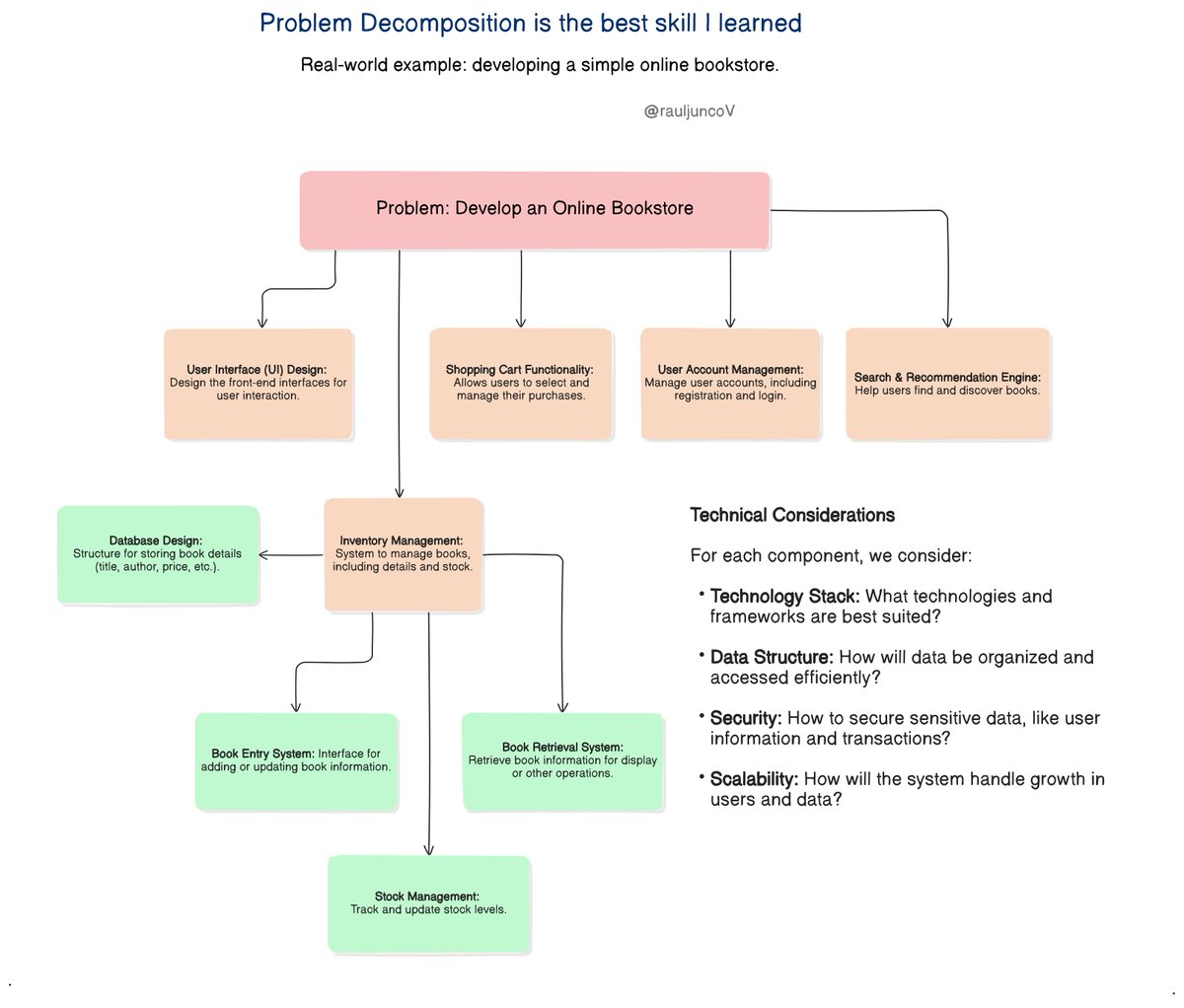
Problem Decomposition is the best skill I learned.
The idea is simple but powerful: Break a complex problem into smaller components.
Here are you have 7 benefits and a practical example.
1. Better Understanding
Breaking down a complex problem into smaller parts makes it easier to understand.
Each component will be easy to work with and less intimidating.
2. Improve Focus
Decomposition allows you to concentrate on one aspect of the problem at a time, reducing the cognitive load.
3. Smaller problems are easy to solve.
4. Fast development
In a team setting, team members can work on different tasks simultaneously.
5. Scalable and Modular Development
Decomposed problems lead to the development of modular systems.
You can develop, test, and even deploy each module independently.
6. Better testing
Testing is easy when a problem is smaller.
7. Easy to maintain
Modular systems, resulting from problem decomposition, are easier to integrate with other systems.
They are also more adaptable to changes and modifications.
If you learn the Problem Decomposition, then everything else will become easier.
In 2011, Netflix was in trouble.
They have dozens of internal services; if one fails, the error will break the UI.
20,000 requests per second, about 1,000,000+ requests from the API into upstream services in 10s.
They have no choice but to increase resiliency.
The solution was brilliant; they went beyond the classic CircuitBreaker.
3 strategies that will help you make your system resilient:
Fail Fast
You use this strategy when no reliable fallback mechanism is available.
Instead of trying, the system halts the operation when as soon as an error an error happens.
Providing immediate feedback to the other systems, saving system resources.
But it could impact the user experience.
Fail Silent
This strategy comes into play for optional or non-essential data.
In case of a failure, the API would return a null value or a default value instead of propagating the failure.
This way, the failure does not propagate, and the user might only notice if the data is critical to the operation.
Custom Fallback
Use this strategy when local data is available, for instance, in a cookie or local cache.
Instead of calling a failed service or DB, the system uses local data to provide a fallback response.
The user still receives a response even if it's not the most up-to-date or complete.
These strategies are not one-size-fits-all; you must find the one that fits your system.
The more you know your system, the better you can prepare it to bounce back from failure.