.@Travs_baseball Martin's RHP Carson Carrell (@carsoncarrell3) strikes out the side to close the game.
Lake Highlands (TX) 2029 #uncommitted
Profile: https://t.co/RUnAnEdRUZ
.@Travs_baseball Martin's RHP Carson Carrell (@carsoncarrell3) strikes out the side to close the game.
Lake Highlands (TX) 2029 #uncommitted
Profile: https://t.co/RUnAnEdRUZ
The UWW baseball posts are killing me.
2025 win Natty
Between graduation and portal 18 of 35 players leave
Ben Lee can’t play beginning of season due to injury recovery
Brust, Gilroy, Malkow, Phillips, Steuber suffer season ending injuries
Go 43-6 but “embarrassing” season 🤦♀️
Back in the 1960s there was a company called National Video. They made color television picture tubes, and were the first to produce a 23-inch rectangular color TV picture tube. It quickly became the industry standard, and every major TV set producer scrambled to get their hands on National Video’s picture tubes. They literally couldn’t make them fast enough.
The stock went from a low of 15 in 1964 to a peak of 120 in October 1965. The final 70 points came in just the last few months.
Eventually, though, the Motorola’s and Zenith’s of the world produced their own color TV picture tubes. They didn’t need National Video’s any longer.
The stock went from 120 to a low of 40 in 1966, 15 in 1967, and then to zero in 1968 as the company went bankrupt. The poor thing couldn’t even make it to the Go-Go years.
In those days, Mueller and Company produced tick volume charts. National Video’s chart depicted the stock going from Northwest to Southeast in a straight line while the tick volume line went straight up.
The stock was a fundamental short. In those days, short sales could only be executed on an uptick. Which meant the whole world was always offered up an eighth.
Oh, National Video’s ticker symbol? NVD.A.
This story is true, but any resemblance to any other companies is purely coincidental.
REGIONAL FINAL TIME
UWW faces Bethany Lutheran in 2026 NCAA Regional Final
📍: Prucha Field, Whitewater, WI
⏰: 11 AM
📺: https://t.co/QEwdiZ19mM
📊: https://t.co/SYYxx5o69v
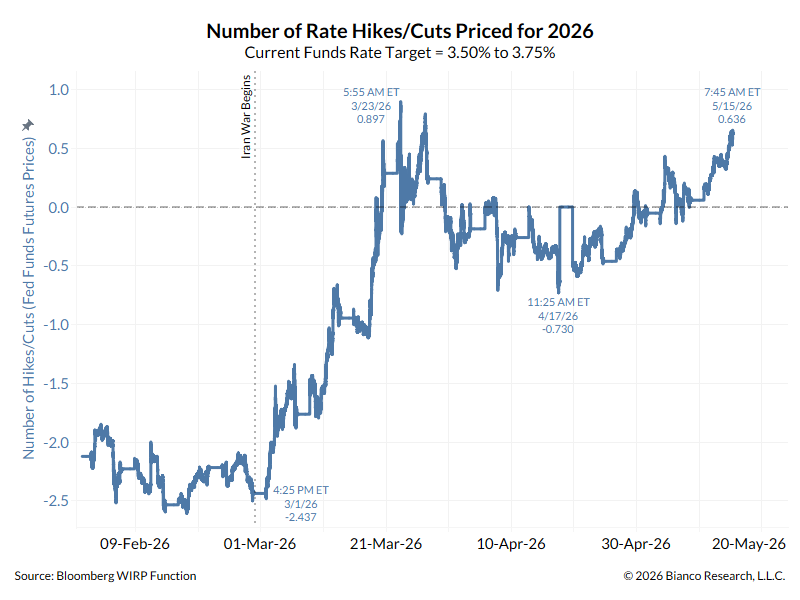
Dear Kevin Warsh
Later today, you will be sworn in as the next Chairman of the Federal Reserve.
Congratulations.
You got the job by convincing the President you share his vision that the Fed needs to cut rates.
The problem is that today, on your first day as Chairman, the market is pricing in a 64% probability that rates will HIKE before the end of the year.
Good luck!
Ken Griffin on the single factor he looks for when hiring at Citadel:
"show me an athlete who did well academically."
"an athlete because they know what it takes to win and they've had to experience loss."
talent is everywhere. what's rare is someone who knows how to lose, recover, and still perform at a high level.
same thing separates profitable traders from everyone else.
Peak concentration of every major bubble in history.
The AI Big 10 just hit 40%. The line is still rising. Peak theme concentration at bubble top:
- Railroads (1880s) — 63% of US stock market
- Nifty Fifty (1972) — 40% of S&P 500
- Japan (1989) — 44% of MSCI ACWI
- Tech/Telecom (2000) — 41% of S&P 500
- AI Big 10 (2026) — 40% of S&P 500 still rising…
The prior four didn't end because the businesses were bad. Railroads were the internet of their era.
Cisco and Intel had real earnings.
Japan had genuinely excellent industrials.
They ended because concentration itself is the risk.
At 40%+ of a benchmark, every institutional portfolio is overweight by construction.
Rebalancing becomes one directional.
Momentum becomes crowding. Crowding becomes fragility.
The trigger doesn't need to be fundamental — it just needs to be big enough to force systematic derisking.
Then the unwind feeds itself.
AI is real. The question is whether $800B+ capex, 40% concentration, and P/E above 28× are compatible with anything other than perfect execution from every company in the cohort for the next three to five years.
One $NVDA miss. One capex revision. One rate shock.
That's not a rotation. That's a market event.
Nifty Fifty peaked at 40% in 1972. S&P fell 48% over the next two years.
Not because the companies failed. Because the concentration did…
In fittingly dominant fashion UW-Whitewater sweeps UW-Stout to complete the #WIAC schedule 28-0. They’re the first team to go undefeated in conference play since the schedule expanded to 28 WIAC games.
They’ll host the conference tournament Thursday-Saturday.
#d3baseball
On Monday, the S&P 500 $SPY closed at a record high. The next day, at least 1% more stocks hit a 52-week low than a 52-week high.
In 70+ years of history, that's happened twice. Yesterday was one.
January 3, 2000 was the other.
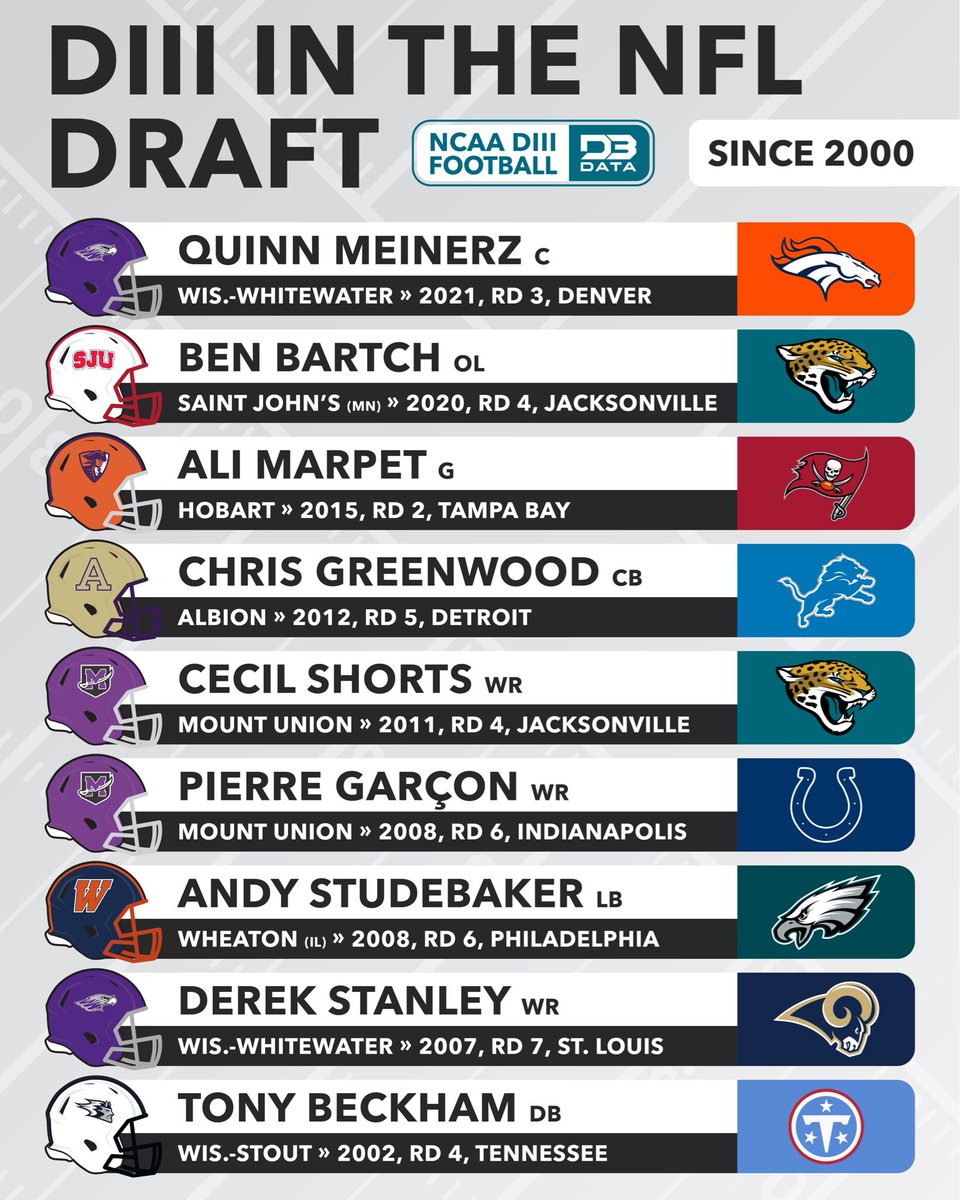
Since 2000, 9 players have been drafted directly from the DIII ranks.
Quinn Meinerz is a two time All-Pro lineman and joins Ben Bartch as active NFL players.
#d3data#d3#d3sports#d3football#d3fb
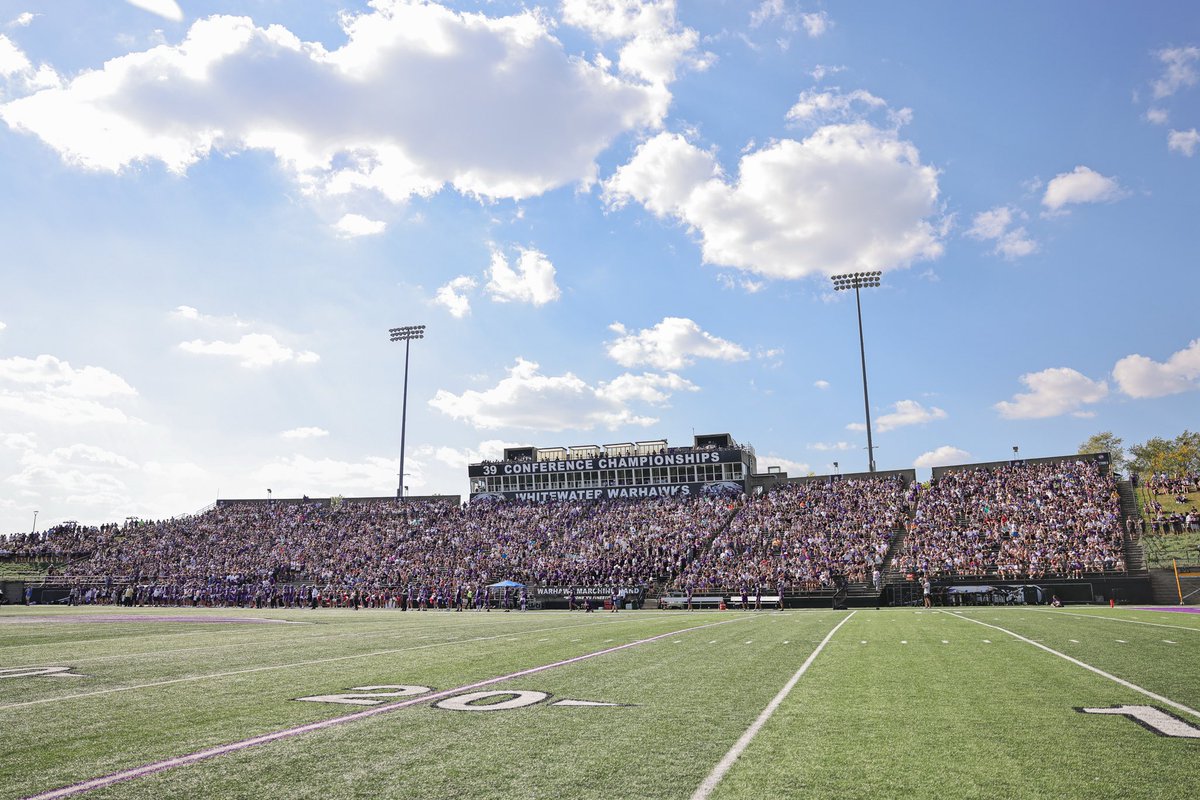
🔥 Perkins Stadium = The Place To Be on Saturdays‼️
🏟️Warhawks averaged 10,141 fans per home game, and packed 20,167+ to set a Division III on-campus attendance record‼️
This should be the reason for college athletics.
Mentorship and guidance.
Coaching is about building relationships and being impactful in developing young men on and off the court or field.
This is what it looks like.
True admiration, appreciation and love between Rick Barnes and Zakai Zeigler.
The Fed's worst nightmare is materializing in front of our eyes.
What is often overlooked is that the Fed primarily controls demand-side inflation, not supply-side inflation. In other words, it can influence how much people borrow and spend, but it cannot directly increase supply, like producing more oil.
This means that in the case of a supply-shock, as we are seeing now with energy prices, the Fed often has to overcompensate on the demand-side to contain inflation, and vice-versa.
During the pandemic in 2020, this meant effectively cutting interest rates to zero, as lockdowns triggered a sharp collapse in demand alongside widespread supply disruptions.
With oil and gas prices skyrocketing, our models suggest US CPI inflation is set to rise toward 3.5%, or 150 basis points above the Fed's long-run target. In a vacuum chamber, this means the Fed should tighten policy and theoretically hike rates.
However, the issue becomes the fact that the US labor market is objectively at its weakest point in years, and it has not improved despite recent Fed easing. Therefore, if the Fed hikes interest rates now, the US is positioning itself for a full-blown labor market crisis.
On the flip side, if the Fed does not tighten its policy stance, US CPI inflation could potentially even exceed 4.0%, depending on how long the Iran War persists, and how long the post-war recovery takes.
In a sudden turn of events, the Fed is now forced to pick between 3.5%+ inflation or 5.0%+ unemployment.
The Fed is in a very bad spot.
Dear - Wall St. Bank Research — Q3 / Q4 - We were lectured and lectured and lectured again private credit risk hot spots were one off “idiosyncratic” events. Now crickets.
Every day at 7PM, taps is played over the loudspeakers at Dallas National Cemetery, just beyond the outfield wall at DBU
During every gameday at 7, they pause to honor the fallen troops buried just beyond the wall
One of the best traditions in sports