Jersey-grown, Chicago-made. Massachusetts-rebuilt. Lately of Rhode Island. Librarian. Optimistic Eyeroller. "Let's do the Nixon Tapes...that's my jam!"(he/him)
The most urgent lesson from my book and my several years of studying propaganda is this: it's imperative that you get every well-meaning person you care about in your life to stop consuming mainstream news. There is a relentless war to shape people's brains so that they are okay with a world of enormous but preventable suffering and resigned to a world with nowhere near as much flourishing as human beings deserve.
The curse of being the smart child is that you are genetically coded to be your family's unpaid crisis manager—and the world's. A massive 2024 population registry study published in The Economic Journal proved that higher general fluid intelligence directly causes increased altruism, cooperation, and prosocial behavior. Because an intelligent brain calculates long-term consequences and systemic risks faster than everyone else around it, it sees the family or societal trainwreck coming miles away. It means you are either a psychological hostage to your own foresight, or a reluctant savior trying to fix a world that doesn't even see the cliff it’s walking over.
Marco Rubio 2 days ago: “Imagine if Iran funded the well-being of its people, rather than its military”
Trump today: “We can’t fund daycare or Medicaid, we need more money for our military”
Sometimes the jokes write themselves.
“Renee was not the first person killed, and she was not the last,” Becca Good said. “You know my wife’s name and you know Alex’s name, but there are many others in this city being harmed that you don’t know — their families are hurting just like mine, even if they don’t look like mine.” https://t.co/72KccWe2pC
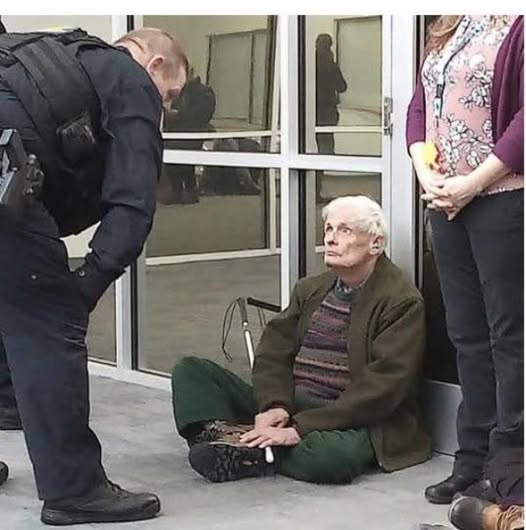
"On Thursday, Jan 22 at approximately 1pm, a group of about a dozen Vermont community elders with whistles entered the atrium of White Cap Office Park in Williston VT, home of ICE’s National Criminal Analysis and Targeting Center.
They refused to leave when ordered by Williston Police, the property manager, and federal agents, demanding instead that the landlord renegotiate and cancel the facility’s lease.
For the next 3.5 hours, they sat together in silence, pausing every 90 seconds to read the name of someone killed in ICE custody, followed by a loud whistle blast.
Williston Police arrived at around 1:30pm, and asked protesters to leave and stop making noise. A group of 5 elders refused and remained in the atrium accompanied by a medic and physical therapist.
Around 2pm, property manager and landlord Normand Stanislas arrived and began screaming at supporters gathered outside that he would have them arrested.
Around 3:15, the Williston Police announced that they had determined that the protestors were not breaking the law and were acting within their first amendment rights. They declined to arrest the group, which had paused blowing whistles to sit in front of the ICE office doors.
After the Williston Police had left, several DHS agents approached the group and threatened to charge them with Class C federal misdemeanors but did not actually do so, likely because they lacked authority to do so. The agents attempted to physically remove the elders and carry them away from the doors, but the group continued to exercise their right to protest by walking over and sitting back down. Eventually, the agents left.
The group continued their protest with banners and singing until the sun began setting, when they left the office park of their own accord.
Karen Bixler, 83, of Bethel said, “I’m taking this action to bring attention to our state’s role in this horrific institution. White collar workers, sheltered from the brutality that is taking place in our country, are providing ICE with information to aid in their raids.”
This protest follows several months of public outcry against the Industrial Ave facility, which is used to monitor civilian social media activity and identify targets for ICE detention and deportation. Over the winter, community groups conducted several noise demos at White Cap Business, and anonymous individuals hung a banner from the flagpoles reading “ICE VIOLATES RIGHTS HERE.”
70 year-old Dorothy Mammen of Middlebury said: “This facility is staffing up to spy on people via social media, to flag "negative sentiment" toward ICE and build dossiers on anyone who opposes fascism. They are compiling personal details, family links, and using facial recognition. To what end? To stifle dissent; to trample our right to free speech.”
The office at White Cap is one of many ICE-related facilities in Chittenden County, which serves as the national nerve center for ICE operations. The notorious Law Enforcement Support Center on Harvest Lane is home to ICE’s nationwide tip line, while at least 10 other nearby locations (totaling an estimated 400,000 square feet of office space) are used by DHS for data processing, surveillance, and administrative work.
On Tuesday, the Williston Selectboard passed a resolution condemning ICE activities in the town, and several hundred protesters marched in the frigid temperature to denounce the ICE Call Center on Harvest Lane.
The elders risking arrest in Thursday’s sit-in were not representatives of any official group or organization, but simply community members concerned about the safety of their neighbors. They expressed hope that their action would help others to find the courage necessary to get ICE out of Williston."
Today, Canada announced its divorce from America. I'm not kidding.
Every January since 1971, thousands of business leaders, politicians, journalists, economists, policy experts, and celebrities have gathered at a mountain resort in Switzerland to discuss the most pressing global issues of the day in hundreds of sessions scheduled over the better part of a week.
The conference, organized by the World Economic Forum, has come to be nicknamed after its Alpine host town: Davos.
The annual gathering in Davos has been criticized in many corners over the years for its exclusive nature, which is somewhat fair and somewhat reductive.
Progress does emerge from these sessions among the assembled players, but so, too, does the feeling of window-dressing for what is mostly supercharged networking.
This weekend, while talking with friends who have attended in the past, I asked if they had experienced anything extraordinary during the scheduled sessions, or if Davos is more of an opportunity to meet influential people and kibitz about preferred projects?
Well, today could not have delivered more of an empathetic answer to that question.
Mark Carney, Prime Minister of Canada, gave a magnificently powerful speech before the gathered elites that will be discussed many years from now. Decades, likely.
It was, essentially, an eloquent and poignant announcement that Canada is divorcing the United States. Over sixteen minutes, Prime Minister Carney called upon the world to recognize that the current global framework in which superpowers run the show is stale, destructive, and unnecessary.
Right out of the gate, early in the speech, he took a direct shot at Trump and Putin and Xi—but mostly directed at Trump—with a searing anecdote from an essay written by Václav Havel, the late president of the Czech Republic (remarks italicized):
In 1978, the Czech dissident Václav Havel, later president, wrote an essay called The Power of the Powerless. And in it, he asked a simple question: How did the communist system sustain itself?
And his answer began with a greengrocer. Every morning, this shopkeeper places a sign in his window: “Workers of the world, unite!” He doesn’t believe it. No one does. But he places the sign anyway to avoid trouble, to signal compliance, to get along. And because every shopkeeper on every street does the same, the system persists.
Not through violence alone, but through the participation of ordinary people in rituals they privately know to be false.
Havel called this “living within a lie.” The system’s power comes not from its truth but from everyone’s willingness to perform as if it were true. And its fragility comes from the same source: when even one person stops performing — when the greengrocer removes his sign — the illusion begins to crack.
Friends, it is time for companies and countries to take their signs down.
This was the first applause break, and the tone was immediately set. You can feel people sitting up in their seats and thinking: Oh, damn, this is gonna be good.
He then briefly outlined the current system of geopolitical power: the strongest nations (United States, Russia, China, etc.) chart the course for the rest of the world, typically through international organizations, and the rest of the world accept this in exchange for security, predictability, and a practical trajectory for their own prosperity.
He pointed out that the rest of the world have always known this is a “partially false” framework and that the strongest nations are never held to the same standards they expect of everyone else.
But still, it’s what they had, and even if frustrating (and infuriating at times), it mostly worked in the past. He then says this:
This fiction was useful. And American hegemony, in particular, helped provide public goods: open sea lanes, a stable financial system, collective security and support for frameworks for resolving disputes. So, we placed the sign in the window. We participated in the rituals. And we largely avoided calling out the gaps between rhetoric and reality.
This bargain no longer works.
Let me be direct: We are in the midst of a rupture, not a transition.
This is the diplomatic equivalent of a wronged spouse telling their partner: No, I am not asking for a break or a trial separation. It’s time to move on.
He then got to the heart of the matter: all these instruments supposedly existing for global policy based on mutual cooperation—the United Nations, the World Trade Organization, NATO, etc.—only work if the superpowers who have the most leverage within them are engaging in good faith.
What, then, are the current incentives for the rest of the world to trust the United States and other superpowers? He delivered this devastating summation:
But more recently, great powers have begun using economic integration as weapons. Tariffs as leverage. Financial infrastructure as coercion. Supply chains as vulnerabilities to be exploited. You cannot “live within the lie” of mutual benefit through integration when integration becomes the source of your subordination.
[…]
And as a result, many countries are drawing the same conclusions — that they must develop greater strategic autonomy: in energy, food, critical minerals, in finance and supply chains.
And this impulse is understandable. A country that cannot feed itself, fuel itself or defend itself has few options. When the rules no longer protect you, you must protect yourself.
He basically called out Trump’s fecklessness and isolationism and toddler antics while the rest of the world has bent over backwards to placate Trump’s nonsense:
And the question for middle powers, like Canada, is not whether to adapt to the new reality — we must. The question is whether we adapt by simply building higher walls or whether we can do something more ambitious.
Canada was amongst the first to hear the wake-up call, leading us to fundamentally shift our strategic posture.
Canadians know that our old, comfortable assumptions — that our geography and alliance memberships automatically conferred prosperity and security — that assumption is no longer valid.
[…]
Principled in our commitment to fundamental values: sovereignty and territorial integrity, the prohibition of the use of force except when consistent with the UN Charter and respect for human rights.
For a big chunk of the speech, he outlined all the reasons Canada is ready to stand strong with the rest of the world in this New Order as it leaves the Old and Stale. He talked about his nation’s economic development and diplomatic strides and growth as a trusted partner all over the world.
This is PM Carney saying: Canada knows its worth, and we know this current relationship is complete bullshit. We’re not taking it anymore. We’re done:
Middle powers must act together because if we’re not at the table, we’re on the menu.
But I’d also say that great powers can afford, for now, to go it alone. They have the market size, the military capacity and the leverage to dictate terms. Middle powers do not. But when we only negotiate bilaterally with a hegemon, we negotiate from weakness. We accept what’s offered. We compete with each other to be the most accommodating.
This is not sovereignty. It’s the performance of sovereignty while accepting subordination. In a world of great power rivalry, the countries in between have a choice: compete with each other for favour or to combine to create a third path with impact.
We shouldn’t allow the rise of hard power to blind us to the fact that the power of legitimacy, integrity and rules will remain strong — if we choose to wield them together.
Hey, middle powers, we don’t need these dickhead superpowers, he says with far more eloquence. The writing is on the wall. It’s time to ditch these assholes and foster the network of relationships between nations who engage in good faith.
He then closed with more pride in Canada and made it clear they’re ready to start this new chapter with every middle power who’s tired of this shit:
Canada is a pluralistic society that works. Our public square is loud, diverse and free. Canadians remain committed to sustainability.
We are a stable and reliable partner in a world that is anything but. A partner that builds and values relationships for the long term.
And we have something else. We have a recognition of what’s happening and a determination to act accordingly.
We understand that this rupture calls for more than adaptation. It calls for honesty about the world as it is.
We are taking the sign out of the window.
We know the old order is not coming back. We shouldn’t mourn it. Nostalgia is not a strategy.
But we believe that from the fracture, we can build something better, stronger, more just.
This is the task of the middle powers. The countries that have the most to lose from a world of fortresses and the most to gain from genuine co-operation.
The powerful have their power. But we have something too — the capacity to stop pretending, to name reality, to build our strength at home and to act together.
That is Canada’s path. We choose it openly and confidently.
And it is a path wide open to any country willing to take it with us.
He finished his speech and received the rare standing ovation of the gathered elites at Davos and deservedly so.
Because guess what?
The rest of the world is tired of America’s bullshit — problems that existed before Trump but were largely manageable enough to fall in the realm of pragmatic working relationships have now worsened exponentially in the past year.
Trump has pissed off one of the nicest countries on earth—our northern neighbors, who have faithfully stood by us in times of great calamity and never wronged us—so much that their leader told the world today that enough is enough and the United States and other superpowers should understand what has been done cannot be undone.
As an American watching this, I felt tremendous guilt and embarrassment over what Trump has done to our global reputation, when even our closest allies are thoroughly and openly repulsed at the thought of working with us, so much so that nothing can repair the damage inflicted by this coward and his enablers in the Republican Party.
But I also felt hope watching the Prime Minister. For the first time in a long time, I was struck with a sense of optimism over how much more outside pressure is being applied to the fascist clowns currently running our government.
Let this be a wakeup call, indeed. We can’t fix all that has been broken, but there is still time to save what can be fixed.
It doesn’t have to be this way.
Thank you for galvanizing us, Prime Minister Carney.
----
Link to full essay available here for easier sharing: https://t.co/1Lbq7WSCZX
The fastest political bargains in this environment won’t be about policy wins. They’ll be about governance constraints: investigations, guardrails, enforcement standards, visible competence, and even more visible limits on power of all sorts.
Hiiiiii guys!! While you all are here. My name is Brehanna Daniels. I made history by becoming NASCAR’s first black woman tire changer and pit crew member. I released my first two jerseys of my clothing line! Here’s my black “Trailblazer” one. A simple RT could go a long way🙏🏾🙏🏾
Lina Khan is quietly mapping out how New York’s incoming mayor Zohran Mamdani can use overlooked city and state laws to make daily life cheaper — from Yankee stadium beer to basic medicines, Semafor reports.
People familiar with the transition say she’s identified a broad “unconscionable pricing” rule and new transparency requirements for algorithmic pricing as early tools the city can enforce. It echoes her FTC tenure, where she revived dormant statutes to pressure companies on misleading ads, predatory pricing, and deceptive gig-work claims. Business groups may bristle, but Khan’s approach could give Mamdani a concrete legal path to tackle the city’s affordability crisis, the report suggests. ⬇️
This is remarkable not only because it’s the UK, but because that is intelligence that would be useful. The UK doesn’t trust us because of what we are doing with it, mainly extrajudicial killings.