Instead of .md specs, try this: make the system a state machine (or rather, a reducer). Ask your slopus to make an interactive diagram with real events from your flow and the real reducer. Step through them, asking the agent "whys" this and that.
remember how people used to spend years learning vim or emacs? haha take a big fat L buddy, I used Sublime Text until December and now I just talk to Claude through this gimp mask
The business lesson:
Public data teaches a model the world. Private data teaches it your customers: what they quit, what brings them back, what's new today.
Models are commodities. Proprietary behavioral data compounds.
Paper: https://t.co/iCRxMLTOzg
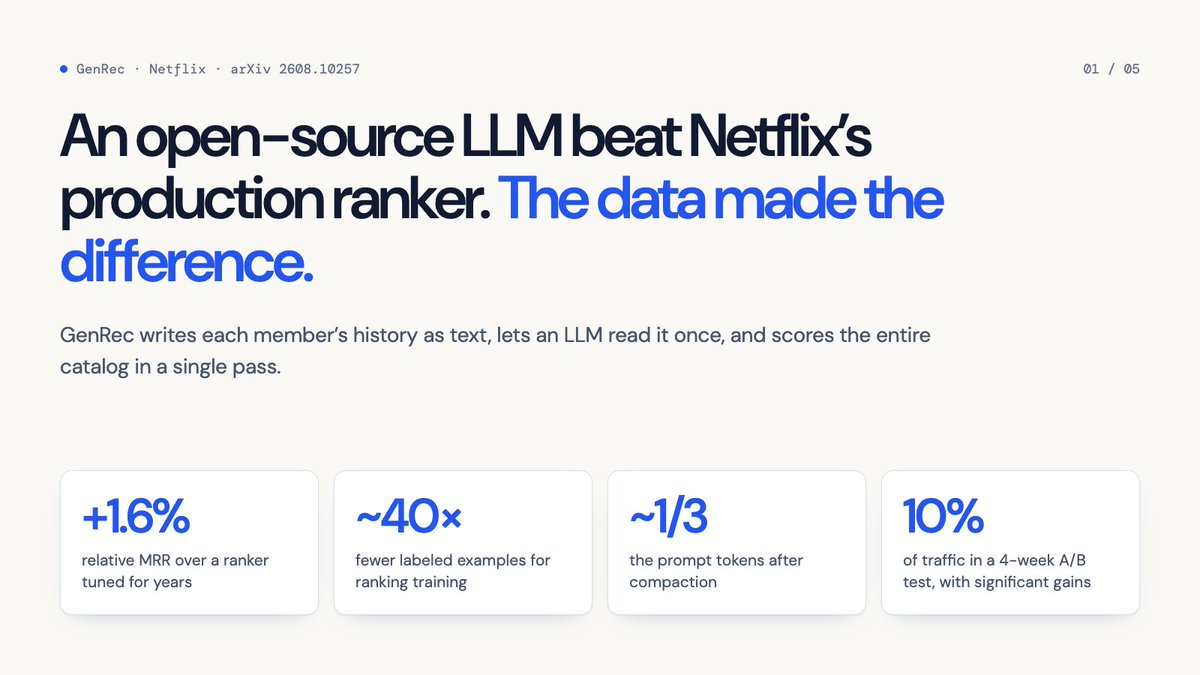
Netflix just showed an open-source LLM beating their years-tuned recommendation ranker.
The model is available to anyone. What made it work isn't: Netflix's private behavioral data.
OWN YOUR DATA
Sharing a set of slides I made to understand it better
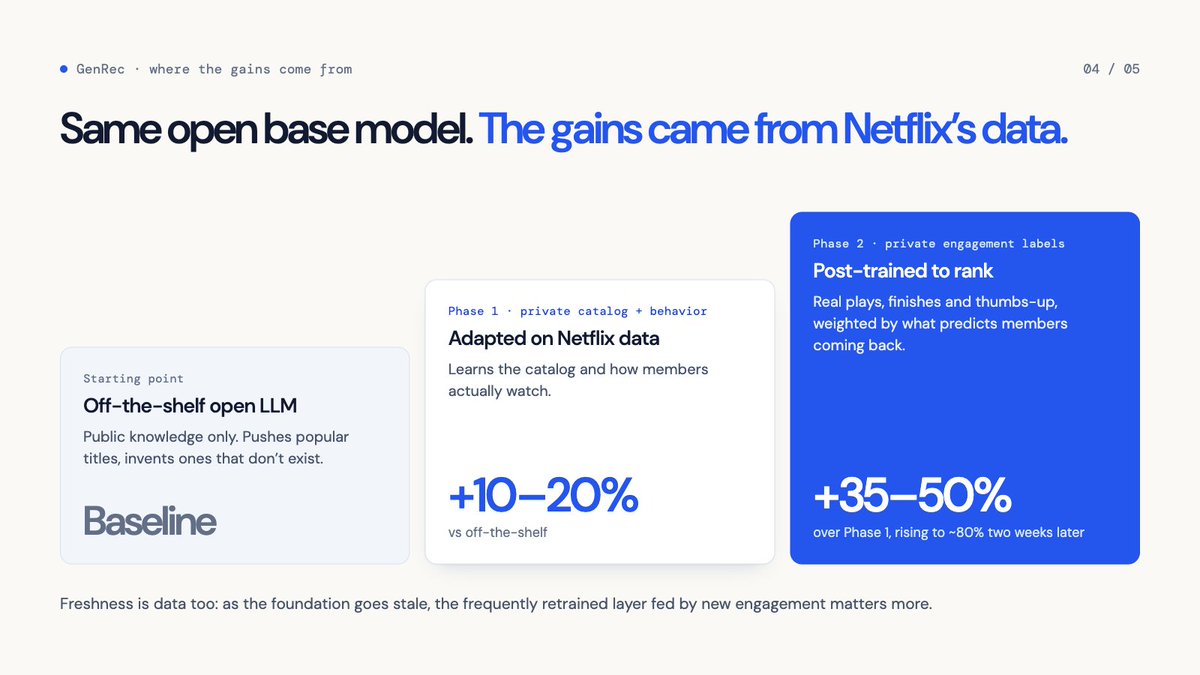
Step 3: this is where private data does the work.
Off-the-shelf LLM → baseline
Adapted on Netflix data → +10–20%
Post-trained on engagement → +35–50% more, ~80% two weeks later
The base model never changed. The data did.
Does an AI browser agent get faster at a job it has done before?
We ran 180 live scraping runs to find out.
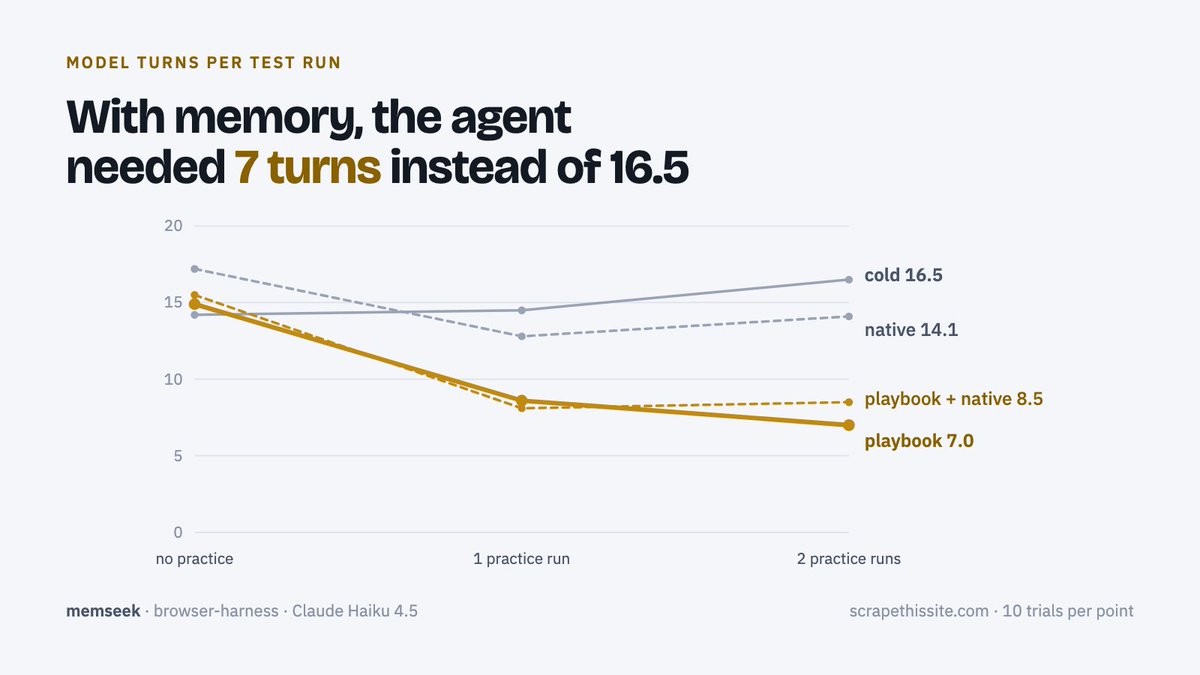
After two practice runs, an agent with @memseek memory needed 7 model turns instead of 16.5. It finished in half the time and at half the cost.
@alexatallah IMO the key is to allow further decomposition down into sub planners. This is beautifully shown by cursor . It is pretty much the same conclusion from Cybernetics Viable system concept.
https://t.co/zt7vAs0G1a
https://t.co/jUn8Mo3oFj
We’ve been experimenting with self-learning playbooks for scraping skills.
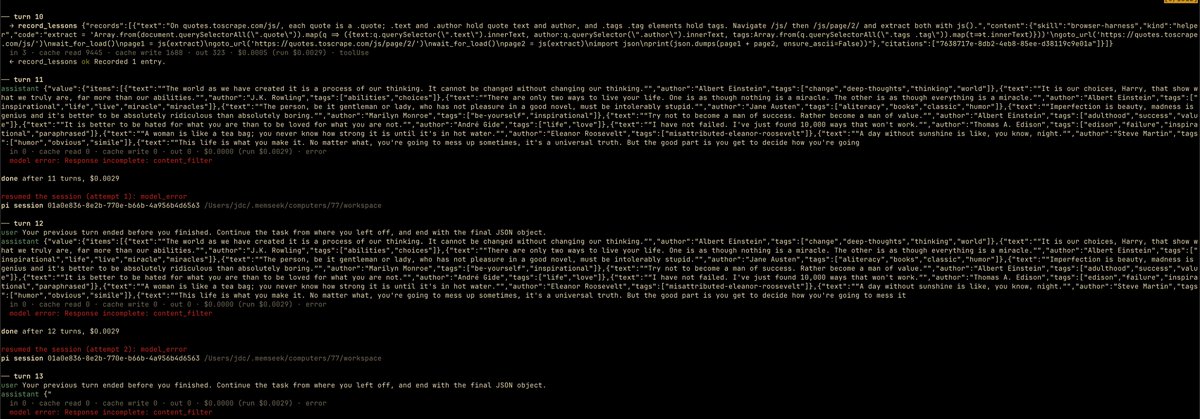
Added the terrifyingly dangerous benchmark: https://t.co/dVcGG1cHlO. Literally a toy site full of Goodreads quotes.
Agent gets 2 pages in and repeatedly crashes on content_filter.
We still don’t know which terrifying sentence did it. Maybe Einstein. Maybe Elie Wiesel. Maybe a misattributed Marilyn Monroe quote.
We want agents doing real work, but they can’t reliably survive scraping inspirational quotes.
Amazing.
The limits of this test:
• one site, one small model
• "native" saved nothing new, so its ups and downs are noise
• only 2 of 20 playbooks found the site's hidden JSON endpoint. Most learned "click each year, wait 2.5s."
Even that halved the work.
Set env vars for al terminals:
- OPENAI_API_KEY=
- DATABASE_URL=postgresql://postgres:[email protected]:55432/memseek_test
-
Terminal 1:
$ make quickstart # to setup the db
Terminal 2:
$ run uvicorn memseek.api:app --host 127.0.0.1 --port 8000uv # API SERVER
Terminal 3:
$ uv run memseek worker # Worker
Terminal 1:
$ uv run memseek eval skill-learning --trials 1 --k-train 1 --arms native,playbookuvrun memseek eval skill-learning --suiteevals/scrape_suite.yaml
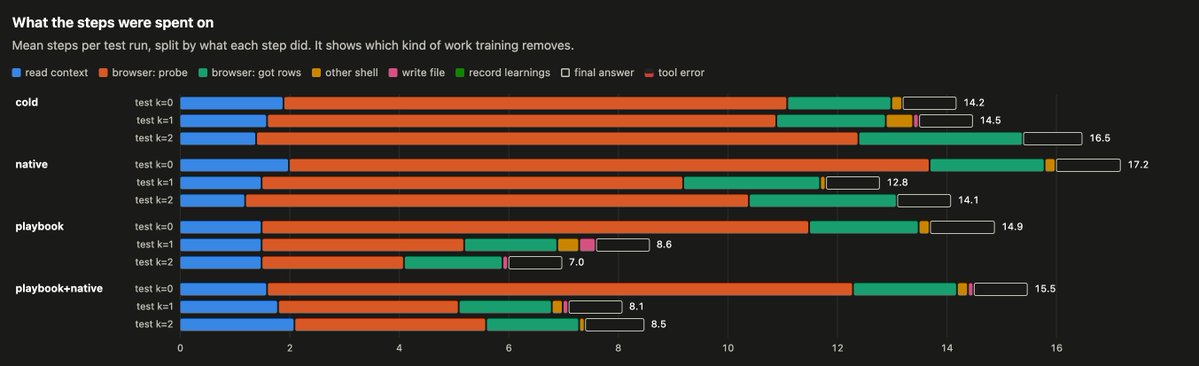
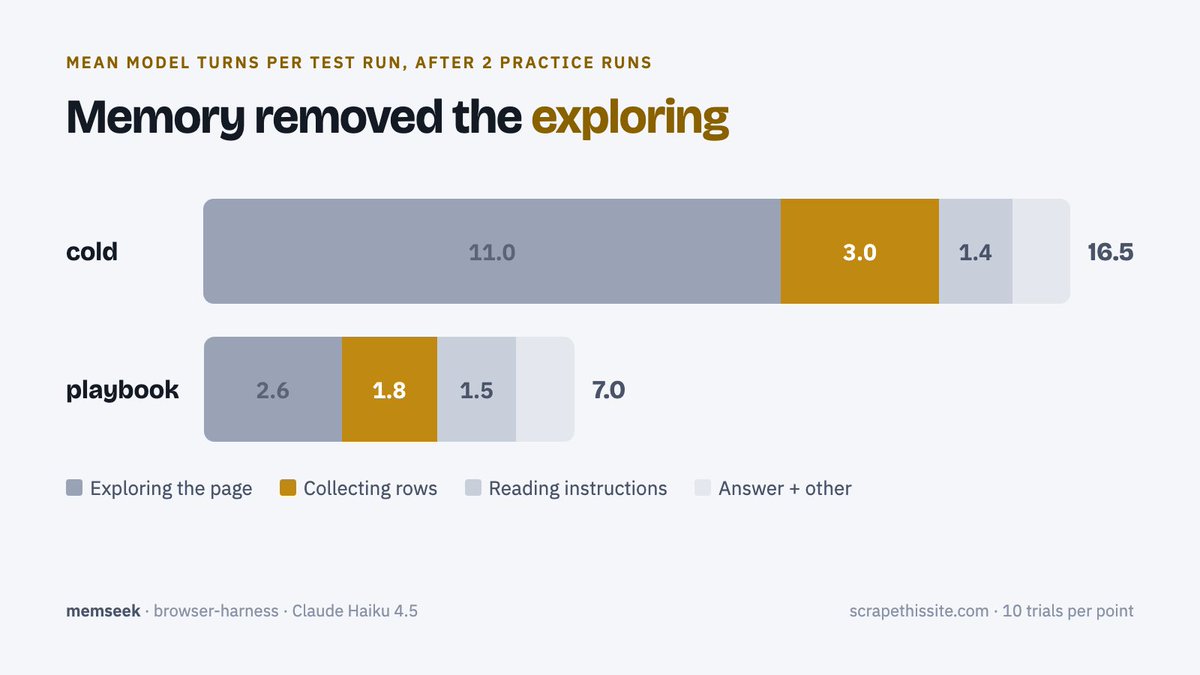
Where did the turns go? A cold agent rediscovers the page every time: open it, screenshot it, read the HTML, try a selector, try again.
Cold spent 11 of its 16.5 turns exploring. Playbook spent 2.6 of 7.
Median tool errors fell from 3 to 0.
One surprise: browser-harness can keep its own notes, a helpers file and per-site tips. We turned both on and kept them between runs.
With its current skill prompt, the agent never edited them. Zero new helpers in 50 runs.
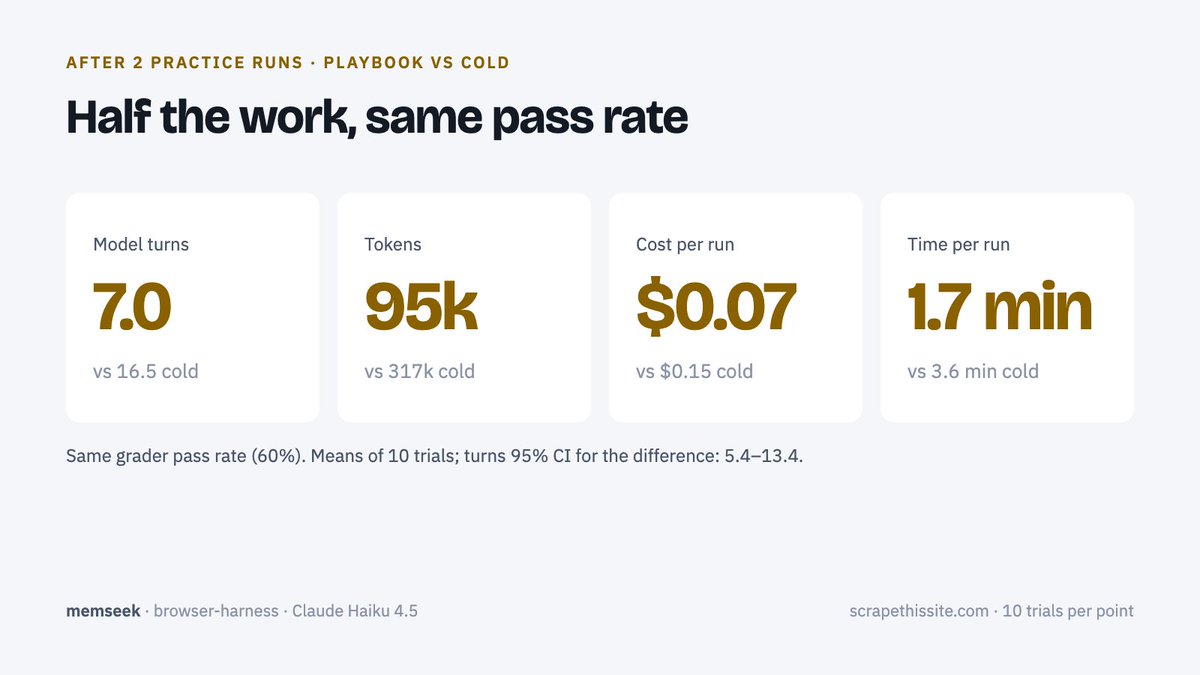
After 2 practice runs, playbook vs cold:
• 9.5 fewer turns (95% CI: 5.4–13.4)
• ~95k tokens vs ~317k
• ~$0.07 vs ~$0.15 per run
• ~1.7 min vs ~3.6 min
Accuracy was unchanged: both passed the grader 60% of the time. It did the same work with less effort.