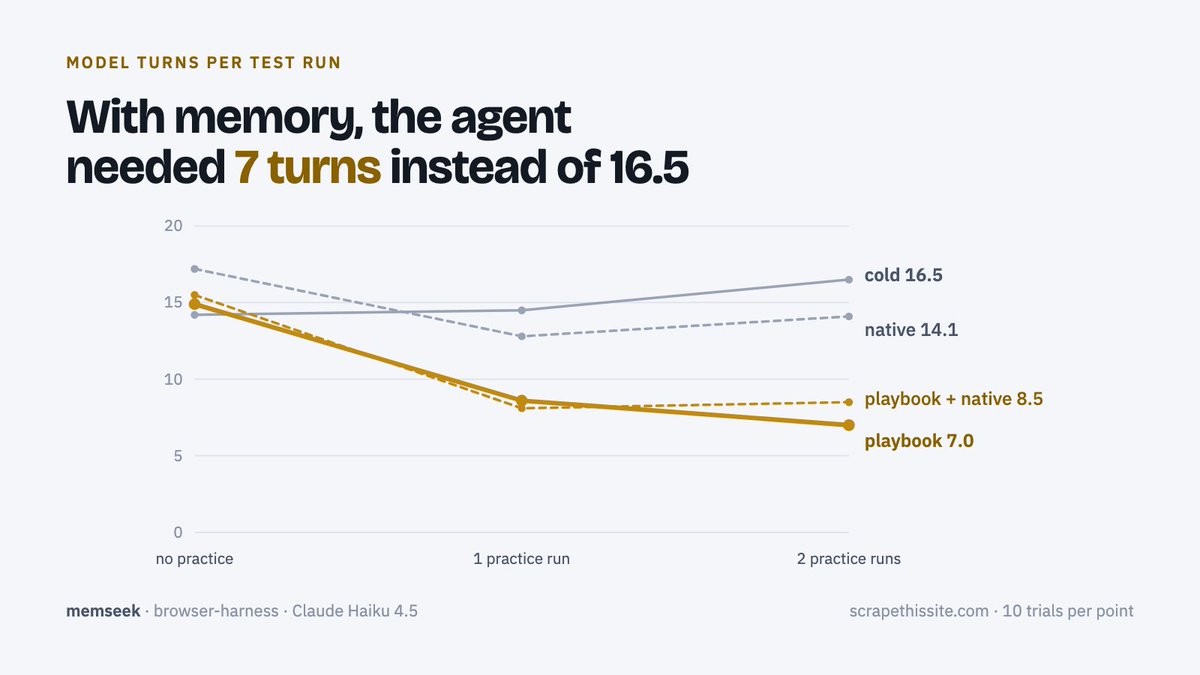
Does an AI browser agent get faster at a job it has done before?
We ran 180 live scraping runs to find out.
After two practice runs, an agent with @memseek memory needed 7 model turns instead of 16.5. It finished in half the time and at half the cost.
With Memseek, you could easily implement WikiSkill from Google. It takes some YAML files 😉
- https://arxiv. org/abs/2608.27454v1
Check out a mini version of a self-maintainable skill
https://t.co/qwFzRm4Bwh
What does it take for an agent to actually remember?
We put together a runnable Memseek walkthrough of the Generative Agents architecture, from recall and reflection to provenance.
Inspired by the work of @joon_s_pk and collaborators.
https://t.co/miQ7RyCSYr
Best agent in the room passes 91% of business tasks if you give it 20 tries.
Passes all 20? 25%.
This is the gap between "a good run exists" and "you can trust it to act." It's also the gap most benchmarks don't measure.
arxiv. org/abs/2608.19741
Anthropic’s new “mind viruses” paper is interesting.
But agents spreading ideas, goals, and gossip through conversation + memory? That was demonstrated in 2023 by Park et al. (Generative Agents).
Our live recreation lets you observe the exact diffusion process:
Hello, memory.
Memseek is now open source: a declarative context engine for agents that need to remember, reflect, retrieve, update, and cite what they know.
Built on Postgres. Speaks MCP. Designed for long-running agents in loops and graphs.
https://t.co/NdyIrB1YWj
AI agents can now try things humans never could
Thousands of times
Millions of times
But trying more is only useful if you can tell what worked
The gap between pass@k and reliability@k may be one of the most important ideas in building reliable agents
https://t.co/RAmp0xYItS