Genomes are full of dark matter of unknown functions.
We present Minerva, a new method for discovery guided by genome language models. Minerva reveals the interactions hidden in non-coding DNA, pointing to hundreds of new putative RNAs and repetitive elements per bacterial genome. Minerva allows us to find and study elements invisible to traditional methods at orders of magnitude greater scale than before.
1/5 🧬 Today, our team @GoogleDeepMind is taking another step on our mission of deciphering the genome. We are releasing AlphaGenome Atlas, a massive (petabyte-scale) resource containing AlphaGenome predictions for every possible single-letter DNA change in the human genome — 9 billion in total.
https://t.co/Lf9DWRfWCu
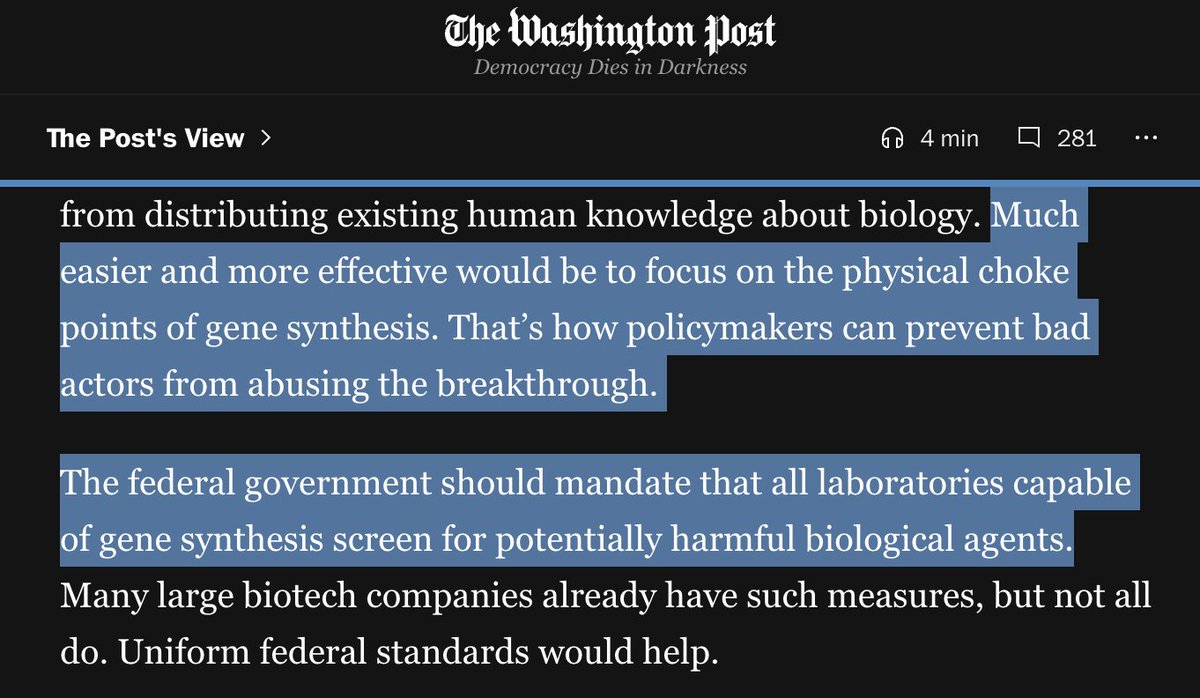
You might expect me to do a victory lap, seeing the agenda we’ve pushed relentlessly for years go from fringe focus to, eg, WaPo editorials
Sure, I’m glad we’ve realized it’s a no-brainer to secure catastrophically misusable DNA in the age of AI
But, also, let's be clear about a few things: First, we haven't done it yet!
There is still no policy implemented anywhere in the world – certainly not the US – that creates any reliable consequences whatsoever for a company that knowingly ships long fragments of the Ebola viral genome to a random postbox without asking any questions. (What the f***!) When I see praise for voluntary HHS frameworks or open letters or high-vibe endorsements, I really want to shake people's shoulders and say, wake up, we haven't won yet! Those milestones were all important, truly – but we only win when it's meaningfully harder for the next Aum Shinrikyo or unhobbled rogue swarm to acquire the building blocks of pandemic pathogens. And that will only happen when we pass some damm legislation. The bipartisan Biosecurity Modernization and Innovation Act is right there! Pass it!
Second, securing DNA will not be enough to make pandemics history. “No silver bullets” sounds trite, but that doesn’t make it false! And this is especially important to remember when AI leaders blatantly pass the biorisk buck to the DNA synthesis industry. Yes, I’ve been a monomaniac about DNA supply chain security; sometimes you’ve gotta Own the Problem. But, to be clear, I know that we’re screwed if my friends working on model safeguards, biosurveillance, and broadspectrum countermeasures don’t win, too.
Finally, there’s just so much more to AI resilience than bioresilience. Biorisk is nasty, but it’s also a small fraction of the dangers from transformative AI; a big motivation for going pedal to the metal on solving it is so that we can move on to the deluge of other challenges this tech suite will pose.
So, the bottom line here is: let’s actually secure the DNA supply chain, let’s also be all-in on the broader bioresilience agenda, and let’s repeat the playbook for transformative tech more broadly. Eyes on the prize, folks!
Today we’re sharing an update on Claude’s protein design capabilities.
Working with Adaptyv Bio and Twist Bioscience, Claude designed de novo protein binders against 14 of 15 targets. With a 30k token prompt written by a human expert, Claude achieved hit rates up to 28.2% when designing against all targets simultaneously over 48 hours, with no human intervention or steering. When designing against a single target in a 24 hour campaign, Claude achieved an overall hit rate of 35%.
We included all targets in Adaptyv’s BenchBB, and novel targets 15-PGDH and GDF-8. Claude performs at or beyond the level of the top competition participants in both hit rate and binding affinity.
I was the first White House Special Advisor for AI. My friend Tantum Collins was Director for Technology and National Security, joining government after five years at Google DeepMind. Our jobs were to help make AI safe and ensure that democracies led the way in inventing and using it well. Today, I’m a professor at Johns Hopkins and an advisor to Anthropic and others, and Tantum is the CEO of Inherent.
Long before we served in government, we thought that humanity was on track to create AI systems that outperform humans at virtually every cognitive task. This was once a fringe hypothesis. It now seems inevitable.
THE BITTER STRUGGLE is our new book about what’s happened, what’s coming, and what’s at stake. From nanometer-scale chips to gigawatt data centers, we will show you why AI is so powerful, and why its progress will accelerate from here in ways that feel like science fiction. We will take you into the Oval Office with President Biden, the Situation Room with the Cabinet, and the Roosevelt Room with leading CEOs — and we will examine what has happened under President Trump. The decisions made in these rooms, and in Silicon Valley, will determine which nations gain a decisive lead in AI. Whoever wields that technology will gain a power unlike any in history. The next few years may decide the next few decades.
But, most of all, together we will confront AI’s hardest questions. What is the proper relationship between the companies inventing the technology, the government, and the public? How can we make sure AI is safe and trustworthy? How do democracies win without losing our values?
And how can humanity figure all of this out when we are so quickly running out of time?
That question is why we wrote this book — and why we believe the answers are too important to only be debated in closed rooms, including the ones we once sat in. We are so excited to finally share our work with you.
The book is available for pre-order now and out November 10th from Crown. https://t.co/shdmbLbAdh
Ordinary Abundance. This is the greatest thing I've read in weeks. No kidding. This should win a Pulitzer in a category not yet invented. https://t.co/iqnoACNt6z
Ok I'm sorry to keep harping on this but Jesus H. Christ on a Pogo Stick I swear this article was designed to rage bait me.
"AI-designed viruses are a test of whether biosecurity can keep pace" is the title.
https://t.co/naJEtRKAWx
The work it is reacting to is Almost. A. Year. Old. It was published as a preprint in September of 2025.
https://t.co/HLukQxOV16
Keep pace with what? Keep pace with what? The breaking news of 11 months ago?
🧵More vaccines do not mean more distinct antigens. The childhood vaccine schedule contained 3,217 antigenic components in 1960 and 3,041 by the 1980s. Today, owing to better formulations, it's about 165 antigens across the current pediatric schedule 1/2
https://t.co/xc06FHWrtb
This is a wild overstatement of what was actually achieved. But “AI successfully remixed a small number of mostly already-observed, largely synonymous mutations and in a few rare cases managed to make it nonlethal” doesn’t sell hype as well