More insider buys from Forgent ($FPS ), also Kodiak Gas Services ($KGS ) which sits in the same basket as Liberty ($LBRT ) and ProPetro ($PUMP ). These are all AI infra-related names, with Forgent being the oen with highest exposure. For those saying that the AI-infra trade is dead, we've been seeing insider buys right left centre: FPS, PUMP, LBRT, SEI, PUMP, EQPT, FTAI, DUOT, FTK...
It is an impressive cluster in the last 2 months or so.
More Solaris shares for Dir A.J. Teague. He bought over 1M in shares with a weighted avg cost basis of $67.61. Solaris closed @ $60.69 today.
EQPT Founder and CEO bought more shares today, totallin over 2.2M worth of shares @ $18.74 CB.
Kratos Dir David King purchased 200k shares on Nov 13 @ $33.52, first insider buy in ages.
MP CFO Ryan Cobert bought more shares today, he now bought 327k shares with a cb of $36.45. COO Micahel Rosenthal has bought 59k shares with cb @ $45.53. Dir Randall Weisenburger (cool name) bough 55k shares this year, cb @ $36.
Tyson Hottinger (FPS GC) bought 22.364k shares @ $20.76
TTM Tech Dir Wakid Ali bought 10k shares @ $63.15.
There is so much more though. Insider buys from Duos, Keel, HawkEye, FTAI... Some execs clearly think their companies are at attractive prices in tihs drawdown.
Every good trade comes to an end, but are we really going to ignore companies that will be reaching ridiculous level of FCF and growing at high double digits for the next 2-3 years? The key will be to find the right names that are executing and generating positive return on their capex. Find those and the market shall reward.
As for AI implementation trade, that's the end game and I've written about it on my post on Caris. However, we are still very early in many names the market has run ahead of itself on names. The consequence is clear: come earnings time, these names gap down because the share of AI-related sales is either too small to justify higher multiples, and/or the company isn't growing fast enough to keep inflating away multiples.
One of the names that I looked at a couple months ago was Digimarc ($DMRC ). Perfect example of a name running hot until earnings comes knocking. Same with Caris FWIW. The good thing though is that this early period will give people plenty of entries as you research names.
Too many people have been looking for the infrastructure trade to come back instead of realizing that it happened.
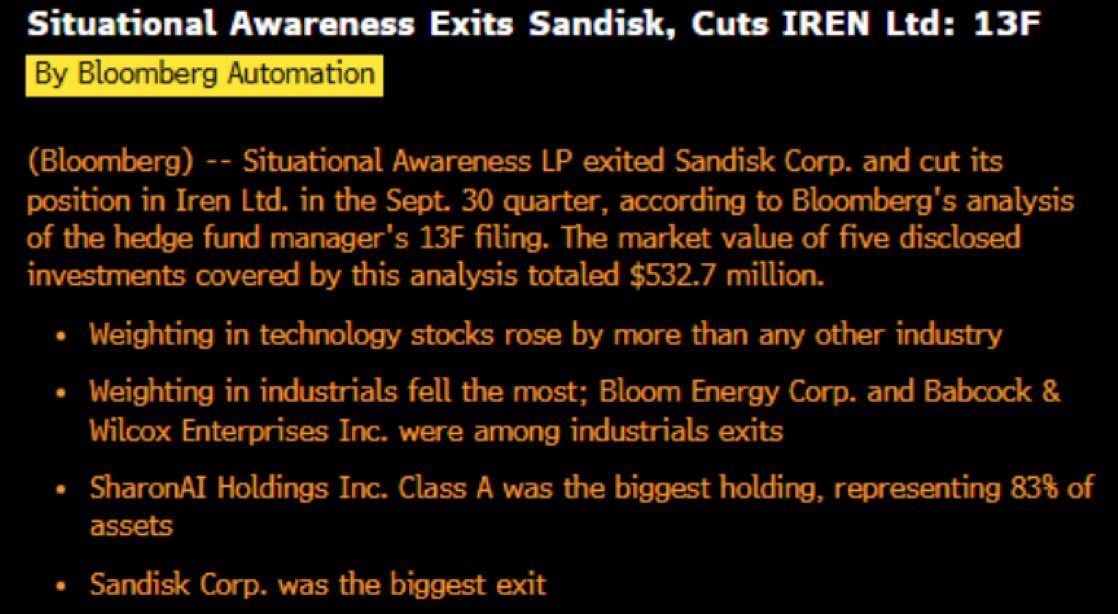
Druck is ready for the next trade.
I've said multiple times on spaces the next AI trade is the implementation trade.
The main takeaway from Nvidia's call is that the company remains firmly committed to its long-term strategy of championing open-source and sovereign AI.
The rationale is simple: Nvidia does not want to operate in an oligopsonistic market, where a handful of powerful buyers can squeeze its margins or even threaten its business by developing their own specialized ASICs.
More Solaris shares for Dir A.J. Teague. He bought over 1M in shares with a weighted avg cost basis of $67.61. Solaris closed @ $60.69 today.
EQPT Founder and CEO bought more shares today, totallin over 2.2M worth of shares @ $18.74 CB.
Kratos Dir David King purchased 200k shares on Nov 13 @ $33.52, first insider buy in ages.
MP CFO Ryan Cobert bought more shares today, he now bought 327k shares with a cb of $36.45. COO Micahel Rosenthal has bought 59k shares with cb @ $45.53. Dir Randall Weisenburger (cool name) bough 55k shares this year, cb @ $36.
Tyson Hottinger (FPS GC) bought 22.364k shares @ $20.76
TTM Tech Dir Wakid Ali bought 10k shares @ $63.15.
There is so much more though. Insider buys from Duos, Keel, HawkEye, FTAI... Some execs clearly think their companies are at attractive prices in tihs drawdown.
Excellent write up, Moip. It's been an interesting journey no doubt. I can see this name turning around by the second trimester in 2027, once the economics become fully realized. The likely dilution is not ideal, but funding is getting very scarce. Hopefully the sector hit a few catalysts in hte meantime which would help them to secure funds.
$DUOT - Some updates on the 3Q call since they spoke at LD Micro ~4 weeks ago. Mix of positives, negatives, and generally interesting details in the call and 10Q. They answered the main questions I think most people that follow this had.
Again, this all comes down to is project funding and execution. Simple doesn't equal easy. Stock is trading below book value and there is 0 value being assigned to the 20MW CSP deal, 55MW AGPU JV, or 100MW land pipeline.
Positives
- Gave important clarification on unit economics/payback. Capex ~$6.5mm/MW, annual revenue ~$2mm-$2.5mm/MW, and annual site-level EBITDA of ~$1.5mm/MW. Implies ~23% return on an EBITDA/Capex basis which also ties with a <5 year payback period. This is a very solid return in absolute and should provide adequate margin of safety in a higher cost of funding environment.
- Sounds like funding in the works for the 20MW CSP site and future sites. "For the 20 MW cloud deployment and our next sites, we’re in active discussions with several potential lenders and capital providers at both the project and corporate level, and we’ll update the market as agreements are finalized."
- 7MW became fully operational in Columbus in beginning of October so should get full quarter of revenue from that in 4Q.
- Developing additional GA site that could go live 1Q27. Guessing this is the 4MW neocloud deployment they mentioned at LD Micro.
- Site for the 20MW CSP already secured and in development phase. They said it could be delivered at or before ready for service date. Per the 10Q, as of 10/5 they put the remaining ~$9mm of ~$10mm purchase price in escrow for the site in Lee County (I believe South Carolina), subject to closing conditions around getting ~20MW of power.
- Majority of remaining 75MW of the 100MW pipeline in negotiation already has deposits down. Imagine we get a few more announcements over the next 6 months.
Negatives
- 10MW hyperscaler deployment in Columbus is delayed because of an issue with Georgia Power. All of the DUOT equipment is there, it's a power delivery issue with GP. Doug saying they have a solution (BTM I am guessing?) that gets this up and running in 2Q27. Operating is hard, but you cannot have delays at this scale of deployment. Thankfully they were able to pay for this site 50% on an earnout basis so cash not wasted on power not secured.
- I thought they could lever up the Columbus site and take proceeds from that raise to fund other projects into early 27. Now that prob can't happen until late 27.
- No update on the 55MW AGPU JV deployment. Not sure if they are waiting for AGPU to discuss more tomorrow morning, but this is not encouraging for the timing.
- No update/comment on 0Lat expiration.
- I think odds are higher than before that equity-like securities could be used for some funding per commentary on the call. I get that in a spreadsheet it will show as "accretive" but common equity should be quite literally the LAST option chosen with stock sub book value.
Other Stuff
- Calling the 20MW CSP deployment "Project Atlas" per the 10Q. Bought the land in Lee County (I think in SC) from a "CTS Infrastructure LLC" for ~$10mm.
- Per the 10Q, Alyeska exercised warrants for 1.5mm shares on 10/21/26. The 9/30 13G showed common shares of 1.4mm and 3.8mm of warrants. The 6/30 13G had common shares 2.0mm and 3.8mm of warrants. Didn't sell as much as I thought in the 6/30-9/30 period, but potentially ramped up selling since 10/21 if they are exercising 1.5mm warrants (based on the 4.99% threshold they are staying under here).
- Hydra Host fully out of the picture per the 10Q.
Duos reported. Some takeaways:
* 10MW Georgia project has been delayed due to power delivery
* SG&A ballooned mostly due to stock grants.
Overall, I am not overly thrilled with the earnings. The new CFO said that they would not guide for 2027 yet (should have one next quarter). My main concern is the delay in the Georgia project and the cash burn. They do have 44M in cash but each MW cost ~6.5M for new projects. Management tried to reassure that they would pursue all possible avenues to secure more funding but did not rule out dilution either.
I must be honest here. On paper, this stock is cheap. They are EBITDA positive and will continue to be in Q4. The revenue growth is eye popping, and the story is attractive. The sentiment around the trade is in the basement though. The call was short compared to Q2 and Q1. Management sounded careful, and sometimes defeated.
On paper, the EDCs should be at a premium in thi smarket: easier to fly under the radar from regulators and quick to deploy. They will fill an important role in spreading inference at both enterprise and consumer level. But the reality is that the technology is relatively new and the market hs yet to digest its nuances.
Looking at Klarna ($KLAR ) and Duos Technologies ($DUOT ) post earnings reactions tonight.
I am moderately bullish on Klarna int his upcoimng earnings. Peers liek Affirm and Sezzle had decent earnings. Most importanlty, U.S. BNPL demand has been resilient, they've been having strong card and subscription adoption, and they are improving profitability per dollar of transaction volume. People have talked about how AI benefits are not obvious, or have poor visibility. Fintech is a good place to look for it. Klarna's historical rev per employee was 400k, today it sits at 1.4M. Mostly attributed to AI.
Also, Klarna has a potentially positive strategic optionality in agentic commerce. Right now, people see agentic AI as a fad but we are in the early innings here, once inference is everywhere, latency is down, and younger cohorts come into the economic scene, this technology should become even more relevant.
For Duos, it could be a short term post earnings bounce, sadly. They have been executing well and their sector (edge data centers) only gets more important by the day. Market is bundling everything AI, especially data centers, in the same basket. But they are not all the same. Duos will play an important role in AI inference. AI is going nowhere, it is not a fad, and inference is just starting. Enterprise will look to buidl their own mini data centers, Duos will play a role in it.
> Excessive leverage in the system is what has caused the worst mass sell off in over a decade.
The opposite is also true. Excessive leverage caused valuations to inflate away excessively.
We are looking at a fund that is down from $70B to $1.5B, 92% down.
Excessive leverage in the system is what has caused the worst mass sell off in over a decade.
I despise some of you taking victory laps over people who likely lost a lot of money in this burst. You are spiritually broken. There is grace in victory. Even though most of you were not right from a fundamental point of view, it wasn't an AI bubble, it was a high beta bubble bursting event. Lots of sector loosely or not correlated with AI are also down 50%>: defense, space, nuclear, rare earths, gold, silver and more. You don't get bragging rights over something that you got it right by chance.
Have some grace guys.
Many people I'm talking to are getting very frustrated with this market. My feeling is it's because of two main factors:
1) Not accepting that the market is in a corrective phase. The Nasdaq Composite is below its 200-day moving average and there's too much complacency in my view. Sentiment is not washed out yet.
2) They are not cutting losses on stocks down 20-50% (or more) off their highs. Mainly because they are married to the huge winners of the past and do not want to let go of them (nor I am saying to sell them because this is not investment advice).
This is mainly for people who like to actively manage their accounts and who like to trade growth stocks. It's going to take some time for conditions to be healthy again. Just be patient. In the meantime, protect your capital, protect your confidence, and as always, know your timeframe. Good luck!
Looking at Klarna ($KLAR ) and Duos Technologies ($DUOT ) post earnings reactions tonight.
I am moderately bullish on Klarna int his upcoimng earnings. Peers liek Affirm and Sezzle had decent earnings. Most importanlty, U.S. BNPL demand has been resilient, they've been having strong card and subscription adoption, and they are improving profitability per dollar of transaction volume. People have talked about how AI benefits are not obvious, or have poor visibility. Fintech is a good place to look for it. Klarna's historical rev per employee was 400k, today it sits at 1.4M. Mostly attributed to AI.
Also, Klarna has a potentially positive strategic optionality in agentic commerce. Right now, people see agentic AI as a fad but we are in the early innings here, once inference is everywhere, latency is down, and younger cohorts come into the economic scene, this technology should become even more relevant.
For Duos, it could be a short term post earnings bounce, sadly. They have been executing well and their sector (edge data centers) only gets more important by the day. Market is bundling everything AI, especially data centers, in the same basket. But they are not all the same. Duos will play an important role in AI inference. AI is going nowhere, it is not a fad, and inference is just starting. Enterprise will look to buidl their own mini data centers, Duos will play a role in it.
JPM Data Center Power Expert Call
1. Gas turbines are in short supply, creating opportunities for alternatives. The expert favors 20–60MW industrial and aeroderivative gas turbines for on-site generation, but deliveries of new units may stretch into 2030 or beyond. This is driving interest in reciprocating gas engines, fuel cells, refurbished turbines and battery storage. Fuel cells can be deployed faster and produce lower emissions, but cost more.
2. Self-supplied power could become a long-term asset rather than a temporary solution. The expert recommends designing projects for an eventual grid connection from the outset: use on-site gas generation initially, then retain it for backup power and export surplus electricity when the grid is under stress. In one example, a 500MW IT load could be supported by roughly 700MW of gas generation, reducing the need for traditional diesel backup generators. Grid connection itself can take four to six years or longer.
3. Local opposition is a real development risk. Residents are concerned about electricity prices, water use, emissions, noise and local economic benefits. The expert cited roughly 385 data center project delays or cancellations this year, versus about 50 last year; the report does not independently verify those figures. Cleaner equipment, alternative cooling systems and community investment may help address opposition, but add costs. Developers may also shift projects to other regions.
4. Equipment suppliers have strong pricing power, while developers are taking on more upfront risk. Multiyear lead times allow suppliers to pass through commodity, tariff and freight costs and secure long-term service agreements. To lock in supply, developers sometimes buy major equipment before projects receive final approval. Shortages of electricians, HVAC technicians and other skilled workers can further delay construction.