I SAID ARE YOU READY FOR THE GREATEST MEMESTORM STONKNADO IN HISTORY
#WEN#MOASS#GME 💎🙌🚀🚀🚀🚀🚀🚀🚀🚀🚀🚀🚀🚀🚀🚀🚀🚀🚀🚀🚀🚀🚀🚀🚀🚀🚀🚀🚀🚀🚀🚀🚀🚀🚀🚀🚀🚀🚀🚀🚀🚀🚀🚀🚀🚀🚀🚀🚀🚀🚀🚀🚀🚀🚀🚀🚀🚀🚀🚀🚀🚀🚀🚀🚀🚀🚀🚀🚀🚀🚀🚀🚀🚀🚀🚀🚀🚀🚀🚀🚀🚀🚀🚀🚀🚀🚀🚀🚀🌪️🌪️🌪️🌪️🌪️♾🏊
🚨 Bank of New York Mellon Corp JUST REVEALED A MONSTER $GME POSITION 👀🔥
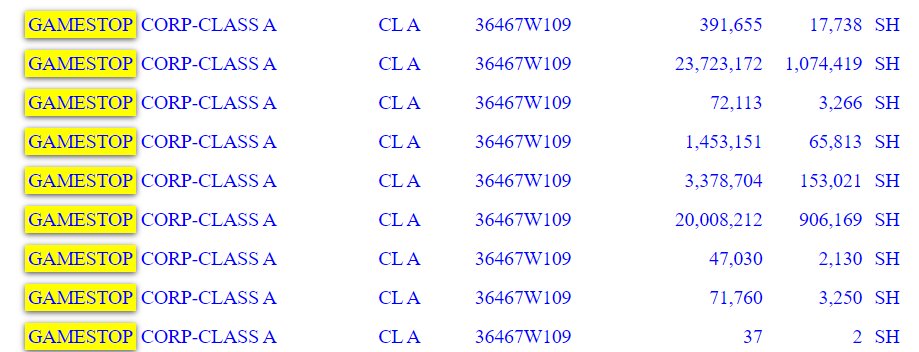
Across 9 separate filing rows, Bank of New York Mellon reported a combined:
🎮 2,225,808 GameStop shares
💰 $49.15 MILLION in reported value
The biggest blocks alone include:
• 1,074,419 shares — $23.72M
• 906,169 shares — $20.01M
• 153,021 shares — $3.38M
This is exactly why you have to combine every row before judging institutional ownership.
Over 2.2 MILLION shares. Nearly $50 MILLION. One institution.
$GME institutional exposure is getting harder to ignore. 👀📈
https://t.co/gYEjwPRNmq
At the start of 2020 Gamestop had
- $570 million in cash
- $417 million in debt
- $470 million annual net loss
- A negative P/E ratio
In 2026 Gamestop has
- $6 billion cash
- $2.8 billion 0% debt
- $300 million in bitcoin
- P/E ratio of 14
- $414 million annual net PROFIT
- FG of $600 billion profit this year NOT including cash interest
Oh, they also own 9.8% of Ebay and have a $400 million gain on the position so far
The float is much bigger but so is the business, so is the brand and so is Ebay
The Hidden Catalyst: The Debt Buyback Thesis
While most people are focused on the potential GME $2 billion share buyback (and potential eBay acquisition), there may be a more strategic move flying under the radar that few are looking at: The possibility of GameStop buying back and retiring its 0% convertible notes.
Buying back and retiring even a fraction of these notes could serve as a major catalyst for upside price movement. Here's why:
1. Unwinds the Arb Short Trade
Hedge funds in the arbitrage short trade bought the convertible notes and shorted GME shares at the same time to hedge their risk. If GameStop retires the notes, those funds are forced to buy GME on the open market to close out their short positions.
2. Kills Dynamic Hedging
Because the funds want to remain market neutral, they constantly adjust their short position based on the stock's price. As GameStop's stock price goes up, the bond behaves more like equity, and to keep their hedge perfectly balanced, the arbitrage funds are forced to short more shares on the open market. This creates an automated wall of short selling that steps in to choke off upward momentum whenever the stock starts to run. Retiring the debt removes this selling pressure.
3. Destroys the Future "Dilution Trapdoor"
The current outstanding notes can convert into tens of millions of new shares in the future as the stock price rises above conversion price, creating an artificial ceiling on the stock through dilution. Retiring the debt permanently destroys this "dilution trapdoor". It's economically similar to a targeted anti-dilution move.
4. No Daily Volume Limits or Authorized Caps
Stock buybacks are limited by the board's authorization ($2B here) and practical factors (liquidity, 10b-18 rules, etc.). A company can retire debt much faster than it could execute an equivalent open-market stock buyback.
5. Strengthens the Stock for M&A
When pursuing a massive acquisition like eBay, a company's stock is its most potent currency. As mentioned above, retiring the convertible debt forces the hedge funds engaged in convertible arbitrage to unwind their short positions. This forced buying would likely drive GameStop's stock price higher. A higher stock price makes any equity-based portion of an eBay buyout much cheaper and less dilutive for GameStop.
6. Provides Strategic Flexibility During Takeover
Regulation M and safe harbor rules restrict share repurchases during a formal "distribution" (like mailing official merger or tender offer materials), which has not occurred yet with the rejected, non-binding eBay proposal. But even if a formal deal later triggers these regulations, debt retirement remains permitted, while share buybacks become heavily restricted and require rigorous compliance to avoid market manipulation claims.
A Hypothetical Scenario
GameStop currently has over $4.16 billion in total outstanding convertible debt. For a clean example, let's look at what happens if they retire just $1 billion of it.
GameStop's notes convert at roughly 34 shares per $1,000 note, meaning $1 billion in debt represents about 34 million underlying shares. Because arbitrage funds typically hedge at a ~60% "delta," they are currently short roughly 20 million shares just to hedge that $1 billion tranche.
If GameStop buys back that $1 billion in debt, the arbitrage funds suddenly have to unwind their hedge. They are immediately forced to buy back those 20 million shares. This could (emphasis on "could") trigger a gamma squeeze, pushing the stock price up significantly in short period of time.
By removing this debt, GameStop not only removes the active short-hedging that suppresses upward momentum, but it also clears the runway for the company to deploy its newly approved $2 billion share repurchase program into a more illiquid market.
TLDR: Retiring convertible debt triggers buying pressure from funds (unwinding their hedges), eliminates the dilution "trapdoor", and clears the runway for upside price movement when the share buybacks hit.
Disclaimer: GameStop may never end up retiring any convertible debt and I might be overlooking some market/legal nuances. BUT if I’m understanding the mechanics correctly, this is a powerhouse of a tool sitting in their arsenal.
Don’t listen to me though, I just had crayons for breakfast.
$GME
@RoaringSensei@gamestop@powerpacks Imagine $GME goes to 32$ everyone is going to cash out on powerpacks revenue goes up better earnings $GME goes up again everyone buy more powerpacks 🤯🤯🤯
Watch
The world will slowly get used to having to talk about GameStop in a different light
First it will appear on twitter this way
Then it will change on cnbc
Once it hits cnbc you will know RC is in full stride $GME