Start your #CVPR2026 with a coffee and some hard truths ☕
Tomorrow morning, we're talking 'Bitter Lessons' -- hard-won wisdom our field has accumulated but rarely discusses
Come be part of a candid conversation👇
https://t.co/P0oJDJG71X
Wed, 8:45am, Four Seasons Ballroom 4
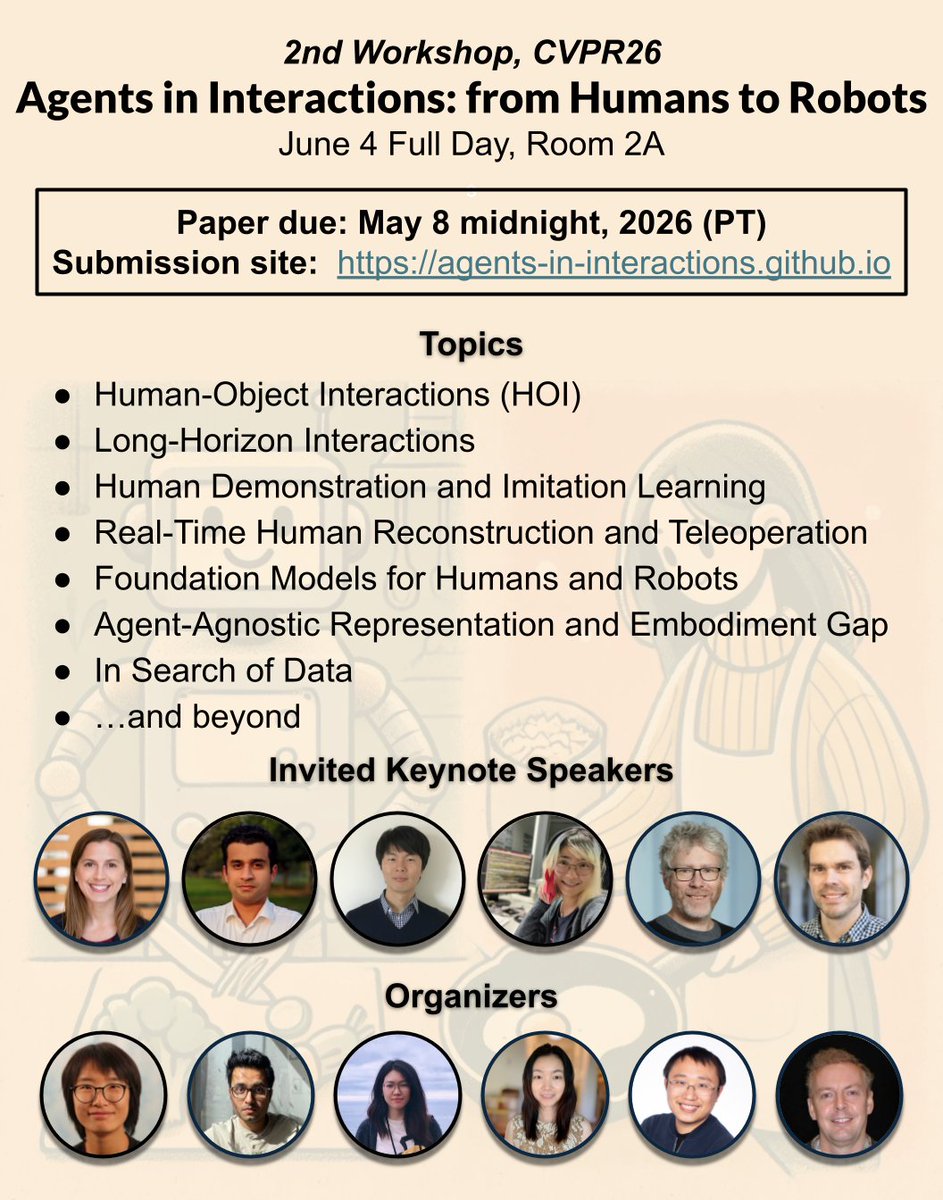
We're thrilled to organize the 2nd Workshop on Agents in Interactions: From Humans to Robots!
Submit your best work by May 8 and join us at CVPR in Denver to discuss research in this exciting space
w/ @yufei_ye@DandanShan_@jiaman01@xiaolonw Alan Yuille
SoftAct: From Virtual Human Demos to Closed-Loop Policies for Soft Robot Hands (that look and behave pretty differently from human hands!)
The key is functional force-aware retargeting using simulation in-the-loop!
Fun collaboration led by @UksangYoo with us at Meta
RGB Human Videos -> Dexterous Manipulation Policies
No teleoperation. No wearables. No robot interaction.
The 🔑: Reliable 3D hand-object trajectory reconstruction and efficient action augmentation
Fun collaboration led by @chen_hongyi_
How humanoid should your humanoid robot be?
Humanoid robot maker Boston Dynamics recently released the new vision of their humanoid robot, the Atlas. This robot has distinctive, bowed legs, a round face, and joints that rotate 360 degrees. To be blunt, it looks like an alien, not a humanoid.
It also offers a compelling vision for what robots could be, moving beyond mere human mimicry. We can build robots with better hands, better arms, and better sensors; humans have our current hardware by accident of evolution, not because it's actually optimal, either for motors or just in general.
And yet bipedal robots still have clear advantages over other form factors for many types of work.
Blog post ->
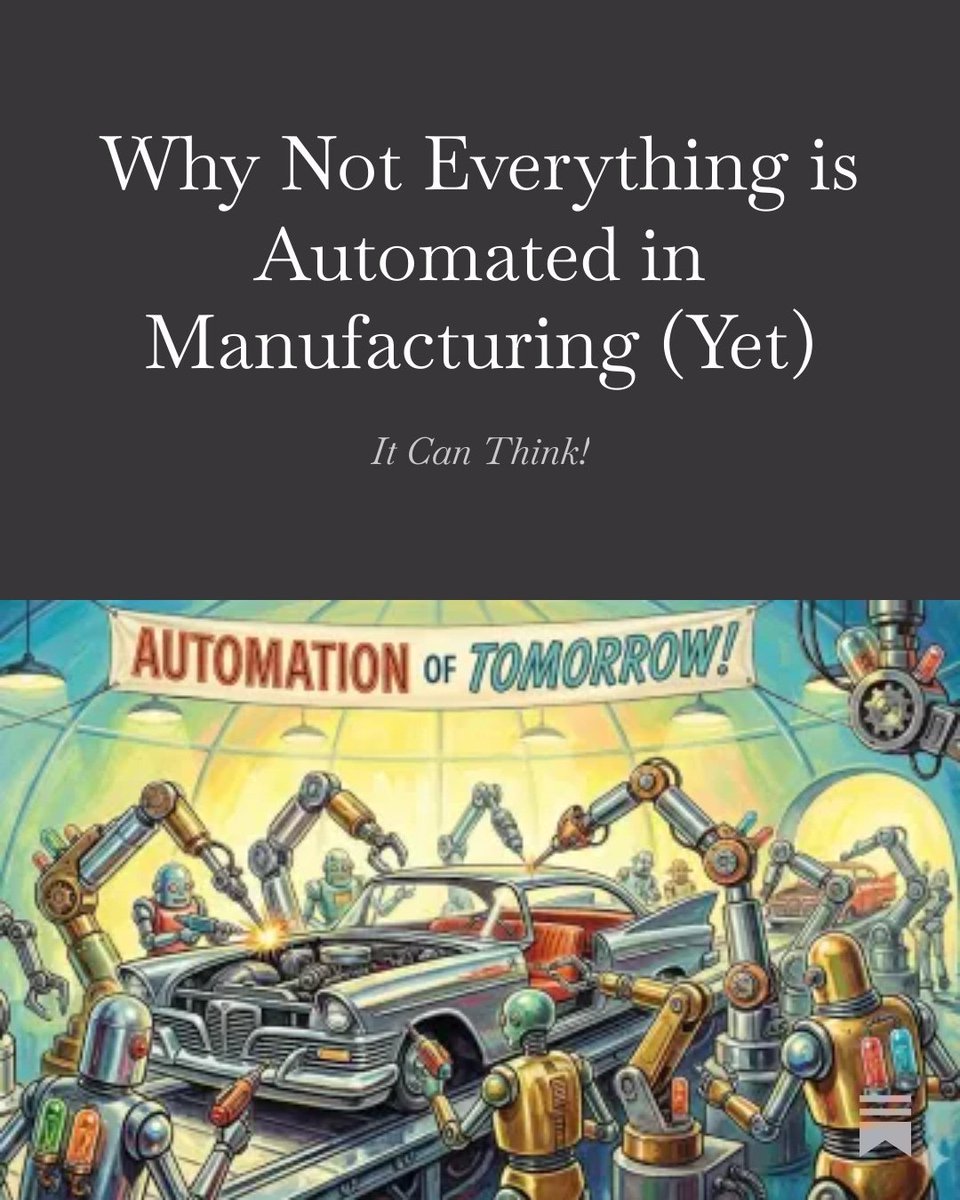
Why not everything in manufacturing is automated (yet)
Every few weeks I see someone (even a major vc) wondering why so little of manufacturing, particularly in the United States, is automated. There are tons of reasons why, all of which boil down to the questions:
- what can robots do reliably?
- how do we engineer systems that are set up so that robots can leverage what few things they can do reliably, to produce actual value?
And from this springs a whole range of issues. For more i wrote a blog post ->
No teleoperation. No simulation. No RL.
Multi-fingered robot manipulation policies directly by watching videos of humans with Aria glasses on.
It was super fun working on this with @irmakkguzey's lead!!
1/n
I wrote a short blog about a really cool video that appeared on the internet a couple days ago, from MindOn tech. It’s the most fluent and fluid home robot video I’ve seen, I’m pretty sure it’s real, and here is how/why.
https://t.co/D7Mxom3hkB
Super excited about our new work on a general re-targeting recipe for converting human data to feasible robot trajectories for dexterous manipulation, and beyond!
Led by the amazing @ChaoyiPan
Happy to have received a Distinguished Dissertation Honorable Mention for my PhD @CMU_Robotics
Grateful to my advisors @gupta_abhinav_@shubhtuls committee @svlevine@Oliver_Kroemer and to all my supporters, collaborators, and mentors over the years!!!
Working with @mangahomanga was incredibly fun and inspiring. He played a key role in me pursuing my PhD! Super excited to see him take robotics research to the next level.
@JHUCompSci really got a great one!
I'll be joining the faculty @JohnsHopkins late next year as a tenure-track assistant professor in @JHUCompSci
Looking for PhD students to join me tackling fun problems in robot manipulation, learning from human data, understanding+predicting physical interactions, and beyond!
Robot skin, made to fit… automatically.
This tool designs full-body tactile skins that match any robot’s shape and task.
[📍 Paper below]
✅ Adapts to any 3D robot model
✅ Places sensors where they’re most useful
✅ Fully 3D-printed, including internal wiring
✅ No one-size-fits-all; every skin is custom
They tested it by printing six versions and putting them on a robot arm in human interaction scenarios.
🔗 See how it works:
https://t.co/UupN2sPmMp
📍Paper: https://t.co/BzURmxA2i9
Robot skin, made to fit… automatically.
This tool designs full-body tactile skins that match any robot’s shape and task.
[📍 Paper below]
✅ Adapts to any 3D robot model
✅ Places sensors where they’re most useful
✅ Fully 3D-printed, including internal wiring
✅ No one-size-fits-all; every skin is custom
They tested it by printing six versions and putting them on a robot arm in human interaction scenarios.
🔗 See how it works:
https://t.co/UupN2sPmMp
📍Paper: https://t.co/BzURmxA2i9
Modern AI is confined to the digital world.
At Skild AI, we are building towards AGI for the real world, unconstrained by robot type or task — a single, omni-bodied brain. Today, we are sharing our journey, starting with early milestones, with more to come in the weeks ahead.
Our Mission: Artificial General Intelligence grounded in the physical world.
We believe AGI that can truly understand and reason in the real world can only be built through grounding in the physical world.
Our Vision: Any robot, Any task, One brain.
We tackle robotics in its full generality – building a continually improving, omni-bodied brain that can control any hardware for any task.
Who are we? A passionate group of scientists & engineers driven by our shared vision.
We have been researching AI and robotics for more than a decade. Our team includes pioneers of self-supervised learning, curiosity-driven exploration, end-to-end sim2real for visual locomotion, dexterous manipulation, learning from human videos, robot parkour, and many more. Many of these works have won awards at top-tier AI and Robotics conferences. Our team has also built production-ready systems at Anduril, Tesla, Nvidia, Meta, Kitty Hawk, Google, Everyday Robotics, and Amazon.
Join us in our mission to build the robot brains of tomorrow.
What are robot world models?
If you follow the robotics space, you'll have almost certainly heard the term "world model." In the end, these mean using generative ai to build data-driven simulators or planners in order to build general-purpose robots.
In this post I write about the two main use cases I see:
- using world models as planners to achieve zero-shot generalization to new tasks
- using world models as data driven simulators as a way to overcome the "robot data gap"
This is an overview and intro; the topic is huge and I hope to follow up with more posts going deeper into the methods, techniques, and limitations.