WPC is excited to announce the Travel Grants program application for WPC 2026 is Now Open. Deadline to apply is October 16th, 2025.
This program is only possible with donations by supporters across the Parkinson’s landscape. Learn more here: https://t.co/7uqFKtuGd1
Can we reboot walking after Parkinson's disease DBS?
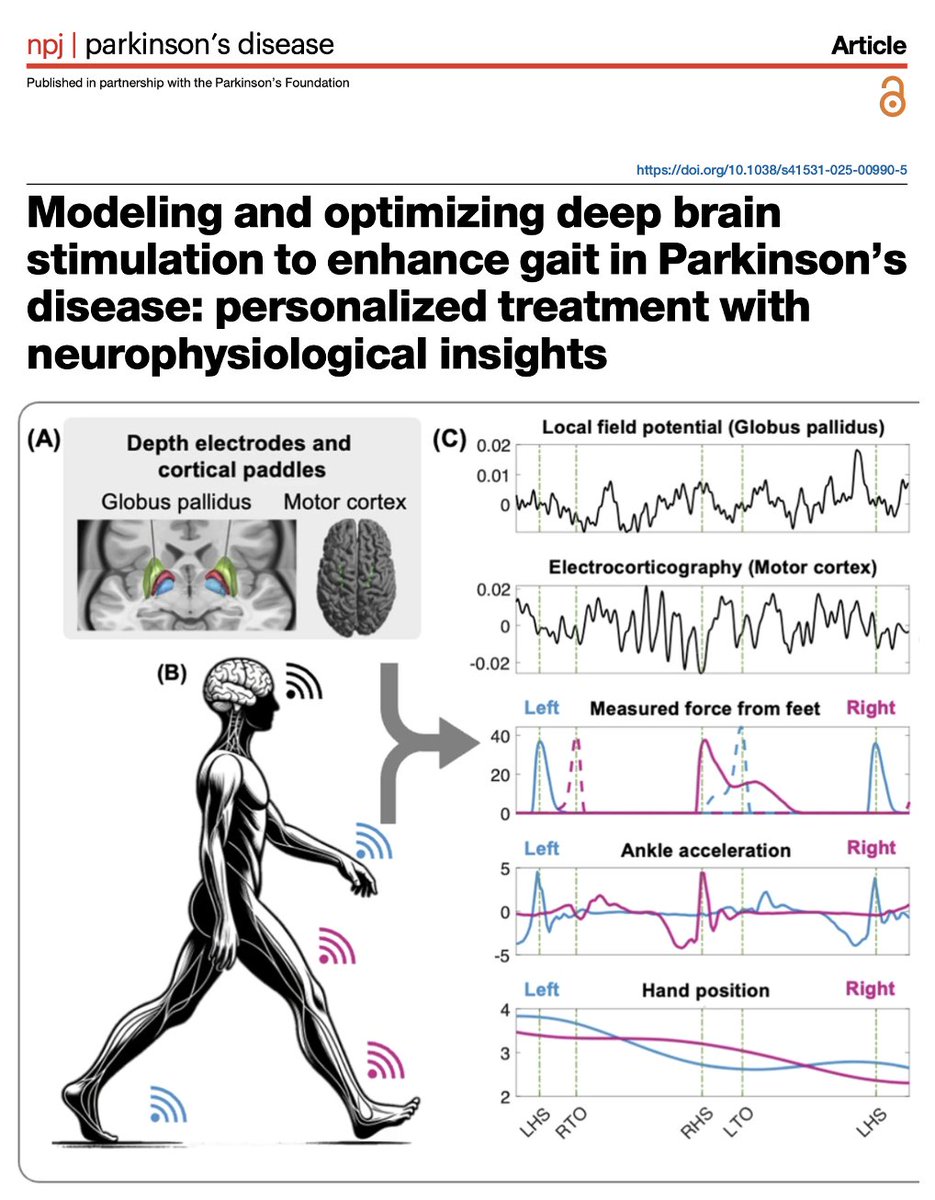
Can AI teach deep brain stimulation devices to help people 'walk the walk?' A new study by Wang and colleagues in Nature Parkinson’s Disease says MAYBE. Using personalized data-driven models, researchers at UCSF have optimized DBS to improve walking in a small group of persons w/ Parkinson’s.
Key Points:
- The authors developed a Walking Performance Index and used a statistical/AI method called Gaussian Process Regression to uncover optimal DBS settings for each individual.
- There were 3 people in the small study and they had potentially meaningful gait improvements.
- The authors used real-time brain feedback. They recorded signals from a brain target called the globus pallidus and from the top of the brain (the motor cortex).
- The brainwave pattern of beta activity seemed to predict better walking performance.
- The authors shared that there was ~18% improvement in walking performance using the new optimized DBS settings.
- The new settings did not seem to sacrifice control of other Parkinson's motor symptoms.
My take: There were 5 points that really resonated w/ me about using this approach to improve Parkinson's walking w/ DBS. 1- Not all DBS settings are created equal. Just like shoe sizes, optimal DBS settings for walking may possibly need customization. 2- Listening to the brain during walking could be important to learning ways to improve gait. What does good walking sound like in the brain? 3- The use of artificial intelligence was key to uncovering improved DBS settings. 4- Walking matters a lot to folks w/ Parkinson's. Gait and balance problems can be limiting. There is a fundamental challenge everyone must appreciate. If you improve walking without improving balance, folks may still fall. This method focuses on walking, and not balance. 5- We are fast moving toward AI based automatic adjusting of DBS devices. Folks should be aware there were only 3 people in this study. Also, these folks had special research devices implanted, and not the standard issue devices available in clinical practice. It will be important to wait and see if this technique can be developed to be more practical and accessible. BRAVO for a clever and potentially impactful 'first step' in learning how to improve Parkinson's gait.
https://t.co/ZYeY8WEqOU @ParkinsonDotOrg@FixelInstitute@DBSThinkTank@DorisWangLab@UCSFHospitals #parkinson #gait
Constipation in Parkinson's is a huge unmet challenge. We must unclog the pipeline. Great article in HealthCentral this week shining light on this topic by Cheyenne Buckingham. She interviewed a few of us in the field and summarized approaches to treatment. I wanted to additionally share a favorite article many folks with Parkinson's may not be aware of. It reminds us to never quit searching for a solution for folks w/ constipation. The trial by Ondo and colleagues was published in Neurology in 2012. The authors provided a 'gut check' and a treatment approach w/ lubiprostone.
Key Points:
- Constipation is more than a nuisance in Parkinson’s.
- It is a huge contributor to quality of life.
- It can disrupt medication absorption.
- A placebo-controlled trial of lubiprostone (Amitiza) showed that 64% on lubiprostone felt “marked” or “very marked” improvement, compared to 18.5% on placebo.
- Stools per day, constipation scores, and visual analog scale scores improved.
- The most common side effect was mild loose stools.
My take: Constipation is treatable and this frequently forgotten article in Neurology should remind us to ask about this symptom and to address it. Here are 5 points that stuck w/ me (no pun intended). 1- Lubiprostone helped to unstick folks. It was a small study but was positive. 2-More bowel movements usually translates to better absorption of PD medications. 3- It’s one size fits all. Some folks may benefit from lubiprostone, others from osmotic agents, dietary changes, or abdominal massage. 4- You are not alone. Constipation is common and folks call us at 18004PDINFO helpline all the time for free advice from the Parkinson's Foundation. 5- If you have Parkinson's and are constipated, push your healthcare team to find a solution.
HealthCentral article:
https://t.co/EQW9yYV0Lq
Ondo article: https://t.co/cpf5lt0fWn
#Parkinsons #Constipation #GutHealth @ParkinsonDotOrg@FixelInstitute@GreenJournal
What about the non-South Asian Asians? Are we not part of the diversity, the research didn't include enough participants, we are lumped together with the whites, other reasons? Asking b/c it's not the first research rendering us invisible
Fantastic paper with very interesting results: “South Asian and Black patients had significantly worse motor scores compared to White patients (mean [SD], 42.2 [18.8], and 47.0 [16.6] vs 35.2 [16.4], p < 0.001 and p < 0.001).” 1/5
The world's first adaptive DBS for #Parkinsons has just been approved by the FDA. I'm looking forward to hearing more about this!
https://t.co/05HMCRl0FL
I avoid horror movies, but netflix' horror tab consists of some of my favorites - #taleofninetailedfox, ##gyeongsongcreature, & #deathnote among others, which I categorize as more fantasy with supernatural elements