Interesting article on an example of possible sympatric speciation in Orcas. It seems in some species differences in behavior can lead to reproductive isolation. @oxyevo https://t.co/QefSPRXYxJ
Ok at this point after 2 lectures on human genome history I’m ready to pull the trigger and get 23&me. Doesn’t even bother me that they’re gonna keep my DNA in a database somewhere and clone me or smth- I just gotta know my Neanderthal variants. @OxyEvo
In my ongoing search for the most ridiculous looking creature plagued by runaway sexual selection, I came across the Irish Elk - a creature whose selection for larger and larger male antlers may have helped drive the species to extinction. @OxyEvo https://t.co/IhB7W9yoJ8
Learning about Ocelated Wrasse in class today reminds me of Flamboyant Cuttlefish I saw on Blue Planet or smth- smaller males use their camouflage powers to appear female and sneak past aggressive males to mate, skipping the fighting. @oxyevo
Learned about phylogeography in my lecture just now. The one scientific paper I could find on the Diamond Turbot (for another class) was about its phylogeography! Now I could probably read that paper if I wanted to.... @OxyEvo
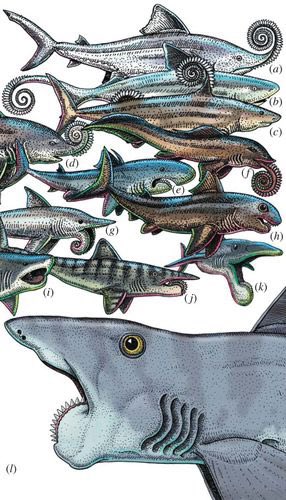
Thinking about the Helicoprion genus of ancient cartilaginous fishes-
Scientists had to construct this animal with only the unique helical jaw as evidence. Imagine puzzling over this evolutionary mystery. @oxyevo
Most faces of most flatfish species are pointed in the same direction- but every so often one is found facing the opposite way- reminds me of negative frequency dependent selection and Scale-Eating Cichlids. @OxyEvo
A rare frog species was just rediscovered in Chile! unlike the Ecuadorian frogs from my last tweet that do not need water bodies to survive, these little guys are fully aquatic and will die out of water. Diversity! @OxyEvo
https://t.co/gAoXqDjtZv
Crazy to think that my three very different cacti are all descended from the same common ancestor. I wonder what a phylogram might look like for them... #OxyEvo
Viruses may not be considered alive by the entire scientific community, but they definitely evolve. It's great that we can use phylogenetic trees to relate them to each other, and hopefully that speeds up the production of an effective vaccine. @OxyEvo
https://t.co/yIgMVRUn3t