one of my favourite study material for vision is https://t.co/9gsk3PahH1 and have always been thinking of writing my own lil book.
working on a transformer neurosurgery book hope to share soon
We cut through the mystery around interpretability in training.
A single, mathematically rigorous framework transforms model internals into training feedback and works across domains, problems, and modalities.
We call this *mechanistic shaping*, and we’ve used it to mitigate reward hacking, remove shortcuts in chest x-rays, and reduce sycophancy and harmfulness. We believe this is a big step forward for technical alignment.
But it carries a known risk: training against a model’s internals can make it harder to monitor. We explore both the technique and this concern below. 🧵
Re: The (true) story of the "attention" operator ... that introduced the Transformer ... by @karpathy. Not quite! The nomenclature has changed, but in 1991, there was already what is now called an unnormalized linear Transformer with "linearized self-attention" [TR5-6]. See (Eq. 5) of [FWP0,1] and the ICML 2021 paper which emphasised the equivalence [FWP6].
At that time, KEY/VALUE was called FROM/TO. 2 years later, in 1993, a recurrent extension of the linear Transformer [FWP2] used the terminology "attention": learning "internal spotlights of attention.”
Compute was millions of times more expensive than today, and so the 1991 "linear" Transformer [FWP0-1] (without a softmax operator [TR1]) had to be more efficient than the 2017 "quadratic" Transformer [TR1]: its computational costs scale linearly in input size, rather than quadratically. (Back then, no journal would have accepted a neural net that scales quadratically.)
Note that this 1991 alternative to recurrent neural nets [FWP0] is older than LSTM! Today, many systems have an end-to-end differentiable memory of the 1991 kind [DLP].
REFERENCES
[FWP0] J. Schmidhuber. Learning to control fast-weight memories: An alternative to recurrent nets. Technical Report FKI-147-91, Inst. f. Informatik, Tech. Univ. Munich, 26 March 1991. First paper on end-to-end-differentiable fast weight programmers that separate storage and control like in traditional computers: a slow feedforward neural net (NN) learns by gradient descent to compute weight changes of a fast feedforward NN with end-to-end differentiable memory. The outer product-based version (Eq. 5) is now known as the unnnormalized linear Transformer or "Transformer with linearized self-attention" [TR5-6]. https://t.co/BcV1LgDoQt
[FWP1] J. Schmidhuber. Learning to control fast-weight memories: An alternative to recurrent nets. Neural Computation, 4(1):131-139, 1992. Based on [FWP0]. https://t.co/0KT7tddcmx
[FWP2] J. Schmidhuber. Reducing the ratio between learning complexity and number of time-varying variables in fully recurrent nets. In Proceedings of the International Conference on Artificial Neural Networks, Amsterdam, pages 460-463. Springer, 1993. This paper described a recurrent extension of the "unnnormalized linear Transformer" [FWP0,1,6][TR5-6], and introduced the terminology of learning "internal spotlights of attention." https://t.co/HnqaSNyrbh
[FWP6] I. Schlag, K. Irie, J. Schmidhuber. Linear Transformers Are Secretly Fast Weight Programmers. ICML 2021. Preprint: https://t.co/TNdnIAnygX
[TR1] A. Vaswani, N. Shazeer, N. Parmar, J. Uszkoreit, L. Jones, A. N. Gomez, L. Kaiser, I. Polosukhin (2017). Attention is all you need. NIPS 2017, pp. 5998-6008. This paper introduced the name "Transformers" for a now widely used NN type. It did not mention the 1991 publication [FWP0,FWP1] on what's now called unnormalised linear Transformers (with "linearized self-attention") [FWP6][TR5-6].
[TR5] A. Katharopoulos, A. Vyas, N. Pappas, F. Fleuret. Transformers are RNNs: Fast autoregressive Transformers with linear attention. In Proc. Int. Conf. on Machine Learning (ICML), July 2020.
[TR6] K. Choromanski, V. Likhosherstov, D. Dohan, X. Song, A. Gane, T. Sarlos, P. Hawkins, J. Davis, A. Mohiuddin, L. Kaiser, et al. Rethinking attention with Performers. In Int. Conf. on Learning Representations (ICLR), 2021.
[DLP] J. Schmidhuber (2023). How 3 Turing awardees republished key methods and ideas whose creators they failed to credit. Technical Report IDSIA-23-23, Swiss AI Lab IDSIA, 14 Dec 2023. https://t.co/Nz0fjc6kyx
Related tweets:
https://t.co/46n2dEwaDN
https://t.co/DGnYTSWJUO
https://t.co/0fJVklXyOr
More:
https://t.co/T4WOmxKWFR
https://t.co/jYOUdmqZUM
https://t.co/saGgWqspxd
30 years ago: Transformers with linearized self-attention in NECO 1992, equivalent to fast weight programmers (apart from normalization), separating storage and control. Key/value was called FROM/TO. The attention terminology was introduced at ICANN 1993 https://t.co/m0hw6JJrbS
from a meta analysis pov, if you provide astra harder problems than pong, it reasons through linear algebra to evaluate the given neural network. meaning just like how @ravfogel came to a conclusion here, astra does the same. its reasoning is algebra.
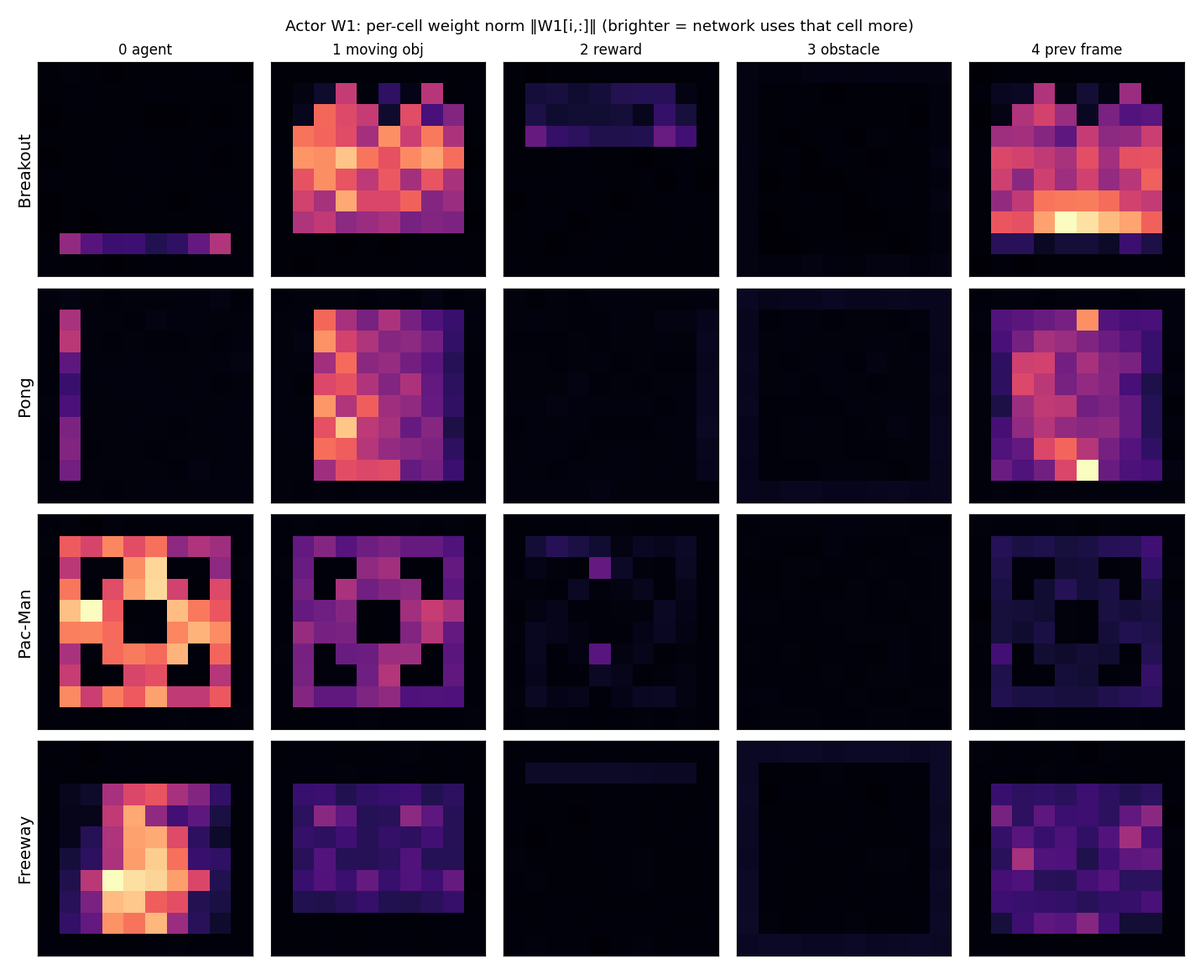
So how can Astra read neural network weights? A thread 🧵
Weights of a deep NN are famously opaque, with one exception: the first and last layers, which map to known inputs and outputs. Is that what Astra is reading?
Post by @rikiyatakehi et al: https://t.co/JKjY2S5KZ1 [1/10]