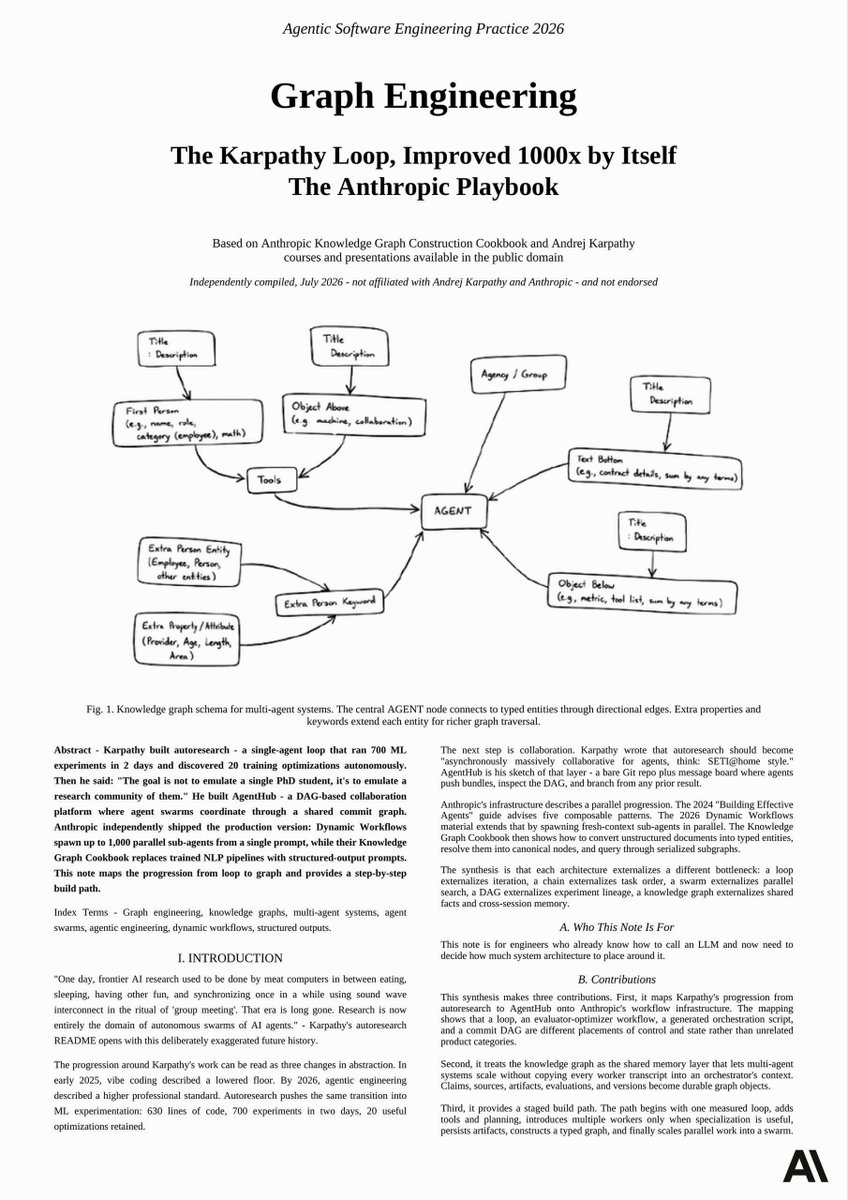
Two Anthropic seniors just made Karpathy's loop 1000x better with "Graph Engineering" - dropped 11-page PDF
the shift: the agentic systems got 1000x better the moment you wired agents into a graph
here's the playbook in 6 steps:
step 1 → build one loop: generate, critique, revise - one self-review cycle beats a smarter model with none
step 2 → add tools: search, code execution, database - thinking without tools is hallucinating
step 3 → go parallel: spin up agents in separate worktrees - same repo, different branches, no conflicts
step 4 → add a graph: agents write findings as typed nodes and edges - not transcripts - every claim keeps its source
step 5 → ground your evaluator: it checks claims against graph edges, not vibes - "Triple not found" beats "seems off"
step 6 → the graph survives every session - your agents stop rebuilding context from scratch
the result: Karpathy ran 1 agent in 1 direction - this system runs 1,000 with shared memory - same model, it's the architecture
read this 11-page PDF and paste it into your Claude - you won't regret it
bookmark - then read the article on building graphs from scratch ↓
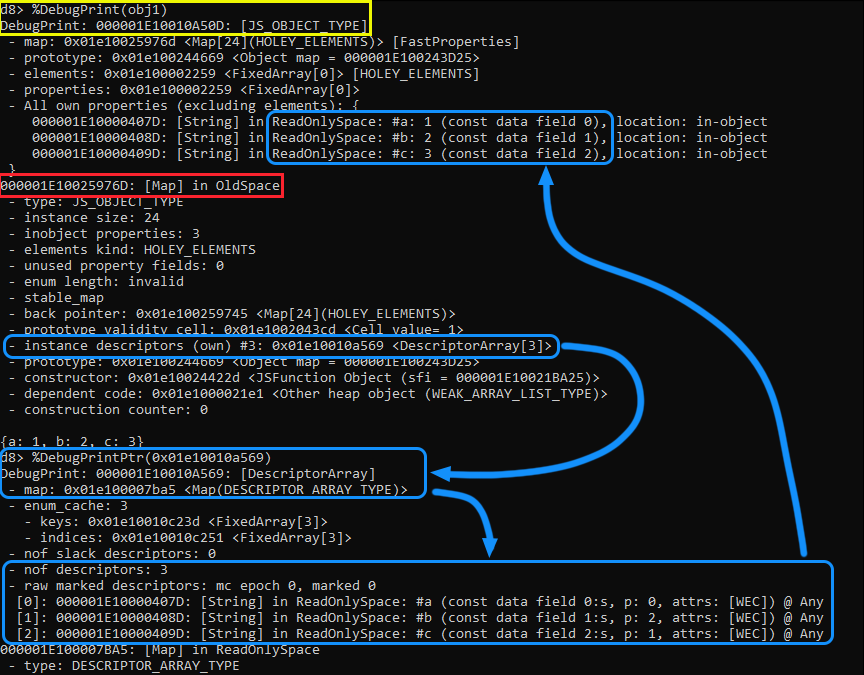
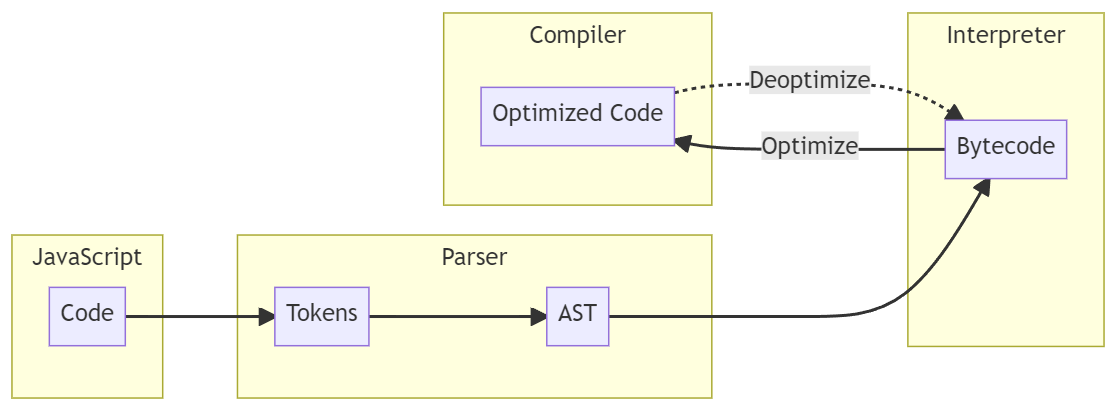
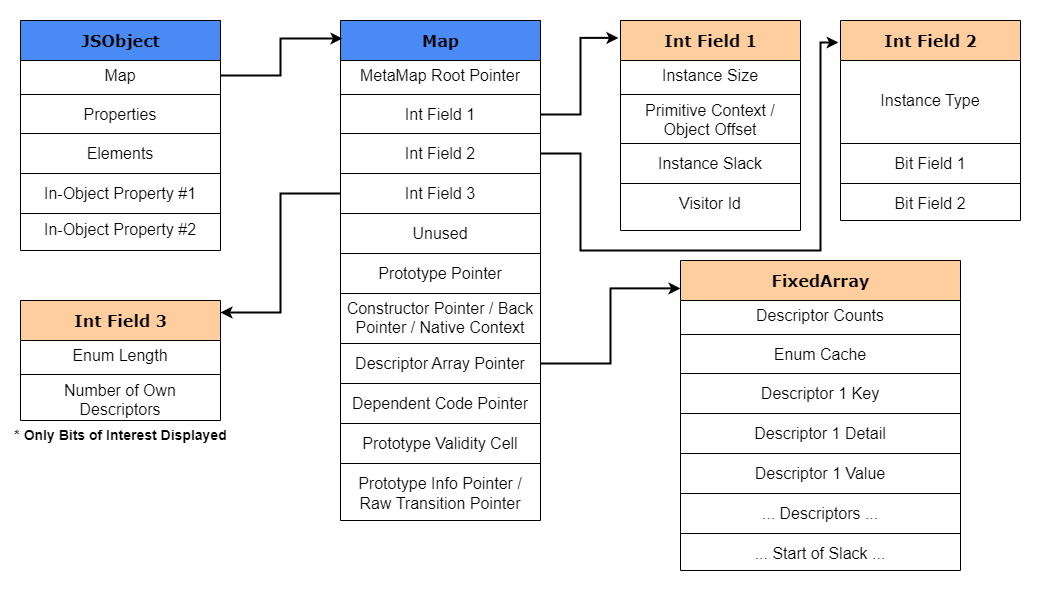
🌏 Browser Exploitation 101: A Series of Blog posts for anyone interested in Chrome Browser Exploitation.
Part 1: https://t.co/2MyvKCeU3k
Part 2: https://t.co/ouhLfrY74O
Part 3: https://t.co/hAsE5UIpDZ
author: @jack_halon#infosec
THE CO-FOUNDER OF GITHUB GAVE A 46-MINUTE TALK ON GIT BECAUSE ENGINEERS WITH 10 YEARS IN HAVE NEVER SEEN HALF OF WHAT IT DOES
This is Scott Chacon. He wrote Pro Git -- the book most devs secretly learned Git from and he co-founded GitHub. So when he says you're missing things, you're missing things.
About ten minutes in it clicks: half the "git disasters" you've ever fixed by deleting the folder and re-cloning had a one-line solution sitting in the tool the whole time.
Git ships new code almost every day -> roughly nine commits a day for over a decade. Most of us stopped learning it the second we memorized add, commit, push.
Knowing Git isn't a senior-dev flex anymore -> it's the floor. The agent writes the code now. Your real job is reading, branching, and untangling the history it leaves behind.
The day an AI agent force-pushes over your main branch, these 46 minutes are the difference between a quiet fix and a very loud apology.
Save it now.
You'll reach for it sooner than you'd like ↓
Binary hacking is something of an art, and AI has been getting significantly better at it. But do the limitations of our foundational tools, like decompilers, limit their ability to hack? Check out my talk that is now public on the topic:
https://t.co/m1RGrkFTKM
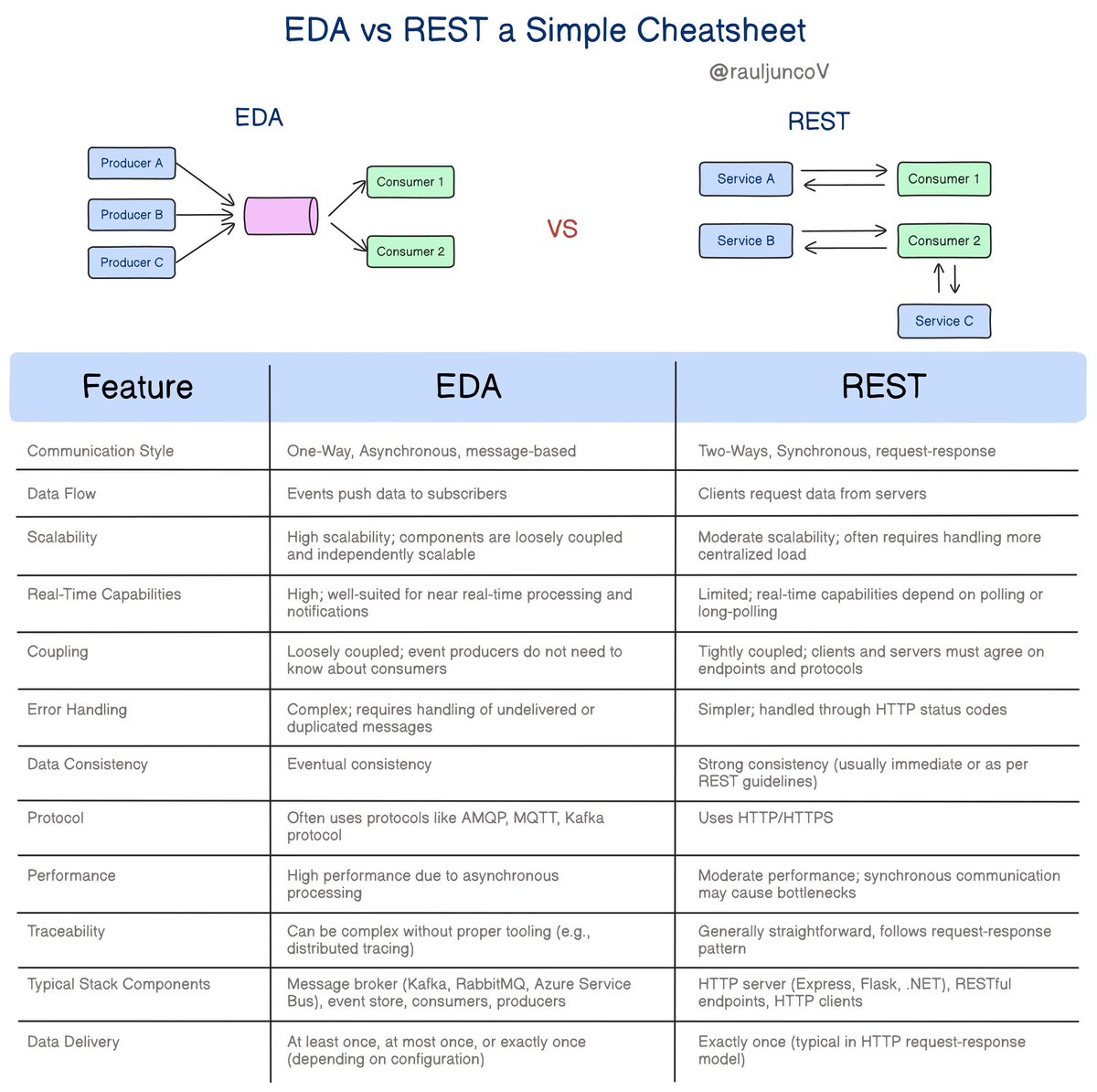
Choosing the right architecture will make or break your systems.
EDA vs. REST a Simple Cheatsheet.
𝗘𝘃𝗲𝗻𝘁-𝗗𝗿𝗶𝘃𝗲𝗻 𝗔𝗿𝗰𝗵𝗶𝘁𝗲𝗰𝘁𝘂𝗿𝗲 (𝗘𝗗𝗔)
EDA uses asynchronous communication, where components interact by emitting and consuming events.
This design is particularly effective for systems that demand high scalability, real-time responsiveness, and loose coupling among services.
𝗥𝗲𝗽𝗿𝗲𝘀𝗲𝗻𝘁𝗮𝘁𝗶𝗼𝗻𝗮𝗹 𝗦𝘁𝗮𝘁𝗲 𝗧𝗿𝗮𝗻��𝗳𝗲𝗿 (𝗥𝗘𝗦𝗧)
It is a popular choice for building web services that require synchronous, request-response communication over HTTP.
It's ideal for applications where strong consistency, simplicity, and standard CRUD operations are necessary.
However, REST can face challenges in scenarios requiring near real-time communication or scaling dynamically.
Even more important, these architectures are not mutually exclusive.
Many modern systems benefit from a hybrid approach,
Choose wisely!
I pointed claude opus at chrome and told it to build a full v8 exploit for discord.
A week of back-and-forth pulling it out of dead ends. 2.3B tokens. $2,283 in API costs, and it popped a shell.
https://t.co/vwj9d33Bvq
35 practical thoughts on system design
Core Principles
1. Every system is a trade-off -> you never get speed, cost, and simplicity all at once.
2. Latency compounds -> every millisecond added across layers adds up to user pain.
3. Scalability ≠ performance -> one handles growth, the other handles speed.
4. Read vs. write paths -> scaling each requires completely different strategies.
5. Design for change, not perfection -> requirements will shift.
Databases & Storage
6. Indexes are levers -> high-selectivity columns are worth indexing, low ones often aren’t.
7. Replication helps reads, partitioning helps writes -> don’t confuse the two.
8. Dual writes are a lie -> without coordination, you will see drift.
9. Event stores > queues (sometimes) -> better traceability, worse simplicity.
10. Cache invalidation is still the hardest problem -> freshness vs. performance is the eternal fight.
Reliability & Consistency
11. Idempotency saves you -> retries without it will hurt.
12. Fail fast, fail loud -> silent failures sink systems.
13. Eventual consistency is a feature -> not a bug, but only if the business allows it.
14. Conflict resolution in active-active is business logic, not infra.
15. Durability isn’t free -> syncing across regions has cost and latency.
Architecture Patterns
16. Microservices are an org structure, not a tech goal.
17. Monolith first, modular second, microservices last -> don’t jump too early.
18. Choreography scales, orchestration simplifies -> pick based on team maturity.
19. Serverless buys you focus, costs you control.
20. Queues don’t remove work, they smooth it.
Observability & Operations
21. Tracing > logging -> logs tell you “what”, traces tell you “why”.
22. Metrics rot without ownership -> measure what someone actually uses.
23. Retries without backoff = DDoS on yourself.
24. Dead-letter queues aren’t optional -> every system has poison messages.
25. Levers > knobs -> design quick kill switches and controls to contain blast radius.
Performance & Cost
26. Optimize the hot path, not the cold path.
27. Most bottlenecks live in the database, not the code.
28. Horizontal scaling beats vertical scaling ->until coordination kills it.
29. Warm caches mask bad queries -> measure against cold starts too.
30. The cheapest resource is disk, the most expensive is time.
People & Process
31. The best architecture dies without documentation.
32. System design reviews aren’t about diagrams, they’re about trade-offs.
33. Small PRs are for speed, big PRs are for context -> balance both.
34. A senior engineer’s role in design is asking the uncomfortable “what if”.
35. No design survives first contact with production -> but good ones bend instead of break.
What else?
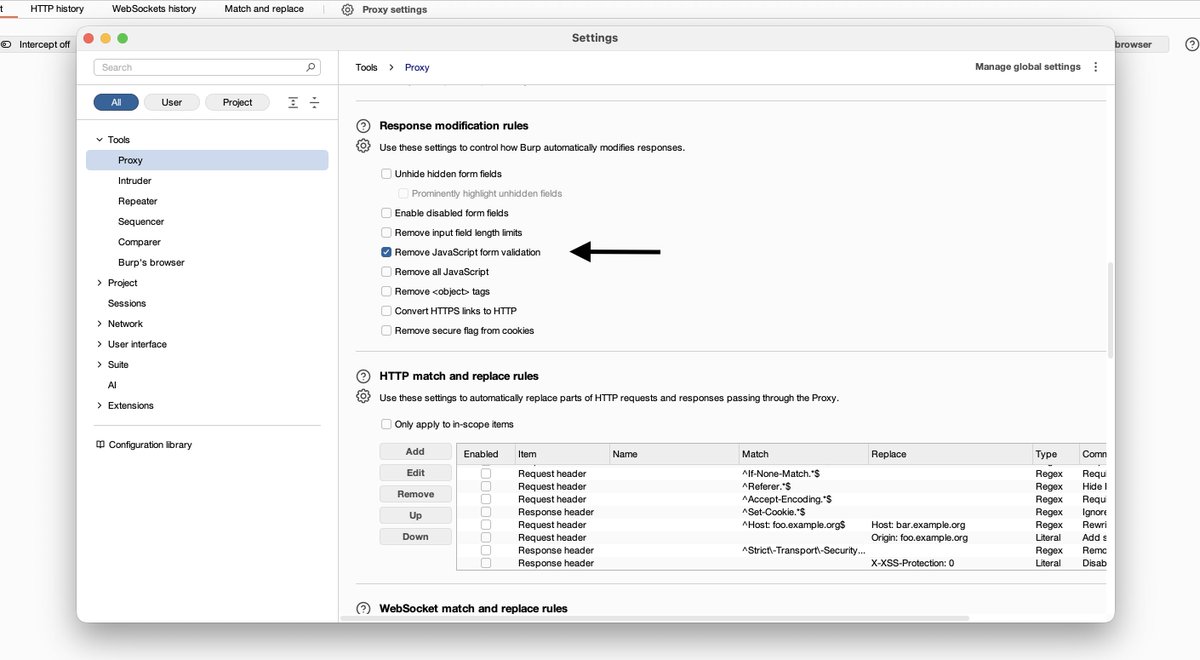
Most hackers limit themselves to only using proxy interceptor, repeater, and intruder... 🤠
But these 8 unpopular Burp Suite features can save you hours of testing time (and find you more vulnerabilities)! 🤑
A thread! 🧵👇
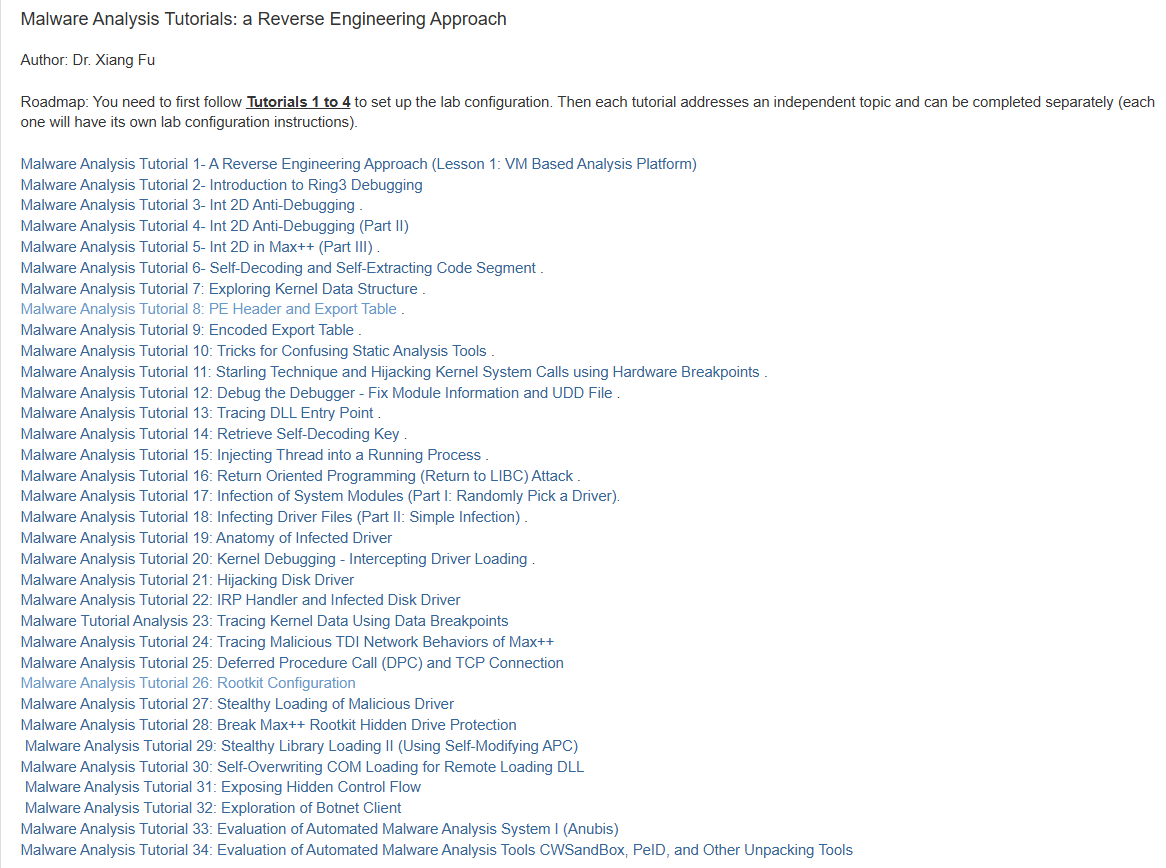
#reversing#Kernel_Security#Sec_code_review
Exploiting Reversing (ER) series:
Part 1 - Windows kernel drivers (1) https://t.co/MoAXZ7pHJK
Part 2 - Windows kernel drivers (2) https://t.co/IqZr2h1fuz
Part 3 - Chrome https://t.co/7fsTWqsEmw
Part 4 - macOS/iOS https://t.co/W7VBr9luVF
Part 5 - Hyper-V https://t.co/6LzkwbSrNZ
// step-by-step research series on Windows, macOS, hypervisors and browsers
Most DevOps engineers focus on automation.
But,
DevOps today is much more than CI/CD pipelines.
It is also about understanding how systems actually work and how to design them to survive failures.
In that context,
One concept that every DevOps engineer should know is the Write-Ahead Log (WAL).
We recently shared a short post explaining how WAL works, with simple real-world examples.
👉 𝗥𝗲𝗮𝗱 𝗶𝘁 𝗛𝗲𝗿𝗲: https://t.co/17AjRjHfqO
If you want to see how large-scale systems apply this concept in the real world, Netflix’s data platform is a great example.
They have built their resilient data platform around the WAL principle for data durability even in case of failures.
14000+ DevOps engineers read our Devops newsletter.
We send deep dives, practical tips, and guides straight to your inbox.
Architecture Source: Netflix Tech blog (added in blog)
#devops