@CountBinface@jondharvey Britain needs liberal leadership that is serious without pomposity, European without nostalgia, green without asceticism, patriotic without nationalism, and funny enough to make populism seem tedious.
Perhaps it is time to take the bin off.
Fraudsters have always followed attention.
As more people use AI assistants to discover products and services, scams are starting to appear in AI-generated recommendations too.
The technology is changing. The underlying problem isn't.
Source - https://t.co/FdRwJCsCWO
The European Commission has ordered Meta to restore access to WhatsApp for 3rd party AI while it investigates whether restricting access unfairly favours Meta AI.
The debate is no longer just about who builds the best AI, but who controls the channels. https://t.co/DoMFBwOtvn
Most companies treat AI like a race car.
They spend months talking about the engine.
Then wonder why they can't get around the track.
The problem is usually somewhere else: the steering, the brakes, or the driver.
Technology rarely fails first. Organisations do.
AI is changing consulting way faster than anyone saw coming.
Clients are starting to ask if they really need giant teams and endless timelines when AI can handle research so quickly. That puts real pressure on firms built around scale and manpower. https://t.co/DiW5kSDcSn
Banks are learning that with AI, their weaknesses show up fast.
Regulators are now pushing financial institutions to strengthen oversight, resilience, and security as AI becomes more deeply embedded into banking systems. https://t.co/WGaZs4AuPa
AI can save time, but there's a fine line between using it as a tool and relying on it too much. The challenge is making sure we still practise critical thinking and problem-solving ourselves. Otherwise, convenience can quietly turn into dependency. https://t.co/sOpQSVsgbN
AI adoption is zooming ahead of accountability. That gap is starting to cause real headaches for leadership and governance, especially as these systems dig deeper into healthcare, finance, and critical infrastructure: https://t.co/mNciBdz3tu
A lot of AI conversations still feel disconnected from everyday human problems.
This partnership stood out because it’s putting serious money into AI for healthcare and education instead of another productivity race. Where we choose to apply AI matters more than the hype.
One thing is pretty obvious: AI is advancing much faster than the systems meant to manage it.
The International AI Safety Report 2026 highlights how oversight and risk management are still struggling to keep pace as AI spreads into more parts of society. https://t.co/KjhYYrXYfU
When even the Vatican is warning about AI, you know this conversation is getting bigger than technology. AI will keep moving fast, but I think the real question is whether people still feel valued and included in the systems being built around it. https://t.co/81rCARdU7D
The future of work is arriving much faster than most people expected.
The fastest-growing roles are tied to AI, data, cybersecurity, and digital infrastructure, while repetitive jobs continue to decline. Adaptability and continuous learning are becoming more valuable every year.
Every company seems to have an AI strategy now.
But AI exposes weak systems, poor data, and unclear ownership much faster than most leaders expect. Real AI value depends as much on organisational readiness as the technology itself.
Read more: https://t.co/VX5iEAv5kG
Education is finally moving past “just ban AI��.
Now, it’s more about teaching people how to use it thoughtfully. AI literacy means knowing how to judge, think critically, and actually work alongside these tools responsibly. https://t.co/zlKrpRlWkn
A Reuters Institute piece makes an interesting point: while many people focus on the risks, AI is also changing how information gets discovered and shared in ways that create new opportunities for publishers and creators: https://t.co/hQnlQ9SlNn
Business schools are catching on to something workplaces are still trying to figure out on the fly: how to actually work alongside AI, not just use it as another tool. The real edge comes from knowing when human judgment matters most. https://t.co/wINPxmsyJ3
Business schools are under pressure to move faster on AI, but many still struggle with one basic question: what should students actually learn now? AI is moving so quickly that schools risk teaching outdated ways of working before students even graduate. https://t.co/GPuC3sY6bo
AI sovereignty is becoming a bigger issue. Countries are starting to realise AI is not only about models, but it's also about who controls the infrastructure, chips, and data behind them. Speed matters, but dependence does too. https://t.co/NPk181V4OA
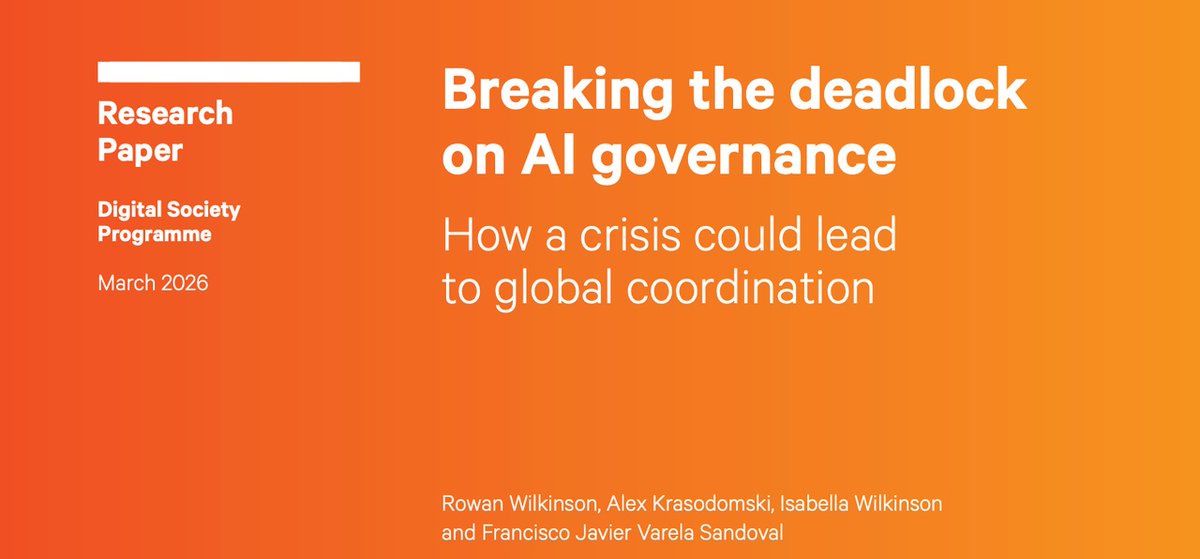
The Chatham House report argues that global AI governance is stuck because countries approach the issue from completely different priorities, from security and competition to regulation and control: https://t.co/76kvuuJI25
Most AI plans are being rushed before they are ready. Boards want speed, CEOs want proof, and you often sit in the middle trying to make both work. A recent survey shows 61% of CEOs feel pressure from boards to move faster on AI. https://t.co/XdxSILOEYv