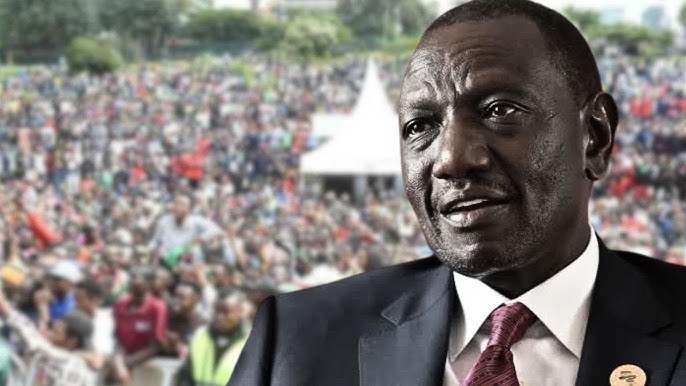
That Ruto is cornered is no longer something to dismiss, because the political mood, the anger on the ground and the fractures around him are becoming harder to ignore.
“Ruto Must Go” can win an election, but it cannot run a country, and the opposition must now start telling Kenyans what happens after the celebrations are over.
Start with the national debt. Which loans will they honour, which ones will they audit, what happens to odious or questionable debt, and how exactly will they stop Kenya from borrowing simply to repay previous borrowing?
Then tell us what happens to this bloated government structure where almost every problem has somehow produced an authority, agency, board, council, commission, fund, secretariat, director general, board chairman, CEO, offices, vehicles and allowances.
Why, for example, does Kenya need a whole Kenya Water Towers Agency with its own board and administration to coordinate conservation of water towers instead of placing that work directly inside the responsible ministry alongside the existing forestry, water and environmental departments?
The government itself has admitted that some State corporations have overlapping or duplicated mandates and has been trying to merge or restructure them, which tells you the problem is not imaginary.
How many water agencies does one country need before water actually reaches people's taps, when we already have the Ministry of Water, Water Works Development Agencies, the National Water Harvesting and Storage Authority, Water Resources Authority and other institutions funded from the same taxpayer?
How many agricultural boards, authorities and corporations do we need before farmers receive affordable fertiliser, functioning markets and reasonable prices for what they produce?
How many youth funds, women funds, enterprise funds and empowerment programmes must exist separately, each carrying administrators and operational costs, instead of creating one properly managed financing institution with measurable results?
Why do functions that could comfortably sit as departments inside ministries repeatedly become standalone State corporations requiring CEOs, boards, procurement departments, HR departments, finance departments, legal departments and expensive headquarters?
The opposition must tell us which State corporations it will abolish, which ones it will merge, which boards disappear on day one and how much money those changes will actually save taxpayers.
Tell us what happens to SHA and whether healthcare will continue being built around deductions, unexplained private technology companies and layers of agencies before money finally reaches the hospital treating the patient.
Tell us what happens to the housing levy, and whether government should really be collecting money from every worker, building houses, identifying beneficiaries, financing mortgages and competing with private developers at the same time.
Tell us what happens to university funding, HELB, school capitation and the endless experiments that leave parents discovering new education policies after schools have already opened.
Tell us what happens to county financing and whether governors will continue travelling to Nairobi every few months begging Treasury to release money that Parliament already allocated to counties.
Tell us what happens to corruption cases, because Kenyans do not need another government that arrives with its own thieves, protects them for five years and suddenly discovers corruption when somebody falls out politically.
Tell us what happens to procurement. Will every tender, beneficial owner, contract variation and final payment become publicly searchable, or will we continue pretending transparency exists when more than half of government contractors can remain hidden behind companies?
Tell us what happens to the police. Will the next president still call commanders when he wants opponents arrested, or will Kenya finally build a police service where an officer fears the law more than he fears State House?
Tell us what happens to the DCI, ODPP, EACC, intelligence services and other institutions that become extremely energetic when powerful people have private problems but suddenly develop weak knees when politically connected goons, killers and thieves are involved.
Tell us what happens to State House spending, advisers, presidential delivery units, special envoys, taskforces and endless committees created whenever somebody in government wants another office.
Tell us what happens to Cabinet size, principal secretaries, CAS style positions if they return under another name, government advisers and political appointees scattered through State corporations.
Tell us whether government vehicles will still consume billions transporting officials to meetings where they discuss why government has no money.
Tell us whether every new president will continue creating offices for election losers and coalition partners instead of forcing political parties to carry the cost of their own political settlements.
Tell us what happens to taxes, because promising to reduce taxation is easy until the same politicians enter Treasury and discover they inherited a government whose recurrent expenditure they are unwilling to cut.
Tell us what happens to pending bills, because thousands of businesses have supplied government, paid VAT, borrowed money to perform contracts and then waited years for the State to pay them.
Tell us what happens to electricity costs, fuel taxes, manufacturing, agriculture and small businesses, because Kenya cannot tax itself into prosperity and then wonder why investors move production elsewhere.
And most importantly, tell us what happens to the structure of political power itself.
If all the opposition is offering is another president controlling Parliament, influencing prosecutors, intimidating independent institutions, appointing friends everywhere and borrowing billions with no consequences, then we are simply preparing the next “Must Go” movement.
Ruto going is now a reality.
But Kenya cannot spend the next year discussing who takes the cake without asking why the cake is this expensive, why so many people are eating from it and why ordinary Kenyans are always the ones paying for it.
Big blow to Prime Cabinet Secretary Musalia Mudavadi as Co-op, KCB and NCBA bosses secure court orders stopping their prosecution in the Sh363 million First Assurance saga.
Mudavadi and fellow shareholders had given the banks a 24-hour deadline to commit to refunding money prosecutors say was stolen from First Assurance by his business partner Salim Busaidy over a six-year period.
The banks refused to pay, questioning how money could allegedly be stolen by a company insider for six years, only for the banks to later be blamed and pressured to refund the entire amount.
State investigative and prosecution agencies under pressure from Mudavadi then moved against the CEOs after the CEOs refused to “cooperate”
The senator of Kwale Issa Juma Boy urges the people to vote for Ruto because he paid for his child's school fees in Dubai.
This is the level of MADNESS that we're seeing from these useless SYCOPHANTS of this killer regime!
So who will pay for the school fees of the common mwanainchi's son in Kwale and other places in the country!
What level of STUPIDITY is this are we seeing from leaders who have decided to use their stomachs instead of their brains!
SHAMEFUL!
Protect Dangote with his investments at all costs. Kenya must move forward. Kenyans are poorer because they are consuming more than they can manufacture. Kenya needs more factories, more industries and more production, not court orders.
A website called Kenya Debt Clock is going viral for showing just how much Kenyan taxpayers owe lenders. What has shocked many people even more is the rate at which the kenyan debt is growing. Meanwhile, the same money continues to be splashed on donations across Kenya by politicians!
Francis Atwoli, the only man in the world throughout history, who has become a billionaire while pretending to be a trade unionist “representing” workers earning Kshs 15,000.00 per month, is wailing that only people who have looted billions of shillings, like him, should vie for the position of president in Kenya.
What kind of disease is this in your mother tongue?
Nobody can pull out a gun or guns in this great nation, attack a group of politicians, kill a driver, spray their vehicles with bullets, stone other vehicles, and more without the police shooting them on the spot—unless they have explicit protection from the government.
Just try pulling out a gun today and see if you won't be shot within the next minute, arrested, or traced back to the most remote village. You probably won't make it past the next day.
So, anything you see out there is the handiwork of the regime.
Kenyan politicians creating goons today are playing with a fire they may never be able to put out, since the country that quietly accepted brutal cleanups after 2007 no longer exists.
Back then, Mungiki was useful during political violence, then John Michuki’s security machinery moved against its members through arrests, disappearances and killings that many Kenyans questioned only after bodies had already appeared in forests and mortuaries.
The ICC cases later showed how political violence can return to haunt its planners, since witnesses, phone records, meetings, transport arrangements and money trails can carry politicians from campaign rallies into international courtrooms.
Today, Kenyans record everything, question every death, trace every vehicle, follow every mobile money trail and demand names, meaning politicians cannot recruit goons now and expect the State to quietly eliminate them later.
Once these gangs become organised, armed, funded and protected, they will not simply disappear when elections end, and any attempt to kill them after using them would create public outrage, evidence trails and fresh international attention.
The real danger is that politicians think they are hiring temporary muscle, yet they may be creating permanent criminal groups that will demand money, territory and protection long after their political usefulness has ended.
Anyone building goon squads today should study Mungiki, Michuki, the 2007 killings and the ICC files, since using violent groups is always easier than removing them without exposing everyone who created them.
Goons will become gangs.
Gangs will become rebel armies controlling regions of Kenya.
We should urgently remove politics from national security or else there will be no place to run.
The reason why Ruto has been quiet on matters goons is because it is his own project. This is what he did in 2007 and ICC charges against him stated so and now he is doing it to the opposing voices against his rogue regime.
Kenyans have the right to protect themselves because govt will not do it!
#RutoMustFall
The CS for Interior should be an old man, preferably a retired general who has no political ambitions. That position is very critical to our security and we are seeing the effects.
The World Bank has delayed Kenya’s Sh78 billion emergency loan after suddenly discovering that the government has no detailed plan explaining how the money will be spent.
Were there detailed spending plans for all the previous billions the World Bank approved, or has accountability only become fashionable after Kenya had already borrowed itself into a hole?
The World Bank cannot spend years financing a government whose appetite for loans is larger than its ability to explain expenditure, then act shocked when another request arrives without a proper plan.
A Sudanese court has sentenced Rapid Support Forces (RSF) commander Mohamed Hamdan Dagalo, widely known as Hemedti and 15 others , to death in absentia after finding them guilty of crimes linked to violence in West Darfur, including the killing of the state's former governor, Khamis Abdallah Abakar.