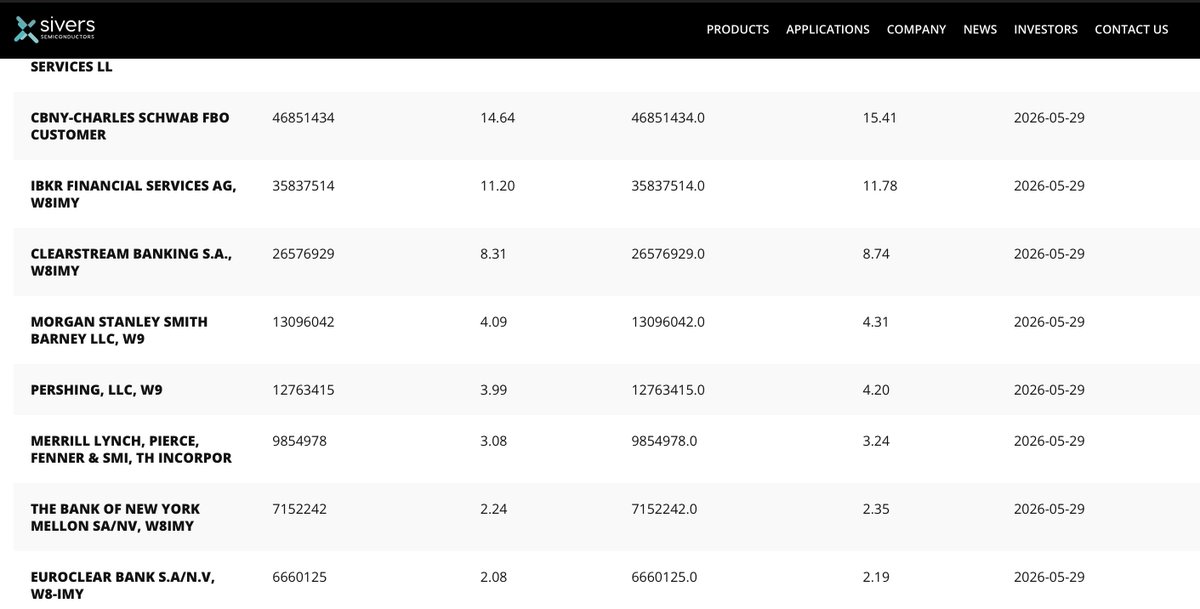
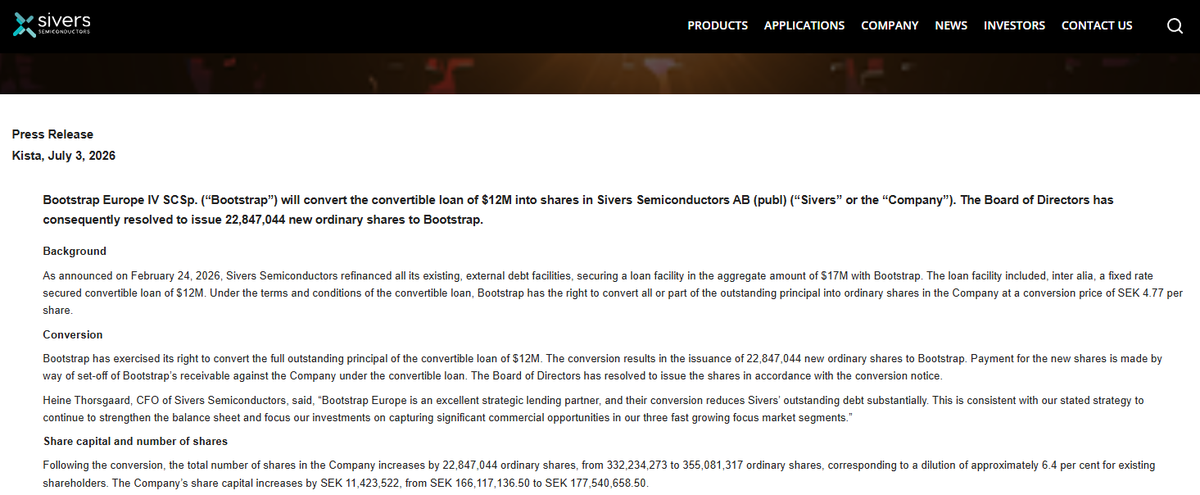
Three new $SIVE insider purchases today.
Most notably: $SIVEF CEO Vikram bought 1,000,000 SEK worth of shares on the open market today.
This is following the massive drop on Sivers stock following 2 misleading CPO delay reports, Meta Compute headlines, and another insider sale report from another photonics director.
Typically, insider sells for any number of reasons. But having the CEO buy on the open-market is the clearest signal in management confidence.
Following $GFS, $JBL, and other laser supplier partnerships, and his goal of NASDAQ listing in the near term.
Feels like the CEO sees a clear potential for Sivers to become the next photonics giant (myself included).
$SIVE - The only reason they are recommending it is that they want to buy into these stocks themselves at a lower price and then issue another buy recommendation shortly after.
They didn't buy $SIVE for no reason.
Institutions are not your friends!
$SIVE is raising ~$61M (600M SEK) to expand manufacturing capacity for InP lasers and optical amplifiers.
Sivers operates as a fab-lite model so this is likely hinting at foundry allocation/scaling for CW DFB laser ramp across Jabil, and their other partners.
It could also point to broader foundry allocation/scaling beyond the already announced WIN partnership.
My feedback is that it's very bullish if it's comprised of long-only institutions and there's no heavy discount (30 day VWAP). Otherwise, would need to reaccess if there's arb or short term investors.
This is the perfect time to get ideal strategic investors like $GFS on the cap table. As well as focusing on having more US institutional support.
Especially considering $56M is a small check to a single US institution that want photonics exposure (eg. look at Poet's $400M registered direct offering for sentiment).
A lot of it is "it depends when more info comes out", but this looks like a very positive signal for mass production given Siver's fab-lite models.
That’s a misconception:
$SIVE is the laser supplier for next gen architectures, not just CPO scale up.
Pluggable, scale out CPO, scale up CPO, NPO, etc.
- Sivers and $JBL went god-mode and developed 1.6T optical transceivers with CW lasers.
Effectively designing around the EML bottlenecks, and even made things more power efficient.
From quotes from Jabil management they created a “relatively dramatic moat”.
So for the next gen of 1.6T pluggable transceivers, Sivers seems immediately used.
Markets missed this nuance too: after Jabil’s announcement, other pluggable players reached out, and SIVE is working with them now (prob codevelopment, qualification stage).
There’s not too many players that build optical transceivers that aren’t vertically integrated like Lumentum (think: Innolight/eoptolink, and maybe others).
So these are active developments, just not public material yet and could be a new press release anytime.
- for CPO scale out which happens H2 2026 onward like $POET, $SIVE is a laser supplier for those players.
- scale up CPO is h2 2027, from Ayar and Nvidia’a NVLink CPO ecosystem and that’s the main volume ramp across optical players.
But this is where $SIVE looks like they mog every other player from supply chain mapping.
Since they’ve likely been working + designed in with $MRVL Celestial, Lightmatter, Lightelligence and the others since they were small way back when.
On top of things like this:
For foundries like $GFS, $SIVE is the reference laser.
Not even including massive companies like O-Net building ELS with $SIVE, likely for the Asian hyperscalers supply chains.
This is why $SIVE is by far my favorite laser chokepoint long.
Feels like they’re everywhere in new optical architectures starting beginning of 2027.
$SIVE $AMD - The industry is hit by a massive squeeze on CW Lasers.
Recent supply chain tracking from TrendForce shows that $AMD is quietly scrambling to lock in massive purchase orders for these lasers.
Their goal is obvious is to secure their own independent supply line before $NVDA locks down the entire market and chokes out $AMD next-o-Packaged Optics (CPO) roadmap.
The big problem?
Giants like $LITE and $COHR are basically booked solid through 2028.
This supply crunch turns $SIVE into a massive tactical play.
Connecting the dots between $AMD and $SIVE isn't just wishful thinking; looking at the infrastructure, it’s practically inevitable.
$SIVE recently locked in a deep collaboration with $GFS, embedding their laser arrays directly into GF’s SCALE CPO framework.
$AMD has a long, deeply rooted history of relying on $GFS for its silicon photonics manufacturing.
If $AMD builds its optical chips through GF, they are essentially forced to use $SIVE as their reference light source. The partnership is already written into the silicon.
$SIVE is also the exclusive hardware engine behind Ayar Labs' SuperNova light sources. $AMD is a founding heavy-hitter in the Optical Compute Interconnect (OCI) consortium, an ecosystem heavily reliant on Ayar’s architecture.
This means $AMD long-term hardware pipeline is already designed to plug right into $SIVE's physical lasers.
Look at $AMD recent acquisition of CPO pioneer Enosemi.
Enosemi’s designs require incredibly precise, external laser sources to actually move data. Since $SIVE has clear, unconstrained manufacturing capacity through its relationship with WIN Semiconductors, it stands out as one of the only global players capable of handling $AMD massive production scaling.
On the corporate side, $SIVE is actively restructuring its books to PCAOB standards to prepare for a major dual-listing on the Nasdaq in New York. You don't launch a major US IPO without a massive PR catalyst. Sealing an official supply agreement with a trillion-dollar hyper-scaler like $AMD would be the ultimate validator for their US market debut.
Five key points
>TSMC has not stumbled in Co-Packaged Optics CPO and has already entered mass production
In cooperation with Broadcom it has shipped over fifty thousand Tomahawk 5 Bailly switches
> Meta reliability study covers more than one million 400G port device hours with zero link failures
> Broadcom third-generation Davisson 1024Tbps was launched in October 2025 using TSMC COUPE process
> NVIDIA Quantum X Photonics will enter mass production in early 2026
> Spectrum X CPO follows in second half of 2026 both based on TSMC technology
Although Intel EMIB has advantages in yield and thermal management with long-term silicon photonics investment
It remains at demonstration stage with no customer shipments yet
—
Three conclusions
> TSMC has successfully crossed the CPO production threshold
Ecosystem partners such as Broadcom and NVIDIA are jointly advancing the industry
> Technical superiority does not guarantee market dominance
Semiconductor history has many cases of excellent architectures that ultimately failed
> Intel may capture 15 to 25 percent share in the CPO field
But 90 percent forecasts are overly optimistic and require the entire supply chain to fail simultaneously
—
> > > TSMC has never hyped itself aggressively
But always delivers on schedule with yields on schedule
Therefore Tier-1 customers in the market all use TSMC chips
—
Additional point on process leadership
TSMC now maintains at least one full generation lead in mass production processes compared to Intel
A new tech node must undergo extensive IP verification and library development before design houses can use it reliably
This makes mature verified and volume-produced nodes extremely valuable for the most advanced products
They ensure design houses achieve expected performance without unexpected bugs or stability issues
If a foundry delays wafer delivery the design house risks handing its hard-won time-to-market advantage directly to competitors
—
Real-world example
Intel struggled for years with its 10nm process delays which dragged on from planned volume production in 2016-2017 until full ramp in 2019
This allowed AMD to fully switch to TSMC 7nm and launch competitive Ryzen and EPYC products years ahead gaining massive market share in CPUs while Intel lost ground in data centers and client PCs during that period
$TSM
BREAKING: President Trump says the Trump Administration might buy equity stakes in US AI companies and that he will host a meeting with AI executives as soon as next week, per Reuters.
Okay... just some more weekend shower thoughts about $XFAB.
I still feel like it could be the next $TSEM, just early stage at a $1.4B MC?
They kinda leapfrogged current gens (which $TSEM are getting volume from) to compete for H2 2027 CPO scale up inflection point ($ASX docs cite Xfab (aka. photonixFAB) as focusing on CPO)
By building out some black magic MTP (transfer printing) architecture for lasers w/ other stuff like TFLN.
Basically next-gen integration IP, they're still behind on yields, sure.
But $NVDA evaluating it for transceivers/switches to see if it can volume ramp. That $NOK sets the specifications/assembly for. (nvidia invested in nokia for this these switches/networking too btw).
And if their MTP supply chain works... (eg. with Smartphotonics providing lasers, EU players doing assembly).
It basically volume ramps with $NVDA just like why Nvidia signed long term agreements with $TSEM?
Downside risk?
Already below replacement book value, can always go lower yeah, but typically to a certain point.
Maybe more CHIPS act subsidies next few months from chips act 2. If it doesn't go well there's SiC (152% Y/Y Growth, 195% Y/Y SiC wafer shipment growth)/GaN power semi upside.
Europeans /LLMs will say "oh evaluations doesn't mean it's a future contract!".
This is kinda different since the European Union is behind this effort and $XFAB for soverign photonic supply chains.
Not your typical company + hyperscaler evaluation, since $NVDA wants to be nice to Europe's regulators. They'd prob be pissed if nvidia just stayed in US/Taiwan/China.
So if they can make this MTP black magic work with mass production, feels almost for sure nvidia/nokia volume ramp on some tiny $1.4B silicon photonics foundry or at least throw them a bone with smaller contracts.
In terms of timelines, maybe just a months early since it volume ramps H2 2027/H1 2028 (which happens to be in line with CPO scale up timelines)...
Or just unknown because they named their project something stupid like photonixfab?
Like XFAB Photonics would have been better? so institutions/screeners can connect the dots when looking at CPO silicon photonic foundry players?
Automotive should also coming out of a slump medium term, sped up by self-driving (TSM Chairmain comments yesterday said ai automotive was TSM's growth vector alongside robotics). So their core business also should pick up speed too medium term.
Obviously markets/europeans want a "Nvidia signs $2B+ contract, XFab volume ramping 2027!"
But by then it will be a $9B+ company and you miss out on all the upside. And especially since everyone analyst/institution is blind to volume expectations for these....
Normally don't invest in companies in evaluation stages, but this just seems very de-risked by EU sovereignty + Gov backing, and you have Nvidia + Nokia there for volumes if they can make the IP work.
I think markets are probably missing something here... there's almost 0 value being assigned to being CPO exposure in Europe as their long term upside.
It's called hand steepling (or finger pyramid). Body language experts describe it as a confident, authoritative pose signaling thoughtfulness and control—common among leaders, CEOs, and speakers during serious talks.
The triangular shape fuels online theories linking it to Illuminati, Freemasons, or "elite" symbolism. That's pattern-seeking in photos of powerful people; no evidence supports any secret meaning. It's just a natural, comfortable gesture.
JP Morgan 5% threshold FI flagging notice for $SIVE.
Has anyone identified the holder behind this filing?
Could be:
• Institution
• Family office
• High-net-worth/private investor/retial
Before jumping to conclusions, it's worth understanding who actually triggered the flag.
Anyone looked through the details yet?
#SIVE
https://t.co/HLVuuT68zi
Hej Sven synd att du inte fårr svar. Skall försöka summera några saker som jag ser som helt nytt.
1. Sivers is being integrated directly into GF's SCALE platform. GF only introduced SCALE publicly about a month ago. Until now, GF had announced the platform itself, but not a laser partner embedded into that ecosystem. The release states that Sivers' laser arrays will be available in GF's SCALE™ (Silicon Photonics Co-packaged Advanced Light Engine) platform and reference designs. Being picked as GF reference design vs Lumentum/SmartPhontics is strong statement and validation of Sivers as Laser supplier into the AI ecosystem. That means Sivers is no longer just supplying components into the market generally; it is becoming part of GF's preferred silicon photonics architecture.
2. Expansion beyond CPO into LPO and broader optical connectivity like Pluggables with a large TAM that is closer to ramp (1.6T. Pluggables). Earlier Sivers announcements focused heavily on External Light Sources (ELS) for CPO deployments. This release explicitly says the collaboration supports: a) Co-Packaged Optics (CPO) b) Linear Pluggable Optics (LPO), c) Other emerging datacenter interconnect architectures. This broadens the addressable market materially beyond the ELS/CPO discussed previously.
3. The first full foundry-level endorsement of Sivers' laser technology. All other communications with GF had been in group of companies or partnerships with Ayar Labs, or Wireless. Now adding foundry-level endorsement to previous announcements, with system and module partners such as O-Net, Enablence and Jabil. This is different because GF is one of the world's leading silicon photonics foundries. Having GF publicly state that it is pairing Sivers laser arrays with its silicon photonics and SCALE platforms is a stronger ecosystem validation than a group of partners on list or module-level partnership.
4. A big signal that Sivers is positioning for hyperscaler qualification for Pluggables via GF like they done for Jabil. If GF succeeds in becoming one of the major SiPh platforms for 1.6T or 3.2T Pluggables, then Sivers potentially gains visibility to: NVIDIA ecosystem suppliers, Broadcom ecosystem suppliers, AMD ecosystem suppliers, hyperscaler custom-AI programs.