@penfriendrocks @lizzlipscombe @johnhackettband Oh.. and a video I'm very pleased with, quirky pop about Temptation - Lead Us Not
Literal vibes.
https://t.co/X0G0D2cTgD
Bass on this by @lelandsklar :-)
Movie set in the Cambrian period where nothing happens because it’s set on land. No animals, no plants, no trees, no sound but the lonely wind wandering over endless gravel. Occasionally the words “Ten million years later” appear on screen, but nothing changes.
The constant banging on about DEI is an infuriating American import into the UK.
In the UK we call it EDI. And EDI training is essentially summed up like this:
‘Don’t be a knob to other people, and realise some people face barriers you don’t.’
It’s not some woke conspiracy.
In Denmark, McDonalds workers make $25 an hour and, if they are over twenty, the company starts paying into a pension plan for them, and in addition they have a full 6 weeks of paid vacation.
Now how much do you think this costs customers? The Economist looked into this and found out that the Big Mac costs 76 cents less than it does here.
Don't believe the lies that raising the minimum wage would force prices to go up.
One man in California has spent 57 years recording the sounds of natural places. Much of what he's recorded no longer exists.
His name is Bernie Krause. He started as a folk musician and an early pioneer of the Moog synthesizer. In 1968, he began carrying recording equipment into rainforests, deserts, coral reefs, African savannas, and research sites associated with scientists like Jane Goodall and Dian Fossey.
The Wild Sanctuary archive now contains more than 5,000 hours of recordings and over 15,000 identified species. Krause coined the term "biophony" to describe the collective sound of living organisms in a habitat and helped establish the field of soundscape ecology.
Through thousands of recordings, he observed that healthy ecosystems often partition acoustic space, with different species occupying different frequencies and times of day. On a spectrogram, an intact habitat can resemble a densely layered musical score.
When Krause revisited many of the places he had recorded decades earlier, he found that over half had become silent, severely degraded, or so altered by human activity that their original biophonies could no longer be heard. His archive preserves sounds from ecosystems that have been transformed or lost.
A fascinating and surprisingly plausible theory is that a volcanic eruption in Iceland may have helped set the stage for the French Revolution.
The 1783 eruption of Laki released vast amounts of sulphur dioxide and other gases into the atmosphere, creating a toxic haze that spread across much of Europe.
This contributed to poor air quality, crop failures and wider agricultural disruption in some regions.
While it didn't cause the Revolution, some historians believe it added to the economic and food pressures already building in France in the years leading up to 1789.
Just wait and see what climate change is really capable of.
From 1966 to 2025 we dropped sterile flies over South America that ate screwworm and thus prevented them from spreading, but the le epic efficient cracked coders at DOGE thought this was a silly waste of the ~0 dollars it cost us.
They poisoned your water. They knew they were going to. They removed the laws that prevented it, built the zones that enabled it, and are now filling those zones with infrastructure that makes it permanent. This is not negligence. This latest thread is about who did it, how, and what they're building next
In December 2023, I posted about the charter city plans of 3 notorious libertarian figures, Peter Thiel, Erick Brimen, and Shanker Singham. Read it first. Then come back. Because everything I flagged as warning signs is now infrastructure.
The French hate air conditioning.
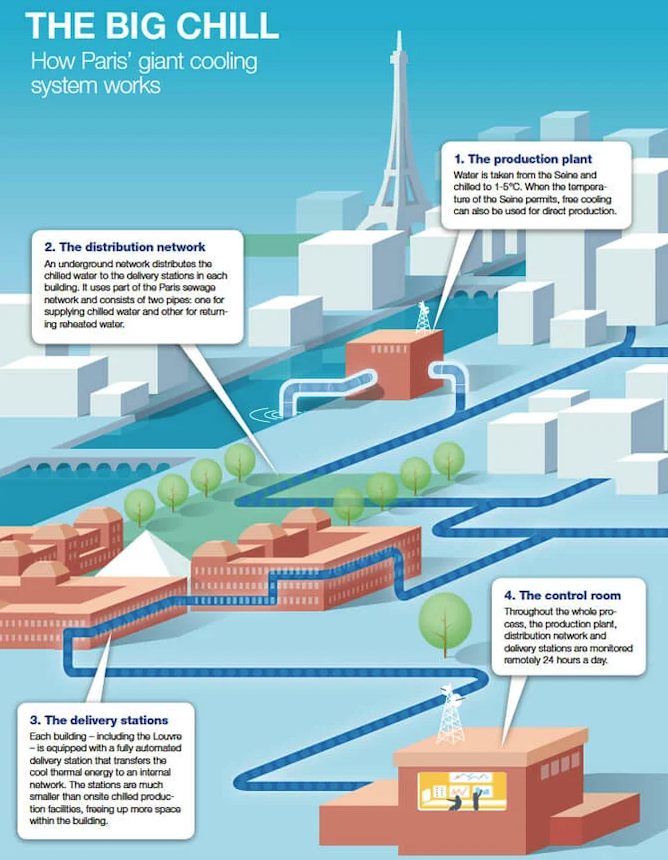
So Paris built a 120-kilometre machine under its streets for producing cold.
It’s called Fraîcheur de Paris, and it does for summer heat what district heating did for winter: centralise the problem.
Instead of every museum, office, hotel, hospital and shop bolting its own cooling plant onto the building, Paris moves cold through pipes.
The network sends water chilled to 2 to 4°C through buried supply lines. The water enters a connected building, absorbs heat through an exchange station, then returns at 12 to 14°C to be cooled again.
It essentially functions with two pipes. One carries the cold out, the other carries heat back.
The production plants cool the circuit from 12°C to 4°C. Some sites use the Seine as a heat sink. In colder periods, the system can use the river’s own temperature for free cooling, which means the machines work less and the electricity demand drops. The Seine water doesn’t become the building water. It stays separate, passing temperature across heat exchangers.
The scale is pretty strange when you see it written down though.
It's got 15 production sites, 4 storage sites, 120 km of underground network with 924 subscribers. This has resulted in 7 million square metres cooled, and 493 GWh of cooling sold.
A cold utility running beneath one of the densest cities in Europe.
The Forum des Halles has been cooled this way since 1979. The Louvre since 1986. Galeries Lafayette, Opéra Garnier, Hôtel de Ville, Station F, La Samaritaine and the National Assembly all sit on the same idea. Tourists stand in the Louvre looking at paintings while a municipal cold loop does part of the dull work below ground.
The boring part is the breakthrough.
Cold can be stored at night in chilled water or ice, then used during daytime peaks. The network is monitored from a control room with more than 125,000 control points. A delivery station inside a building takes 5 to 7 times less space than a standalone cooling installation and avoids the roof and façade clutter that turns cities into compressor farms.
That matters because conventional air conditioning solves heat by moving it somewhere nearby. In a dense city, thousands of private machines mean thousands of outdoor units rejecting heat into streets, courtyards and roofs, plus refrigerants, noise, vibration and maintenance spread across every building.
Paris’s public cooling network has a stated coefficient of performance of 4, against 3 for a wet standalone system and 2 for a dry standalone system. Against an equivalent set of autonomous installations, Fraîcheur de Paris says the network gives 100% higher energy efficiency, 35% less electricity use, 90% fewer refrigerant-fluid emissions and 50% lower CO2 emissions.
The climate backdrop is the real reason this exists.
Paris ran a full crisis exercise called “Paris at 50°C” in 2023. Météo-France’s 2050 reference trajectory for France points to heatwave days becoming five times more frequent, hot nights rising sharply in urban centres, and some local extremes around 48°C becoming possible.
The city signed a 20-year concession in 2022 with Fraîcheur de Paris, owned 85% by ENGIE and 15% by RATP. The contract is worth a projected €2.4 billion. The plan is to extend the network by 158 km by 2042, add 20 production plants and 10 storage sites, and reach more than 3,000 subscribers, including hospitals, nurseries, schools and care homes.
This is basically the infrastructure version of admitting that summer is becoming a public systems problem...
Around 1,950 years ago in Pompeii, a weaver named Successus fell in love with a barmaid named Iris.
She did not love him back.
We know this because his rival, a man named Severus, decided to humiliate him publicly. He grabbed something sharp and carved this into a wall for the whole city to read:
"Successus the weaver loves the innkeeper's slave girl named Iris. She does not care about him at all. But he begs her to have pity on him. His rival wrote this. Goodbye."
Imagine walking to work and seeing that with your name on it.
Successus found it. And instead of letting it go, he carved his reply directly underneath:
"Envious one, why do you get in the way? Yield to a man who is better looking and being treated very unfairly."
Severus came back one more time to end it:
"I have spoken. I have written. You love Iris, but she does not love you."
Then, in 79 AD, Vesuvius erupted and buried the wall, the tavern, and the entire argument under 20 feet of ash. The thread was frozen mid-beef for almost two millennia until archaeologists dug it up and translated it.
We will never know who got the girl. We do not even know if any of the three survived.
Pompeii has over 11,000 of these inscriptions. Bar reviews. Bragging. Bad poetry. A bakery wall that says "Welcome, hungry people." Two guys fighting over a girl in the comments.
The technology changes. We do not.
The most hilarious alien scenario ever would be if they came to Earth threatening to overthrow our leaders, and we all got excited and offered to help.
I call BS.
The facts are these:
Henry Nowak told officers he'd been stabbed. He told them he couldn't breathe. An officer replied, “I don't think you have, mate”. They dragged him along the ground and handcuffed him. He died before anyone called an ambulance.
No DEI course teaches you to ignore a dying man. Officers have a duty to assess injured persons, call for medical assistance, and not take one party's word as gospel. They failed on all three.
This is incompetence repackaged as ideological victimhood. “DEI made us feel certain ways” shifts anger from officers who let a teenager die onto a culture-war target. That's their defence strategy.
Henry told them he was dying. They didn't listen. They didn't follow protocol. That's a conduct and skill problem, not a DEI problem.
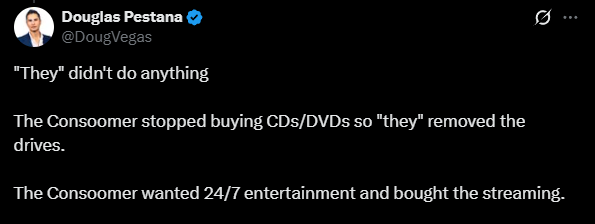
Sometimes I forget how "normies" see the world. There are people out there that believe "consumers just decided to switch to streaming and give up physical media".
Youtube lost money for a decade before it made a profit.
Spotify lost money for 17 years.
None of this is accidental or organic. People didn't "choose" these systems. They outright rejected them for literally decades while these systems operated at a loss that made competition with them impossible, funded by people who wanted to change the world into what we have now. A system where you own nothing, consume whatever is offered on-demand and nothing else, and you have no privacy or anonymity.
Netflix killed Blockbuster with by-mail PHYSICAL MEDIA at a loss. The entire time they were eating Blockbuster's business they were losing money. After Blockbuster died, Netflix phased out physical media and I remember the severe backlash, but the choice was streaming or nothing. Still many (maybe most) people just cobbled together private collections from bargain bins and garage sales. Netflix continued to lose money....10 BILLION dollars of loses in the 2010s even after Blockbuster went out of business.
Understand the truth, that a cabal of global institutional investors funded companies that nobody wanted for literally decades at a cost of untold billions of dollars....until there was NOTHING ELSE LEFT for you to use.