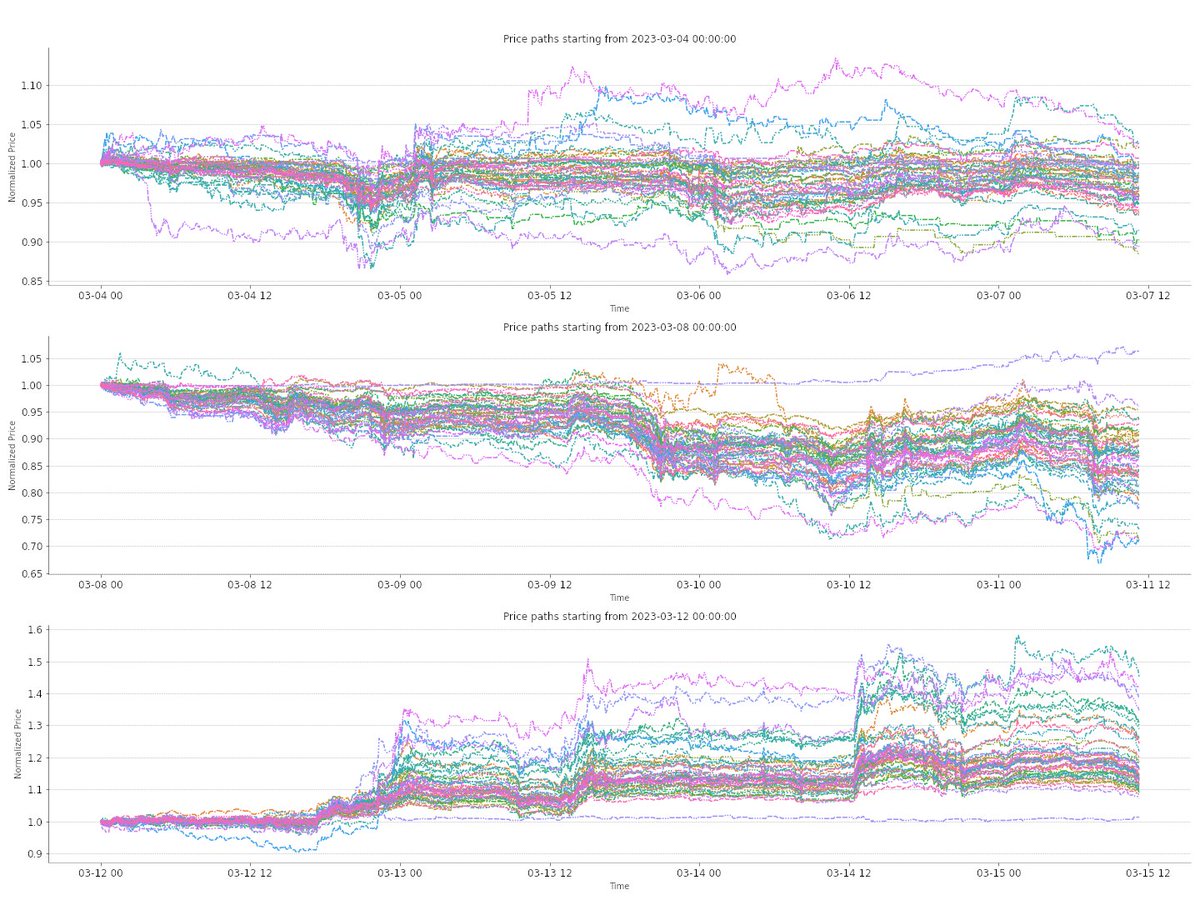
🔬New Research: Exploring Multiple Methods for Forecasting Multivariate Volatility for Risk Indifference Pricing in Perpetual Contracts.
A thread 🧵 (1/8)
Want to jump into the discussion? Visit here:
https://t.co/aOeFBkzBLf
The $TRB market manipulation incident is a vivid demonstration of problems across perp DEXs.
Here’s what happened:
Perp DEXs let traders take on large amounts of leverage, while using Open Interest (OI) caps to limit the total amount of open positions for each asset to manage risk.
Low liquidity assets can become targets for market manipulators because it’s easier to influence their price. By engaging in coordinated buy orders across multiple exchanges they can artificially pump the price.
If OI caps aren’t set correctly, traders can take on much larger positions than what is appropriate.
Eventually, these artificially inflated prices become unsustainable and market manipulators sell off their positions which causes a crash.
In the case of Synthetix, this means stakers (aka LPers) incurred millions of dollars in losses.
Risk parameters need to be responsive to market conditions and riskiness of assets.
In a volatile market event like the $TRB price surge, @VestExchange’s protocol owned liquidity would be the first to absorb the impact and shield LPs from immediate losses.
In addition, Vest calculates the exact capital needed to ensure exchange solvency and LP risk - it charges trades the exact fees needed to be paid to LPs for this risk.
In the case of highly imbalanced markets like $TRB, fees and funding rates paid to LPs and the exchange would have automatically increased, covering potential losses. Unlike other DEXs, these fees are the exact fees needed to ensure that the exchange and LPs are made whole.
Other DEXs, like Synthetix, would have manually and arbitrarily increased their fees in correlation with imbalance, but not with the precision and purpose of counterparty solvency. In the case of Synthetix, the human dependency and manual fine tuning of fees was not enough to cover LP losses.
Vest’s approach is dynamic, automatic, and responsive, offsetting LPs heightened risk exposure with higher earnings and AMM capital protection. In my opinion, this makes Vest currently the most capital efficient and decentralized DEX in the space.
I will soon be publishing official simulation results of Vest on $TRB. Stay tuned for a follow up post!
Given recent discussions on vAMMs, here is our take on how a vAMM with a proper a risk engine can distribute liquidity much more efficiently than on orderbooks.
Write-up:
https://t.co/hhEGBqQfwi
Discussion:
https://t.co/rvGqCd96xp
👇👇👇
1/13