Justice and Empowerment of Minorities (JEM) is an autonomous initiative of @Jamiatulama_in to promote and safeurad human rights of minorities in India.
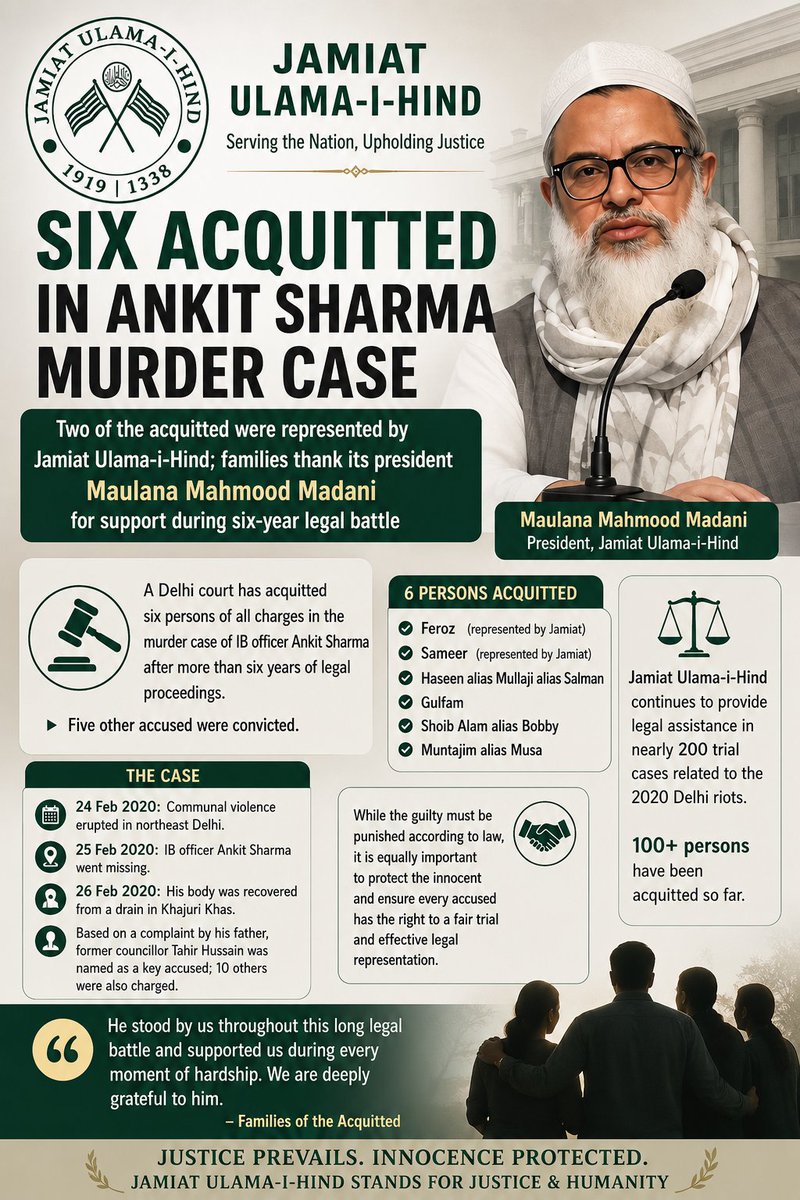
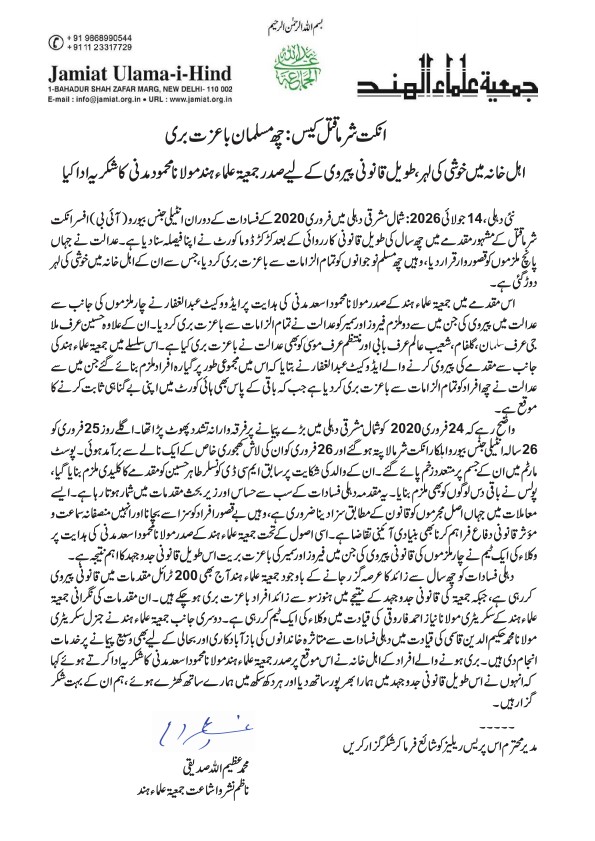
#अंकित शर्मा हत्याकांड: छह मुस्लिम बाइज्जत बरी
परिजनों में खुशी की लहर, लंबी कानूनी लड़ाई के लिए #जमीयत उलमा-ए-हिंद के अध्यक्ष मौलाना #महमूद मदनी का जताया आभार
नई दिल्ली, 14 जुलाई 2026: उत्तर-पूर्वी दिल्ली में फरवरी 2020 के दंगों के दौरान इंटेलिजेंस ब्यूरो (आईबी) अधिकारी अंकित शर्मा की हत्या के चर्चित मामले में छह साल की लंबी कानूनी कार्यवाही के बाद कड़कड़डूमा कोर्ट ने अपना फैसला सुना दिया है। अदालत ने जहां पांच आरोपियों को दोषी करार दिया, वहीं छह मुस्लिम युवकों को सभी आरोपों से बाइज्जत बरी कर दिया, जिससे उनके परिवारों में खुशी की लहर दौड़ गई है।
इस मामले में जमीयत उलमा-ए-हिंद के अध्यक्ष मौलाना महमूद असअद मदनी के निर्देश पर एडवोकेट अब्दुल गफ्फार ने चार आरोपियों की ओर से अदालत में पैरवी की, जिनमें से दो आरोपी—फिरोज और समीर—को अदालत ने सभी आरोपों से बाइज्जत बरी कर दिया। इनके अलावा हुसैन उर्फ मुल्लाजी उर्फ सलमान, गुलफाम, शोएब आलम उर्फ बॉबी और मुन्तज़िम उर्फ मूसा को भी अदालत ने बाइज्जत बरी किया है।
इस संबंध में जमीयत उलमा-ए-हिंद की ओर से मुकदमे की पैरवी करने वाले एडवोकेट अब्दुल गफ्फार ने बताया कि इस मामले में कुल ग्यारह लोगों को आरोपी बनाया गया था, जिनमें से अदालत ने छह लोगों को सभी आरोपों से बाइज्जत बरी कर दिया है, जबकि बाकी लोगों के पास भी हाई कोर्ट में अपनी बेगुनाही साबित करने का अवसर मौजूद है।
उल्लेखनीय है कि 24 फरवरी 2020 को उत्तर-पूर्वी दिल्ली में बड़े पैमाने पर सांप्रदायिक हिंसा भड़क उठी थी। अगले दिन, 25 फरवरी को 26 वर्षीय इंटेलिजेंस ब्यूरो के अधिकारी अंकित शर्मा लापता हो गए और 26 फरवरी को उनका शव खजूरी खास के एक नाले से बरामद हुआ। पोस्टमार्टम में उनके शरीर पर कई चोटों के निशान पाए गए। उनके पिता की शिकायत पर पूर्व पार्षद ताहिर हुसैन को मामले का प्रमुख आरोपी बनाया गया, जबकि पुलिस ने दस अन्य लोगों को भी आरोपी बनाया।
यह मामला दिल्ली दंगों से जुड़े सबसे संवेदनशील और चर्चित मामलों में शामिल रहा है। ऐसे मामलों में जहां वास्तविक दोषियों को कानून के अनुसार सजा देना आवश्यक है, वहीं निर्दोष लोगों को सजा से बचाना और उन्हें निष्पक्ष सुनवाई तथा प्रभावी कानूनी बचाव उपलब्ध कराना भी एक बुनियादी संवैधानिक आवश्यकता है। इसी सिद्धांत के तहत जमीयत उलमा-ए-हिंद के अध्यक्ष मौलाना महमूद मदनी के निर्देश पर वकीलों की एक टीम ने चार आरोपियों की कानूनी पैरवी की, जिनमें फिरोज और समीर का बाइज्जत बरी होना इस लंबी कानूनी लड़ाई का एक महत्वपूर्ण परिणाम है।
दिल्ली दंगों को छह साल से अधिक समय बीत जाने के बावजूद जमीयत उलमा-ए-हिंद आज भी लगभग 200 ट्रायल मामलों में कानूनी पैरवी कर रही है, जबकि जमीयत की कानूनी कोशिशों के परिणामस्वरूप अब तक सौ से अधिक लोग बाइज्जत बरी हो चुके हैं।
बरी किए गए लोगों के परिजनों ने इस अवसर पर जमीयत उलमा-ए-हिंद के अध्यक्ष मौलाना महमूद असअद मदनी का आभार व्यक्त करते हुए कहा, "उन्होंने इस लंबी कानूनी लड़ाई में हमारा भरपूर साथ दिया और हर दुख-सुख में हमारे साथ खड़े रहे। हम उनके बेहद आभारी हैं।"
#mahmoodmadani
#jamiathelp
#Delhiriots2020
#jamiatlegalcell
@jemindia22
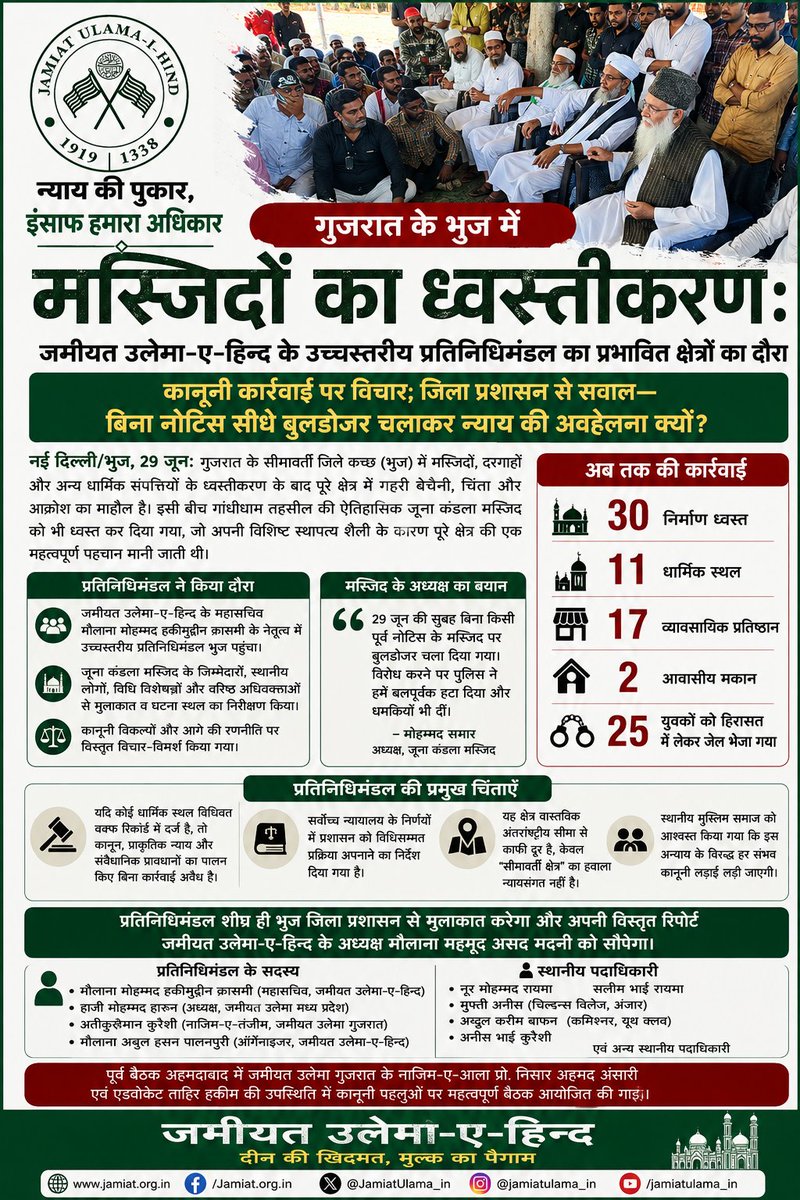
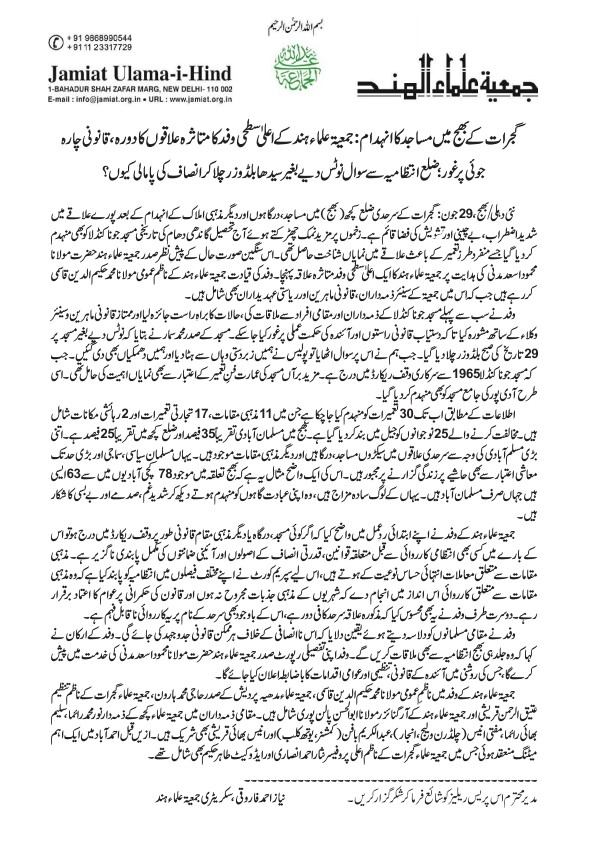
Jamiat delegation visits Kutch over mosque demolitions, weighs legal options
Seeks meeting with district administration; raises questions over alleged demolition without prior notice*
New Delhi/Bhuj, June 29: A high-level delegation of Jamiat Ulama-i-Hind (JUH) on Monday visited parts of Gujarat's Kutch district where mosques and other structures have recently been demolished, and said it was exploring legal remedies while seeking an explanation from the district administration over the alleged demolition of religious structures without prior notice.
The delegation, led by JUH General Secretary Mohammad Hakeemuddin Qasmi, visited the Juna Kandla Mosque in Gandhidham taluka, which was demolished earlier in the day. According to the organisation, the mosque had been entered in the official Waqf records since 1965 and was known locally for its distinctive architectural features.
During the visit, the delegation met members of the mosque committee, local residents and community representatives before holding consultations with senior advocates and legal experts on the legal options available.
Mohammad Samar, president of the mosque committee, alleged that the mosque was demolished on the morning of June 29 without any prior notice. He claimed that when members of the management sought an explanation from the authorities, they were prevented from approaching the site, removed by police personnel and threatened.
The delegation also stated that the Jama Masjid at Adipur had been demolished during the demolition drive.
According to information, 30 structures have so far been demolished, including 11 religious structures, 17 commercial establishments and two residential houses. The organisation further claimed that 25 youths who protested against the demolition drive had been arrested and sent to jail.
The delegation pointed out that Muslims constitute nearly 35% of the population in Bhuj taluka and around 25% of Kutch district. Given the size of the community, the region is home to hundreds of mosques, shrines and other religious institutions. It said the recent demolitions, created apprehension among residents who fear that additional places of worship could face similar action.
In a statement issued after the visit, the delegation said that where a mosque, shrine or any other religious institution is duly recorded in the Waqf register, any administrative action must be carried out in accordance with the law, the principles of natural justice and constitutional safeguards. It added that matters involving places of worship require strict adherence to due process and sensitivity in view of their religious significance.
The delegation also questioned the rationale behind invoking the area's proximity to the international border, contending that the affected localities are situated well away from the actual border and that the justification cited by the authorities requires legal and administrative scrutiny.
Assuring local residents of legal assistance, the delegation said it would pursue all available legal remedies. It added that it would seek a meeting with the Bhuj district administration before submitting a detailed fact-finding report to JUH president Maulana Mahmood Asad Madani, based on which the organisation would determine its future legal and organisational course of action.
The delegation comprised Maulana Mohammad Hakeemuddin Qasmi, JUH General Secretary; Haji Mohammad Haroon, president of Jamiat Ulama Madhya Pradesh; Atiqur Rahman Qureshi, Organising Secretary of Jamiat Ulama Gujarat; and Maulana Abul Hasan Palanpuri, Organiser of Jamiat Ulama-i-Hind. They were accompanied by local representatives Noor Mohammad Raima, Salimbhai Raima, Mufti Anees, Abdul Karim Bafan and Aneesbhai Qureshi.
Prior to the field visit, a meeting was held in Ahmedabad to review the legal aspects of the matter. It was also attended by Prof. Nisar Ahmad Ansari, State General Secretary of Jamiat Ulama Gujarat, and Advocate Tahir Hakim, among others.
They’re #bulldozing at all levels. It’s not just the buildings which are being bulldozed. It’s happening at all levels - Maulana Mahmood Madani, President Jamiat Ulama-i-Hind on @AJEnglish
https://t.co/EVj1iM3WdR
Asking Muslims to Hide Their Identity Won’t Stop Mob Violence’: Maulana Mahmood Madani*
#Jamiat Ulama-i-Hind president rejects former IAS officer #Niaz Khan’s remarks, says the answer lies in enforcing the rule of law—*
New Delhi, July 11, 2026: Maulana Mahmood Madani, President of Jamiat Ulama-i-Hind, has strongly rejected former IAS officer Niaz Khan's suggestion that Muslims should alter their appearance and give up visible markers of their identity, including traditional attire, in order to protect themselves from mob violence. He described the suggestion as a disregard of established facts and a fundamental misdiagnosis of the problem.
Maulana Madani said it was a matter of serious concern that a former IAS officer should advise Muslims to conceal their identity as a means of ensuring their safety.
"The problem does not lie in a victim's beard, the cap on his head, a woman's hijab, or a person's kurta-pyjama. The real problem lies in the hatred harboured in the mind of the attacker and in an environment in which mobs begin to believe that they are above the law. Asking victims to erase their identity, instead of punishing the perpetrators, is neither justice nor something that any civilised democracy can accept," he said.
Citing a research-based report available with Jamiat Ulama-i-Hind, Maulana Madani said that Jamiat Ulama-i-Hind has a research-based report examining 38 major incidents over the past ten years. In 83 % of these cases, the victims were wearing ordinary clothes and displayed no conspicuous outward markers of Islamic identity. He said that, in these incidents, people were targeted on the basis of rumours or allegations.
Maulana Madani said that while it was not possible to recount every incident, several major cases could be cited by way of example. These include the killing of Mohammad Akhlaq in Dadri, Uttar Pradesh, in 2015; the mob killings of Rakbar Khan in Alwar, Rajasthan, and Qasim Qureshi in Hapur, Uttar Pradesh, in 2018; the lynching of Tabrez Ansari in Jharkhand in 2019; the killing of Nasir and Junaid of Bharatpur, Rajasthan, who were burnt alive along with their vehicle in 2023; and the brutal killing of Sabir Malik, a Bengali Muslim migrant worker living in Charkhi Dadri, Haryana, in 2024. In all these cases, the victims' clothing was neither the underlying cause of the attacks nor did their appearance bear any conspicuous markers of Muslim identity.
Drawing on history, Maulana Madani said that Bosnian Muslims were largely indistinguishable from their Christian neighbours in terms of language, dress, outward appearance and social customs. Yet they were subjected to mass killings, detention camps, inhuman atrocities and genocide.
Drawing a historical parallel, Maulana Madani referred to the experience of Bosnian Muslims, who were largely indistinguishable from their Christian neighbours in terms of language, dress, outward appearance and social customs. Yet they were subjected to mass killings, detention camps, systematic atrocities and genocide.
"In the light of these facts, the real question should not be what the victim was wearing. The real question is: what emboldened a mob to stop a citizen, scrutinise his identity, pursue his vehicle, attack him and ultimately kill him? If we shift attention away from this fundamental question and focus instead on the victim's clothing and appearance, we risk transferring responsibility for the violence from the perpetrator to the victim," Maulana Madani observed.
He added that when hatred is systematically fostered against a community, its members are treated with suspicion and its collective identity is portrayed as a threat, merely changing one's appearance can never guarantee safety.