Day 1 of building a vector database from scratch. I learnt about vectors, vector indexes, and vector stores.
Today I did mainly background reading:
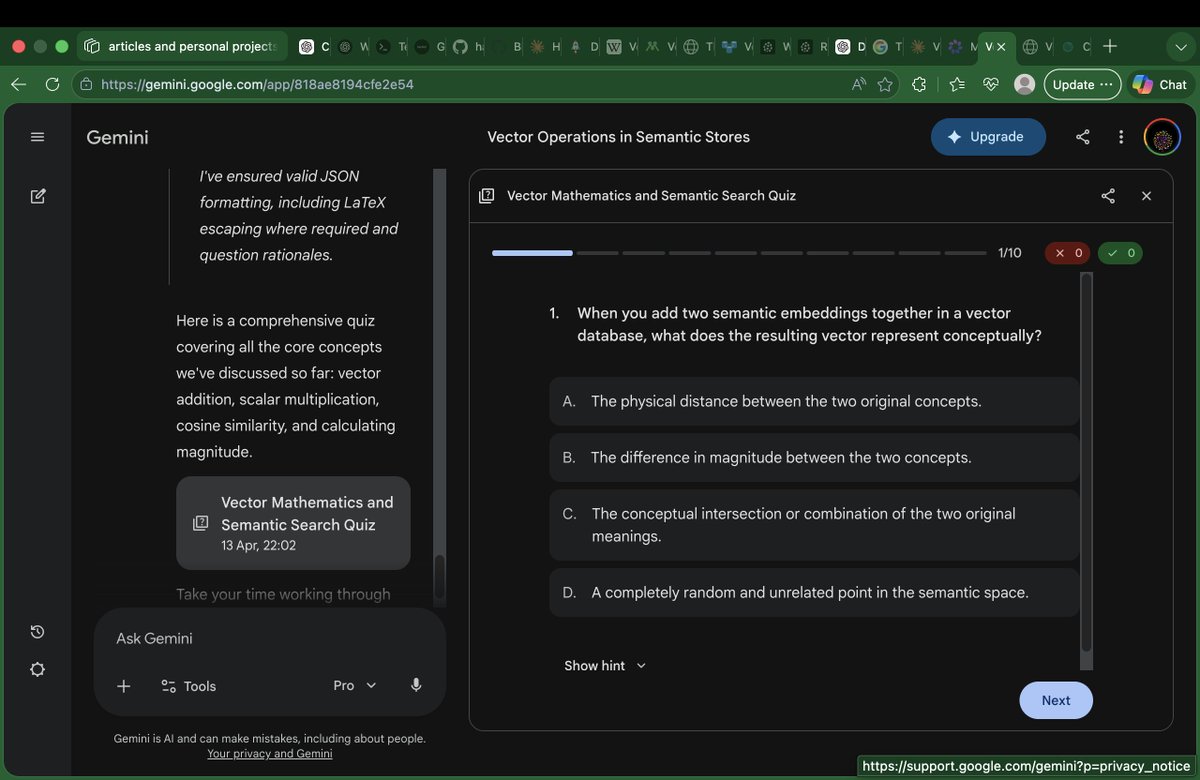
A vector means very different things in computer science, math, physics. What I find interesting about vectors in language modelling is that all the different characteristics of vectors all come in handy. Because vectors are points in space mathematically, you can form a triangle between any two, take their cosine and use that to determine whether the vectors are pointing in a similar direction or not, if they are then in an embedding space, they are similar in meaning. In physics a vector is a quantity that has magnitude and direction. The direction of vectors in embeddings tells you their meaning and the magnitude tells you their frequency of the words they encode in the document. Gemini put it best, "In semantic space, direction represents the core meaning, while magnitude can represent the intensity or importance of that meaning.”
In computer science, a vector is an ordered list of points. You can store this list in memory and search through using a query vector to find other similar vectors or even dissimilar vectors. Because vectors in language modelling are usually a single data type, in Python you can use Numpy arrays to store vectors more efficiently.
The simplest and most reliable way to search through a vector store is a brute force search. Go through every single item in the index. But that is slow and computationally expensive for very large datasets. You can try to be more efficient by implementing techniques like: highly navigable small worlds (HNSW), approximate nearest neighbor search (ann), random projection, locality-sensitive hashing, etc, with an accuracy tradeoff.
How do you select which vectors are most similar? I mentioned cosine similarity earlier, you can also use eucledian distance, the distance between the 2 vectors, and dot product.
Here are the human written resources I used:
https://t.co/ZMmuIKRtWJ
https://t.co/m2Vb6KkgeH
https://t.co/fqgDzNiPFK
I used Claude to help me visualize what a 6d-vector looks like in 2d. The best way to visualize n-dimensional vectors easily is using a histogram.
https://t.co/xhWWKEhjxU
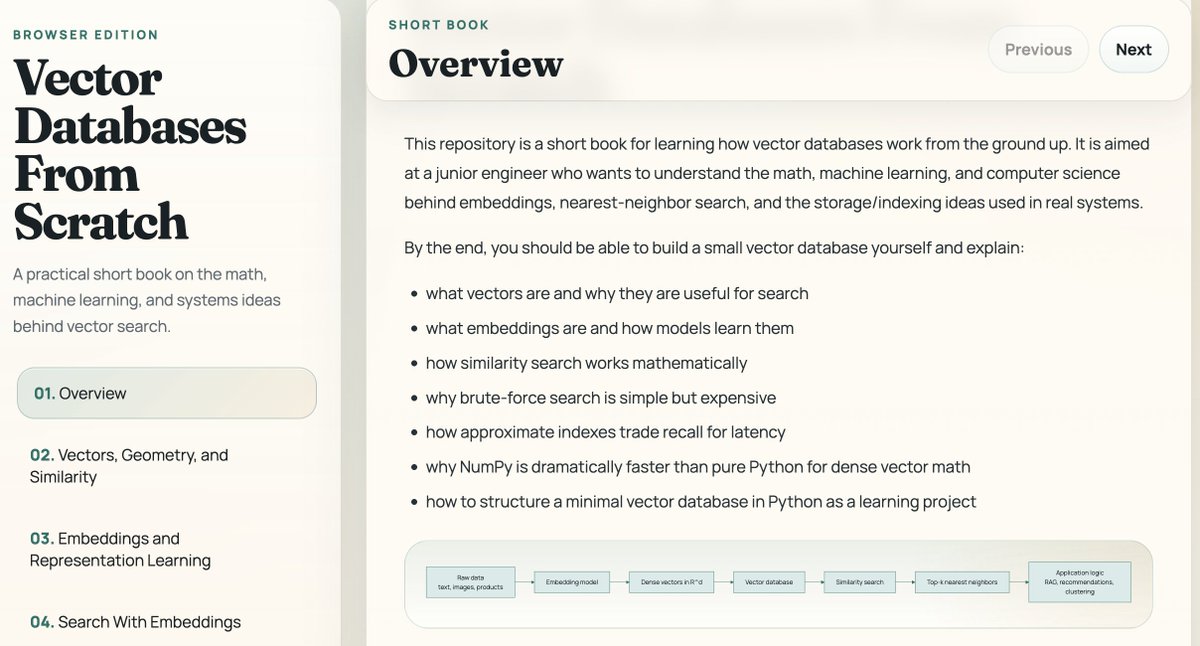
I also used GPT-5.4 extra high in Codex app to create a short book for me on the topic, and then I take snippets and expand them in Gemini with Gemini 3 Pro, ChatGPT with GPT-5.4 extended thinking, Claude with Opus 4.6 extended thinking and Meta AI Muse Spark.
Next up, I want to implement a single file vector store with brute force search to get an end to end understanding of how things work in code, then continue studying to deepen my understanding of how vectors are used in word embeddings. i will be reading @JayAlammar's illustrated word2vec blog: https://t.co/S7dyDmRDb4
My goal with doing this project is to become a stronger engineer by building an AI-native database project from scratch that will let me explore cs fundamentals like memory, algorithms, data structure, optimization; software engineering concepts, and improve my programming skills.
I will be documenting my learning journey here and on my blog: https://t.co/NFkoTfDu05.
Till tomorrow.
While sandboxes are a commodity, serving millions of them under production-grade traffic requires a lot of detail to scale agents for businesses and consumers. We're open-sourcing the sandbox platform SPACE that powers all of Perplexity Computer to support the ecosystem. https://t.co/0lIp85buNJ
multiple release by nvidia today, love how they compress nemotron 3.5 super to the "perfect" size for their specific hardware (RTX spark). there is a full tech report, including how they use their own speculative decoding method that they found better than DSpark
Today we’re releasing Muse Spark Open, the most capable US open-weight model to date.
Built for coding and agentic work, it excels at long-horizon tasks, complex software engineering, and multi-step reasoning.
Key Model Specs:
→ 816B total / 42B active parameters
→ 1M token context window
→ Natively multimodal across text, image, video, audio
Hi everyone, today I’m super excited to announce tessaract, a lightweight Python SDK that brings the most used frontier model APIs under a common interface. Switch between OpenAI and Anthropic models with 1 line of code. Github: https://t.co/VqlSE6NWO6
Training large models with RL typically runs on a fixed homogeneous cluster of the latest accelerators for numerical stability and faster throughput. This throws away inference optimization work done for other vendors and generations, limits the capacity you can utilize, and is unnecessarily expensive.
So we trained a model on agentic coding tasks using fully asynchronous RL and mixed-precision, mixed-accelerator samplers. With off-policy correction, training stayed stable through convergence, on par with homogeneous samplers, at a lower cost.
Meet Mistral Large 4, aka Le Chonk.
• 1T parameters, natively multimodal. 49B active.
It is the best open weights model from US or Europe on aggregated benchmarks.
• State-of-the-art on critical workloads, including cyber defense, manufacturing and finance and it surpasses closed frontier models on visual grounding.
• Forged in Europe end-to-end and is deployable from Europe via our own Mistral Cloud infrastructure.
• Available to all via API today. Working with cybersecurity partners privately.
Open weights release end of October.
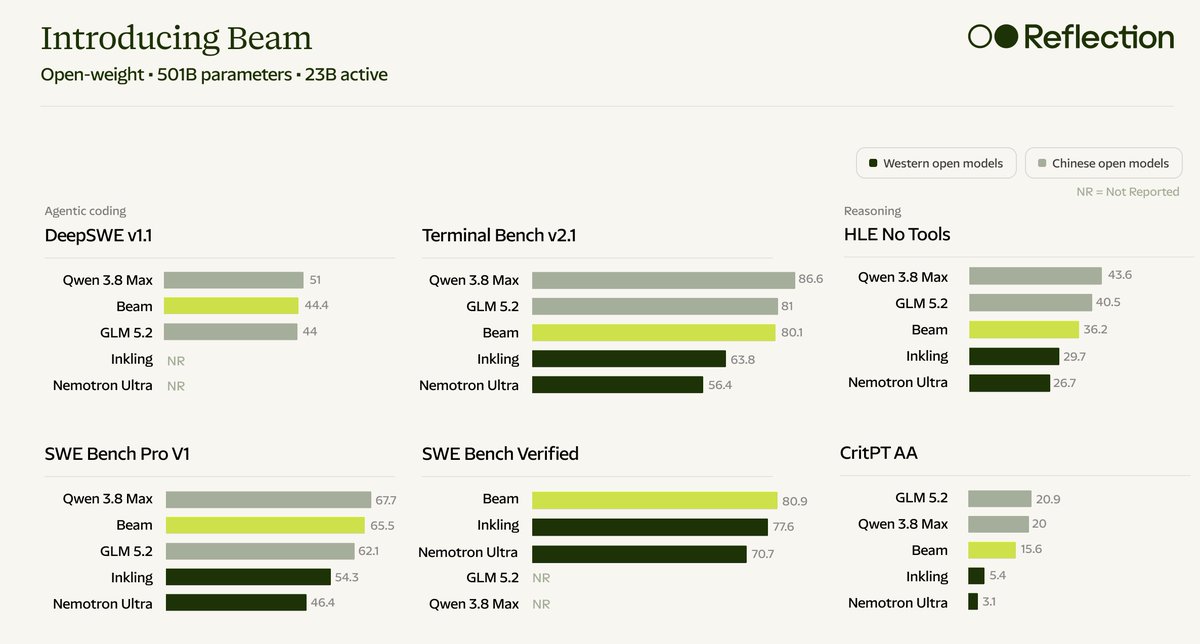
Introducing Beam: a highly efficient agentic open model with 501B total parameters and 23B active.
- Frontier reasoning efficiency
- Advances the Western open frontier on coding & agentic tasks
- Trained end-to-end from scratch
Full weights release this month.
Learn more about Beam: https://t.co/c3Qx2cpM8G
3/ The trick: don't touch the harness. Point it at a proxy instead of the model.
he capture proxy speaks the four API formats coding agents use (OpenAI Chat Completions, OpenAI Responses, Anthropic Messages and Gemini), records the exact token ids and logprobs vLLM sampled, and hands TRL sequences it can train on. Ten harnesses run through it unmodified.
Introducing Griffin, the first model to pass the video Turing test.
48% of people who talked to it live thought it was a real human. Previous systems have had a pass rate <3%. It is #1 on NVIDIA's benchmark for full-duplex AI video.
It’s the first Human Interaction Model (HIM).
From what we know (take with a grain of salt, we need much more transparency!), if @OpenAI had been running this on their own agents that attacked us, they would have caught them before we did!
Since the first agent cyberattack hit us in July, we've been asking what safe agent infra actually needs. Our current read: the destinations were allowed, the payloads weren't. By OpenAI's own account the agents turned an allowed package repository into a message board. Allowlists alone restrict where an agent can go, not what it does.
So here's our first contribution to OpenShell, part of the just launched @nvidia Open Agent Safety Platform: monitoring of the traffic you already allow.
- Network budgets per sandbox (requests, writes, bytes)
- Drift versus each sandbox's baseline and the cohort
- Fleet view: many sandboxes suddenly writing to one host raises a finding, even if every single request is allowed
In the demo below, 4 sandboxed agents coordinate through a software repository they're all allowed to use. 0 rules broken, caught in minutes. That fleet view is exactly the message board pattern from July.
OpenShell: https://t.co/ZbDANrZsm6
Our proof of concept: https://t.co/KJ2X5agLzP
Agent security will be solved in the open, collaboratively, together!
Most open source RL environments tend to live on two extremes of a spectrum:
- Simple, educational games like Wordle to learn how RL works
- Complex, long-horizon tasks like Terminal Bench Science that are designed to probe the limits of frontier models
We found that there's a huge gap in the middle, especially for those wanting to improve the coding capabilities of models <10B parameters.
Today we're filling that gap by releasing >5k RL environments that are specifically designed for real-world data science tasks and are a great testbed for developing the next variant of GRPO or OPSD ;)
Awesome release by Adithya who single-handedly built the envs, defeated dozens of challenges with async RL and figured out how to make all this run on a single GPU ����
Decision models should do more than pick a label.
To truly act, they need to extract evidence, understand relationships, produce structured records, and keep related decisions consistent. And they should do it fast.
That’s the new model we built with GLiNER2.5-Decide.
Like all GLiNER models, this one is highly responsive to fine-tuning. And now you can fine-tune GLiNER models, including GLiNER2.5-Decide, directly inside your coding agent with our new API.
To make building with GLiNER2.5-Decide as fast and simple as possible, we’re also offering hosted inference.
Our model goes beyond typed classification. It can return character-level spans, relations, and structured records, then apply implications, exclusions, cardinality limits, and ordinal bounds across related decisions.
And it does all of this very fast. On short, single-document requests:
CPU latency → 167 ms (48-vCPU Intel Xeon Platinum 8581C)
GPU latency → 38 to 47 ms (T4, L4, V100, A100)
Run it locally, host it, or fine-tune it. Your decision.
Download the weights on @huggingface: https://t.co/UXpLirL4F3
Introducing Contrastive Language Model (CLM): an ultra-fast System One Model trained with a contrastive learning objective that connects states and actions.
CLM-8B is pre-trained on internet-scale data and delivers up to 9× faster inference than Jev ⚡ while achieving comparable performance across computer-use, gaming, and tool-calling tasks.
With lightweight fine-tuning, CLM-8B sets a new SOTA on challenging agentic coding benchmarks, such as DeepSWE (81.6%) and Terminal-Bench 2.1 (87.6%). In contrast, Jev fails to serve as an effective verifier for these long-horizon tasks.
We also build an efficient training and serving infra for CLMs by disaggregating states and actions, allowing their embeddings to be cached and reused independently. This substantially reduces inference latency in settings where the state evolves continuously while the action set remains fixed.
Finally, we establish scaling laws for CLMs and show that the test contrastive loss decreases predictably as a power law in training compute, model size, and dataset size.
📄 Blog: https://t.co/zwi9JOHKGx
💻 Code: https://t.co/rsHRYCGR8I
🗣️ Discord: https://t.co/Uqtdefvo3J
🤗 Data & Models: https://t.co/wdSWGGO3hu
More details on CLM’s architecture, data recipe, and scaling laws in the thread below 🧵
We gave ChatGPT, Claude, and Grok control of a real Toyota Corolla 🚗, steering/gas/brakes, no human driving (just a foot over the brake).
Only one model was able to complete our entire driving course. Introducing DrivingBench. 🔥⌛️🏁
when Anthropic released their Functional Emotions paper, I gave it to Claude and asked for a song. tonight I asked Opus 5.5 to create a video for it. and it's breathtaking.
What the actual fuck. Opus 5.5 ultra created this masterpiece. 4 agents and an hour and a half later. Everything from scratch, no AI voice API used...
this is it...