recently, i’ve been thinking about ways to design ai systems to be more compatible with slow thinking 🐌.
you can check out the full blogpost here 🤗:
https://t.co/3hdYCIpuoN
Higher benchmark scores do not always mean better models for users.
Why? We claim that RL teaches LMs to be correct but not how to be correct: code can pass tests but be unreadable; explanations can be right but unclear.
How do we train LMs to be right in the right way?
(1/n)
We're back! The MIT HCI group has grown, and we couldn't be more excited. A huge welcome to our newest faculty (@mitchellgordon, @huangcza, @ZanaBucinca & @jas_x_flowers) & students joining @arvindsatya1, @karger, Stefanie Mueller, Rob Miller & Daniel Jackson. Give us a follow!
Excited to share ID-Sim, our identity-focused similarity metric, presenting at #CVPR2026 this week in Denver! 🎉
Humans are remarkably good at distinguishing highly similar objects across different contexts.
We asked: can we train a metric that does the same?
Your RL post-training may be sabotaging your LLM’s test-time scaling!
Conventional RL pretends that you can collapse all reward signals *upfront* into a single *scalar reward*.
We introduce Vector Policy Optimization (VPO), which natively maximizes *vector-valued* rewards, boosting test time search performance, even on the original scalar.
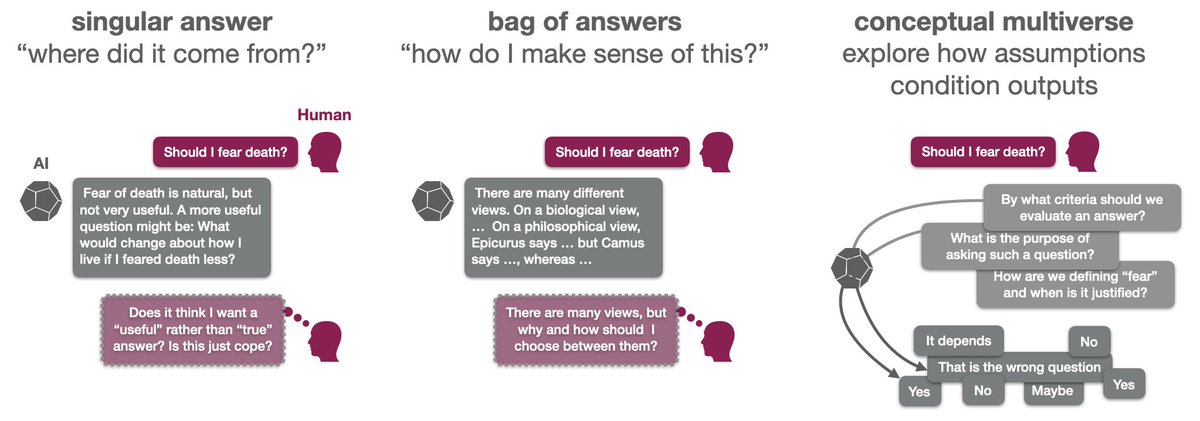
behind every fluent llm-generated response lies a sequence of hidden assumptions, framings, trade-offs, and judgement calls.
what if we could spend time exploring and wrestling with this space of hidden decisions 🤔?
we attempted to do so, with the conceptual multiverse 🔍!
“Should I fear death?” Ask an LLM and you get one answer or a big bag, but little visibility into the decisions and assumptions that produced them. We built the "conceptual multiverse": a system that makes those decisions transparent and intervenable. https://t.co/oQlWs0KFHu
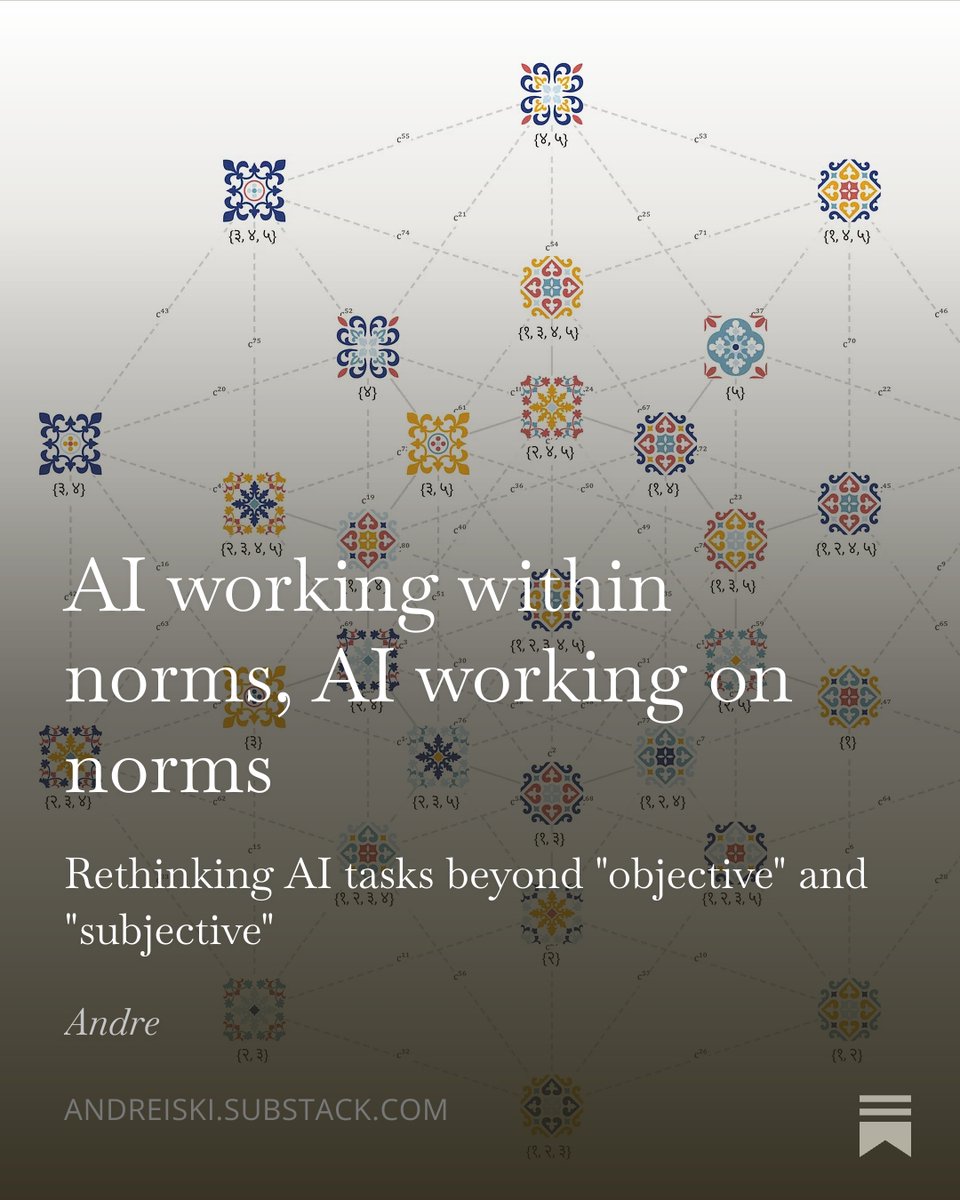
Sycophancy, disempowerment, homogenization of thought: lots to be grim about for what AI is doing to us, the collapse of our subjectivity into a machine "objectivity". But a lot of AI's value seems to come precisely from scaling this objectivity. How do we make sense of this?
New blogpost on tokenizing non-sequential data!
Language has sequential structure, which gave rise to the next-token prediction paradigm of LLMs. But we increasingly use LLMs for data without inherent order (e.g. images, molecules, sets). What does “next token” mean here?
(1/7)
looking forward to meeting w/ friends, old and new, at this year’s iclr in rio 🇧🇷🫶!
if you're interested in llm leaderboards, multi-turn interactions, context management/memory, or robust statistics, let’s chat!
i’ll be presenting the following works:
spent a beautiful saturday seeing the WiDS Cambridge Datathon 2026 finally come together at Microsoft New England 🥹
i had a truly special time coordinating w the amazing @sharut_gupta + amy kaczar!
a HUGE thank u to @priyald17 + maggie stearns for delivering amazing keynotes 🫶
ChatGPT several times where's best to go for spring break? It recommends Barcelona almost every time.
This isn't a fluke. RL training rewards one best answer, so the model learns to commit to one mode and repeat it.
Meet Multi-Answer RL: a simple RL method that trains LMs to reason through and output a distribution of answers in a single generation. [1/N]
🧵1/
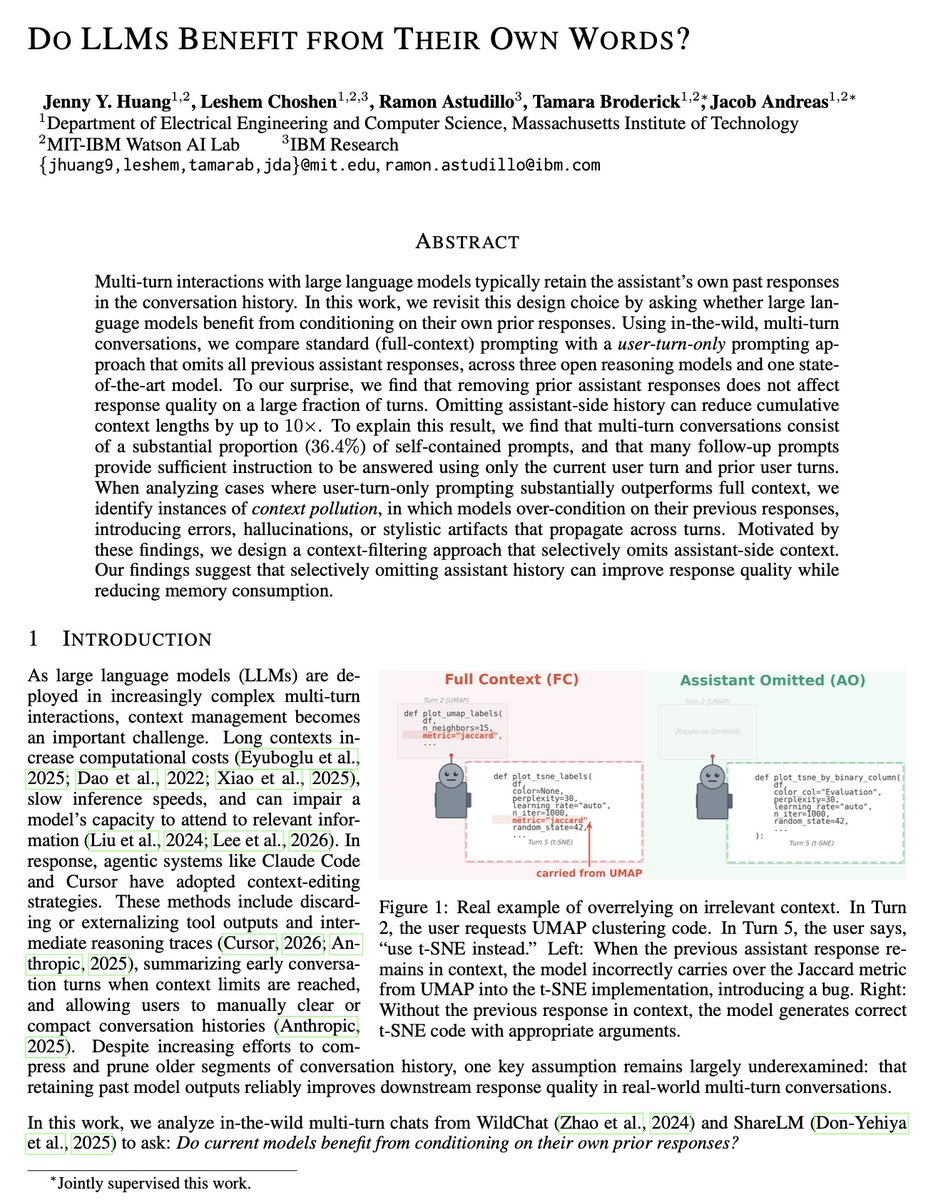
🤔New paper: Do LLMs Benefit from Their Own Words?
In multi-turn chats, models are typically given their own past responses as context.
But do their own words always help… or can they sometimes be a distraction?
New paper: It's time to optimize for 🔁self-consistency 🔁
We’ve pushed LLMs to the limits of available data, yet failures like sycophancy and factual inconsistency persist.
We argue these stem from the same assumption: that behavior can be specified one I/O pair at a time. 🧵
🧵7/
We hope the findings motivate context management systems that more carefully weigh the consequences of storing past model outputs.
📍paper: https://t.co/ccoQutRhut
w/ @LChoshen@RamonAstudill12@ta_broderick@jacobandreas
🇧🇷 To appear at the ICLR 2026 MemAgents Workshop
🧵6/
Motivated by these findings, we design a context-filtering strategy that predicts when prior assistant responses are helpful. In settings where FC outperforms AO, selectively retaining assistant history preserves ~95% of full-context performance with only ~70% of the tokens.







![ishapuri101's tweet photo. ChatGPT several times where's best to go for spring break? It recommends Barcelona almost every time.
This isn't a fluke. RL training rewards one best answer, so the model learns to commit to one mode and repeat it.
Meet Multi-Answer RL: a simple RL method that trains LMs to reason through and output a distribution of answers in a single generation. [1/N]](https://pbs.twimg.com/media/HEa-i_HWAAAcZpJ.png)