An incredibly rare fragment from a Roman household calendar. This section lists days in November and December, and their associated Roman feast days. Beside each day there is a small hole for the insertion of a peg to mark the actual date..
Memorial plaque to “Alexander, a sausage seller at the market. He lived 30 years. He was a good soul and everyone’s friend. May he sleep among the righteous”
The tombstone is carved with a menorah and was found in a Jewish catacomb on the Via Appia, 3rd-4th century AD. Ashmolean
Leather shoes with thistle shaped tab at back. Culture: Romano British. Place of origin: Roman fort of Newstead (Trimontium), Roxburghshire, Scotland. Date: c. 80–180 AD. Medium: Leather. Collection: National Museums Scotland, Edinburgh.
Sean Avery, actor in THE ODYSSEY, revealed that it is the “biggest movie ever made.”
“It is the biggest movie ever made. We filmed in five countries. Um, no CGI, no green screen in the middle of the ocean. We were in Sicily... that's why when Biz is like he goes on his walkabouts. I said I just walked Iceland, Sicily, uh, Greece, where else? Scotland, which is unbelievable.”
As a mediary between #Egypt and #Assyria for the sale of horses, #Israel was able to amass a considerable chariot force that was housed at Megiddo. https://t.co/AxnpF0OHBI
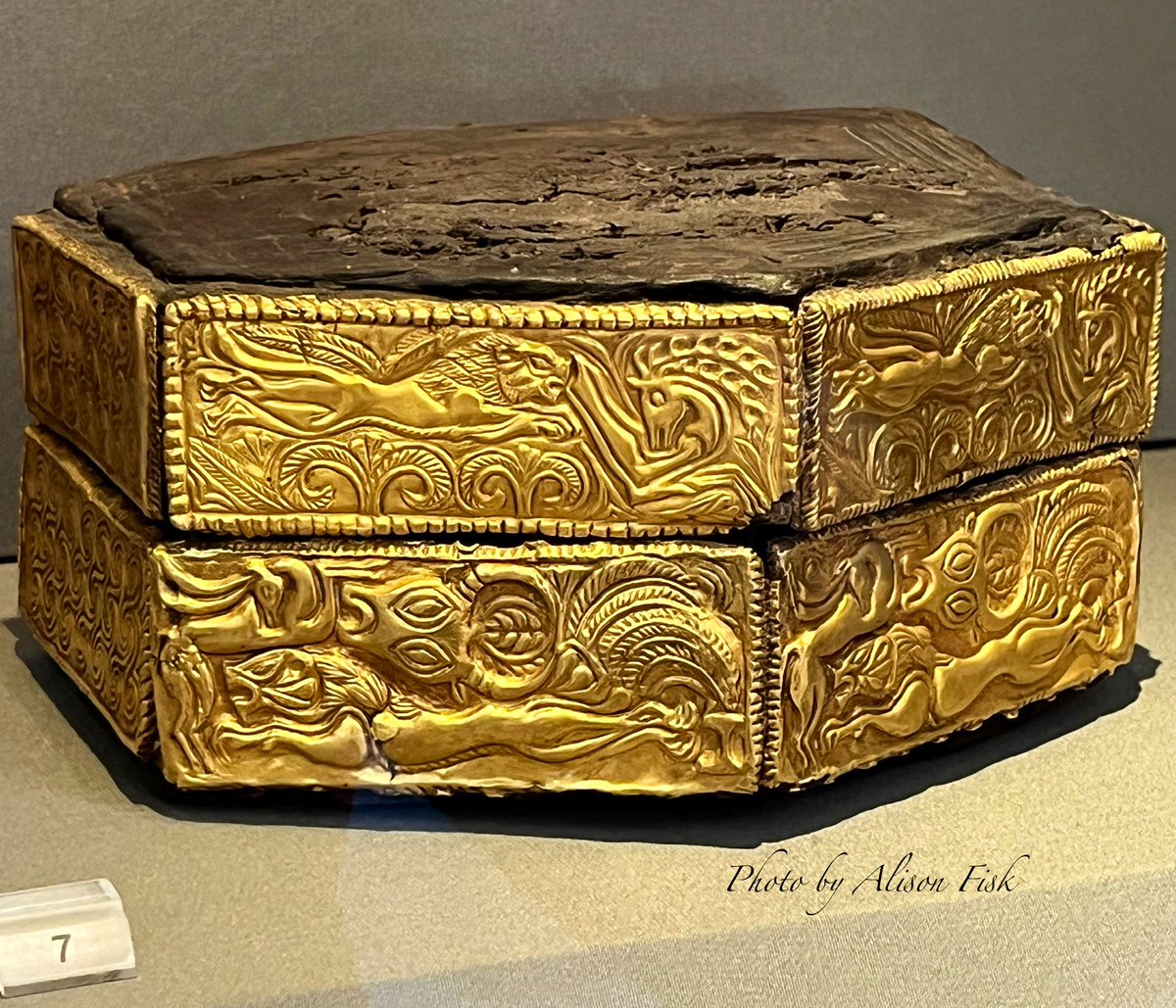
Fabulous 3,500 year-old Mycenaean wooden box embellished with repoussé gold plates with lions chasing deer and antelope, among palm trees, spirals and bulls heads.
From Grave V, Grave Circle A, Mycenae, Greece. National Archaeological Museum, Athens.
📷 by me
#ReliefWednesday
#Archaeology
This is one of the oldest cities in the world, Hamadan. Founded in the 12th Century BC. By 700 BC, it became the first capital of Iran, later chosen by the Achaemenid and Parthian Empires as their summer capital. Over the centuries, it was looted by Alexander the Great, sacked by the Mongols, yet it endures. Today, Hamadan still reflects its ancient layout and is home to over 600,000 inhabitants.
Hamadan, known in ancient times as Ecbatana, is one of the world's oldest continually inhabited cities. It was the capital of the Medes around 700 BC, and later served as a summer capital for both the Achaemenid and Parthian empires, a fact that speaks to its strategic and climatic appeal. Its location at the foothills of Mount Alvand offered a refreshing escape from the summer heat of other capitals.
The city's history is a dramatic tapestry of conquest and resilience. While it was indeed sacked by the Mongols and looted by Alexander the Great, as you noted, it consistently rebuilt and re-established itself. Its ancient layout, which you mentioned, is a key part of its identity, and it has been a center for trade, culture, and learning for millennia. Even today, with a metropolitan population of around 612,000, Hamadan remains an important city in Iran, a living monument to a rich and complex past.
#archaeohistories
Artists have always loved to sketch!
Sketch of a sparrow from Egypt dated c. 1479–1458 BC.
Some 3,500 years ago in Egypt, artists used flakes of limestone as sketchpads!
MMA excavations 1922-23, Deir el-Bahri. 📷 The Met https://t.co/zRoLZE2yjH
#FindsFriday#Archaeology
Wow, this 3,400 year-old ancient Egyptian paint box still contains original pigments!
Looks similar to a modern-day set!
An inscription tells us it belonged to Amenemope, Vizier during the reign of Amenhotep II.
📷 Cleveland Museum of Art https://t.co/5p3SfQptxD