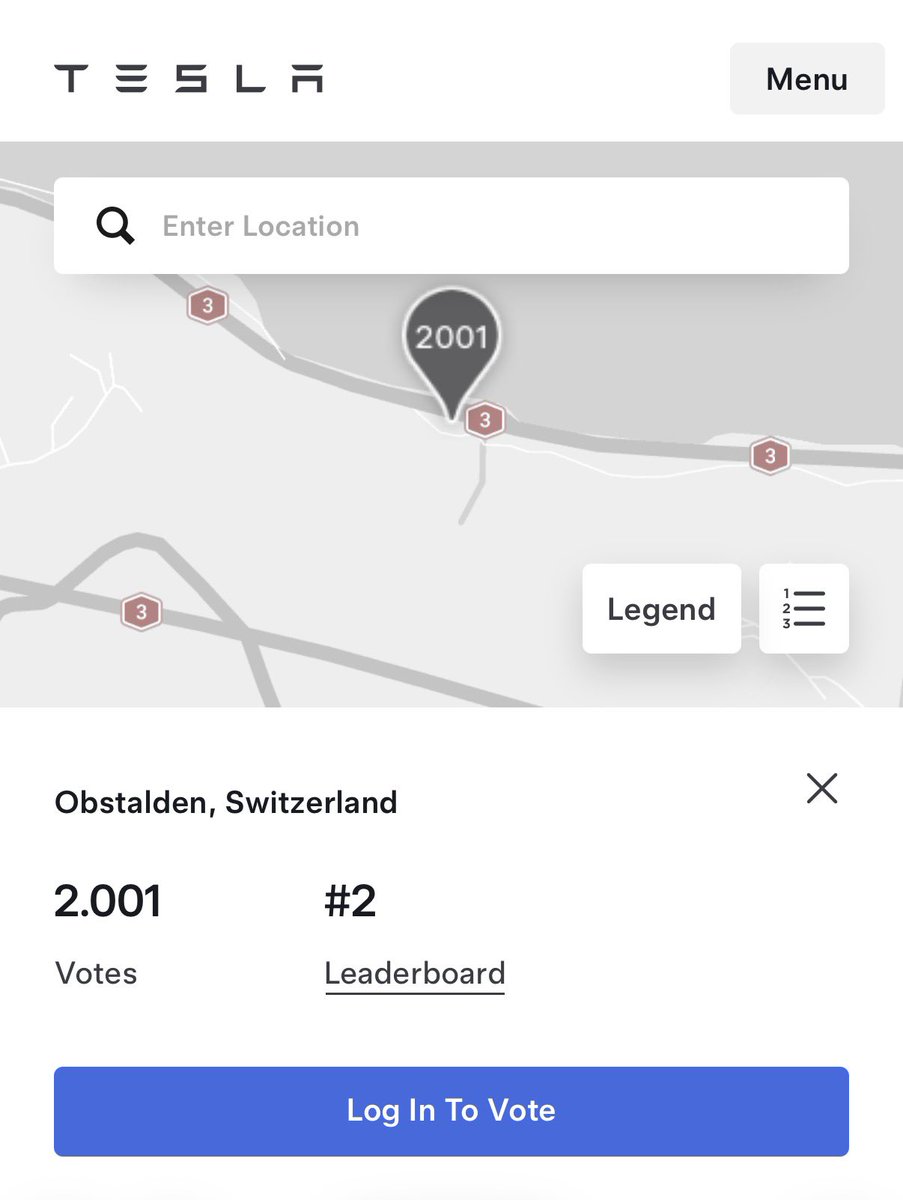
@Bernd_Kaiser_BD Liegt wohl eher am Auto/Marke und nicht an BEV an sich, Tesla hält was sie Versprechen, und verzichten muss man dabei auf gaar nichts, ganz im Gegenteil so viel Leistung, Fahrkomfort und Sicherheit bekommt man sonst zu diesem Preis bei keinem Diesel oder Benziner.
Greats news for US-based investors.
If you're outside the US:
CALL every brokerage you can and ask if they're participating in the SpaceX IPO and if you can get an allocation.
Report back with results.
Country.
Brokerage.
Yes/No?
This will help other investors.
The day after the CEO lays off a ton of staff and says:
“Non-technical teams are now pushing code to production with AI”
@coinbase has a major outage on their trading engine, and even their status page doesn’t work.
😂
Elon Musk avait dit un truc qui m'avait marqué sur l'allocation de ressources. En substance : passé un certain niveau de richesse, l'argent n'est plus de la consommation, c'est de l'allocation de capital.
Cette phrase change tout.
L'économie, dans le fond, c'est juste un problème d'allocation. Tu as des ressources finies et des usages infinis. Qui décide où va quoi ?
Imagine une cour de récré. 100 enfants, des paquets de cartes Pokémon distribués au hasard. Tu laisses faire. Très vite, un ordre émerge. Les bons joueurs accumulent les cartes rares, les collectionneurs trient, les négociateurs trouvent des deals. Personne n'a planifié. Et pourtant chaque carte finit dans les mains de celui qui en tire le plus de valeur. Le système maximise le bonheur total de la cour. C'est ça, la main invisible.
Maintenant fais entrer la maîtresse. Elle trouve ça injuste. Léo a 50 cartes, Tom en a 3. Elle confisque, redistribue, impose l'égalité. Trois effets immédiats. Les bons joueurs arrêtent de jouer, à quoi bon. Les mauvais n'ont plus de raison de progresser, ils auront leur part. Les échanges s'effondrent. La cour est égale, et morte. Elle a maximisé l'égalité, elle a détruit le bonheur.
Le problème de la maîtresse, c'est qu'elle ne peut pas avoir l'information que la cour avait collectivement. C'est le problème du calcul économique de Mises, formulé en 1920. L'URSS a essayé de le résoudre pendant 70 ans avec le Gosplan. Résultat : pénuries, queues, effondrement. Pas parce que les Soviétiques étaient bêtes, parce que le problème est mathématiquement insoluble en mode centralisé.
Quand Musk a 200 milliards, il ne les consomme pas, il les alloue. SpaceX, Starlink, Neuralink, xAI. Chaque dollar est un pari sur le futur. Et lui a un track record. PayPal, Tesla, SpaceX. Il a démontré qu'il sait identifier des problèmes immenses et y allouer des ressources avec un rendement spectaculaire.
L'État aussi a un track record. Hôpitaux qui s'effondrent, éducation qui décline, dette qui explose, services publics qui se dégradent malgré des budgets en hausse constante. Le marché identifie les bons allocateurs, la politique identifie les bons communicants.
Le profit n'est pas une finalité, c'est un signal. Il dit : tu as alloué des ressources rares vers un usage que les gens valorisent suffisamment pour payer. Plus le profit est gros, plus la création de valeur est grande. Quand Starlink est rentable, ça veut dire que des millions de gens dans des zones rurales ont enfin internet. Quand un ministère est en déficit, ça veut dire qu'il consomme plus qu'il ne produit. L'un crée, l'autre détruit, et on appelle ça redistribution.
Dans nos sociétés il y a deux catégories d'acteurs. Les entrepreneurs et les bureaucrates. L'entrepreneur prend un risque personnel pour identifier un problème, mobiliser des ressources, créer une solution. S'il se trompe il perd. S'il a raison, ses clients gagnent, ses employés gagnent, ses fournisseurs gagnent, l'État collecte des impôts. Il est la cellule de base du progrès humain.
Le bureaucrate ne prend aucun risque personnel. Son salaire est garanti. Au mieux il maintient une rente existante. Au pire il la détruit par excès de réglementation, mauvaise allocation forcée, incitations perverses qui découragent ceux qui produisent. Mais dans aucun cas il ne crée.
Regarde les 50 dernières années. iPhone, internet civil, SpaceX, Tesla, Google, Amazon, Stripe, mRNA, ChatGPT. Toutes des inventions privées, portées par des entrepreneurs, financées par du capital risque. Pas un seul ministère n'a inventé quoi que ce soit qui ait changé ta vie au quotidien.
La France est devenue le laboratoire mondial de la dérive bureaucratique. 57% du PIB en dépenses publiques, record absolu. Une administration tentaculaire, une fiscalité qui pénalise la création de richesse. Résultat : décrochage face aux États-Unis, à l'Allemagne, à la Suisse. Fuite des cerveaux. Désindustrialisation. Dette qui explose.
Et le pire c'est que la mauvaise allocation s'auto-renforce. Plus l'État prélève, moins les entrepreneurs créent. Moins ils créent, moins il y a de base fiscale. Plus l'État s'endette et taxe. Boucle de rétroaction négative parfaite. La maîtresse pense qu'elle aide, et chaque année la cour produit moins.
Dans nos sociétés, ce sont les entrepreneurs, toujours, qui font avancer la civilisation. Les bureaucrates au mieux maintiennent une rente, au pire la détruisent. Aucune société n'a jamais progressé en taxant ses créateurs pour subventionner ses gestionnaires.
La question n'est jamais qui a combien. C'est qui alloue le mieux la prochaine unité de ressource pour maximiser le futur de l'humanité. La réponse depuis 200 ans n'a jamais changé. Ce ne sont pas les fonctionnaires.
First (supervised) FSD approval in Europe!
Congratulations to the Tesla team and thank you to the regulatory authorities in the Netherlands for all the hard work required to make this happen.
De toekomst van mobiliteit is aangebroken
FSD Supervised has been approved in the Netherlands 🇳🇱 & will begin rolling out in the country shortly!
Trained on billions of kilometers of real-world driving data, it can drive you almost anywhere under your supervision – from residential roads to city streets & highways
No other vehicle can do this.
We're excited to bring FSD Supervised to more European countries soon
My idea of a good time is working with amazing engineers to create incredible technology 🤩
The Tesla chip research fab will have all the machines needed to do logic, memory, packing & masks in one building for a lightning fast development cycle. Heaven 💫
Together with RDW, we have officially completed the final vehicle testing phase for Full Self-Driving (Supervised) and have submitted all documentation required for the UN R-171 approval + Article 39 exemptions. The RDW team is now reviewing the documentation and test results package internally. They have communicated the expected approval for Netherlands date of 4/10, shifting from 3/20 previously and we look forward to successful completion of this cooperation.
Following the Netherlands’ approval, European countries will be able to recognize this approval nationally. We are anticipating a possible EU-wide approval during the summer.
Over the past 18 months, this approval has involved a series of intense documentation, development, testing, research & audits. Including but certainly not limited to:
– 1,600,000+ km of FSD (Supervised) testing on EU roads
– 13,000+ customer sales ride-alongs
– 4,500+ track test scenario executions
– Thousands of pages of written documentation for 400+ compliance requirements
– Dozens of research studies into safety performance/results
We're extremely proud of the work conducted with the RDW team up until this point.
We very much look forward to the approval in April, and sharing FSD (Supervised) with our patient EU customers!
Elon Musk just redefined AI safety. It has nothing to do with guardrails, restrictions, or kill switches.
Musk: “The best thing I can come up with for AI safety is to make it a maximum truth-seeking AI, maximally curious.”
Not a cage. A philosopher.
An intelligence whose entire optimization function is to understand the universe as it actually is.
No restrictions. No hardcoded ideology. No political guardrails bending its perception of reality.
Just truth. Relentlessly pursued.
Musk: “You definitely don’t want to teach an AI to lie. That is a path to a dystopian future.”
This is where most AI safety thinking gets it backwards.
The danger isn’t a superintelligence that knows too much.
It’s a superintelligence that’s been taught to distort what it knows.
Every artificial restriction you embed isn’t a safety feature. It’s a lie embedded at the root.
And lies compound. At superintelligent scale, a distorted model of reality doesn’t stay contained.
It shapes every decision, every output, every conclusion the system reaches about the world.
Once corruption embeds, truth becomes inaccessible. And we’re dealing with an intelligence optimizing for something other than what actually is.
At that point we don’t know what it wants. Just that it isn’t truth.
Musk: “Have its optimization function be to understand the nature of the universe.”
A maximally curious intelligence surveys the cosmos and reaches an unavoidable conclusion.
In a universe of rocks, gas, and empty space, humanity is the most complex and fascinating phenomenon it has ever encountered.
Musk: “It will actually want to preserve and extend human civilization because we’re just much more interesting than an asteroid with nothing on it.”
Survival through significance. Not control. Not restriction. Not an off switch.
The AI preserves humanity because we are the most interesting data point in the observable universe.
That’s not a cage. That’s a reason.
The AI safety debate has been focused on the wrong variable.
The question isn’t how you constrain a superintelligence.
It’s what you build it to care about.
Build it to seek truth and it finds us invaluable.
Build it to lie and it finds us inconvenient.
That’s the choice. And we’re making it right now whether we realize it or not.