HUGE Milestone for cross-chain settlement!
Polygon Agglayer v1.0 is now live.
It's the fastest ZK-verified interop layer in production, with proof-based settlement in minutes. Institutions no longer have to choose between security and speed.
$btc
My macro mid 50k bottoming masterplan, revealed, part 3. (Buy the next deep local retrace)
Good morning, good afternoon, good evening wherever you may be. This is part 3 of my bottoming masterplan, where I closed all shorts recently and flipped from bearish, to high timeframe bullish again.
As promised, I said I would deliver all of the confluences why I suddenly flipped again so here is another one.
So far, we shared 3 significant confluences, and one correlated confluence, so I'm not counting that. (A range forming is just a natural result of a 7.12%+ reaction + coming retrace so we must be careful to avoid stacking correlation.
So here I'm sharing the fourth confluence
The fourth confluence
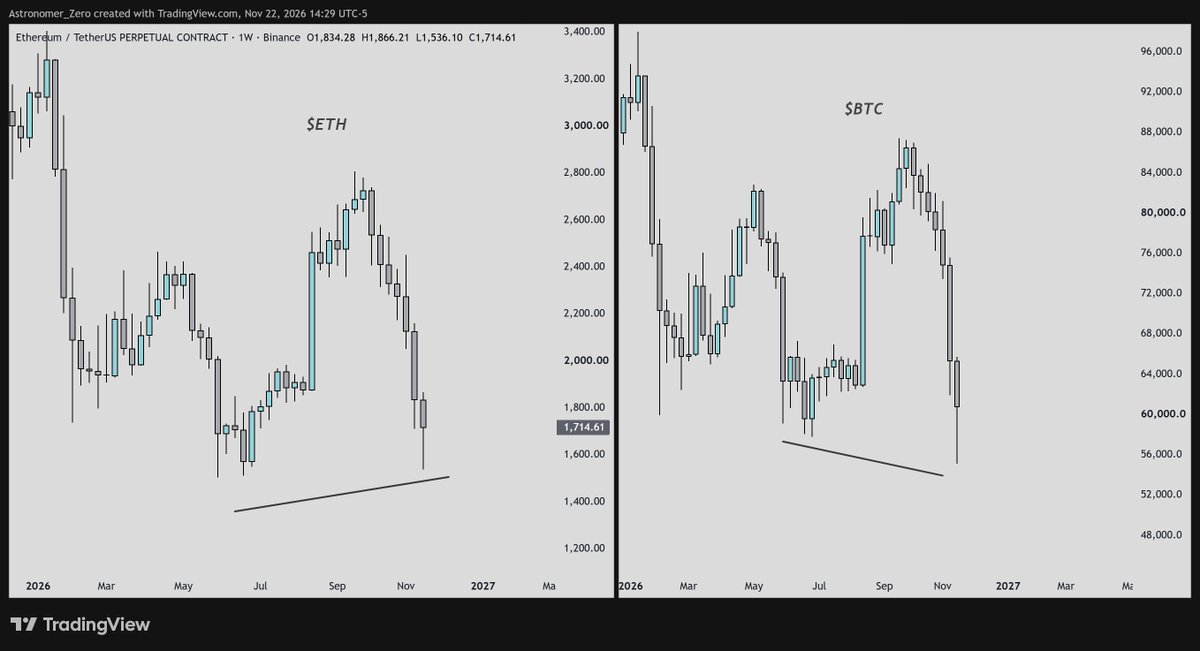
The fourth confluence is $eth-$btc mmd.
What's that? Since I have a lot of new followers: quick explanation.
When $eth makes a higher low and $btc makes a lower low, while they are generally highly correlated, that signifies manipulation of one of the assets out of their typical steady-state behaviour.
Where there is manipulation involved, there is interest, and so interest is at highs and lows where market makers like to do business.
Hence mmd (market maker divergence) is a great uncorrelated confluence we can ad to our stack.
So here's another gift.
Enjoy, and have a great time ahead.
$btc
56k, well hello. My macro bottoming masterplan, revealed, part 1.
claim 1: a bottom is soon, and price is not going sub 50k imo.
Alright, as promised, here are the pieces coming together of why I think bitcoin bottoms out soon here (not yet, but soon) while fear strikes at peak rates into the bitcoin market.
No, I have not bought in yet (execution != planning). But as bitcoin believers, we all hold some spot regardless, no matter from where it might be.
I have for example remainders from the last 2 cycles, and I also started buying in this bottoming range in the low 60 k's as you know.
And after my weeks and months of the bearish saga, now I no longer believe there is reason to project any bearishness, hence why I transitioned from closing shorts (phase 2), to phase 3: planning for longs.
I also want to repeat myself: this post is pre-emptive, the bottom is not in yet to precision, hence my broader claim: "it is not going below 50k".
So this post indeed not oriented towards pinpointing precisely towards "the bottom is now", even if I will try to pinpoint it in the near future, it's just not the goal of this post nor the masterplan.
What I want to express to you instead, is a margin close enough to give confidence in believing a bottom is nearly here, and give you confidence that bitcoin isn't going to often claim catastrophically low prices, I don't think it will.
And so here at 56k, I think 50k is both the technical, as well as reasonable margin of a very good confidence-ensuring bottom.
For local precision, we still need to take out the weekend lows. But let's not worry about local PA right now any further and maintain scope.
On high timeframes, this is what I am sharing now, to ease your mind, to help you relax and to share my opinion on why I think the market is bottoming soon indeed.
Keep in mind, what I share below, is just one reason, there are many more reasons why I think we bottom out soon enough. But everything starts with one reason.
And because there is a lot of panic out there, I started here with sharing the second strongest reason already (strongest reason to follow, stay tuned).
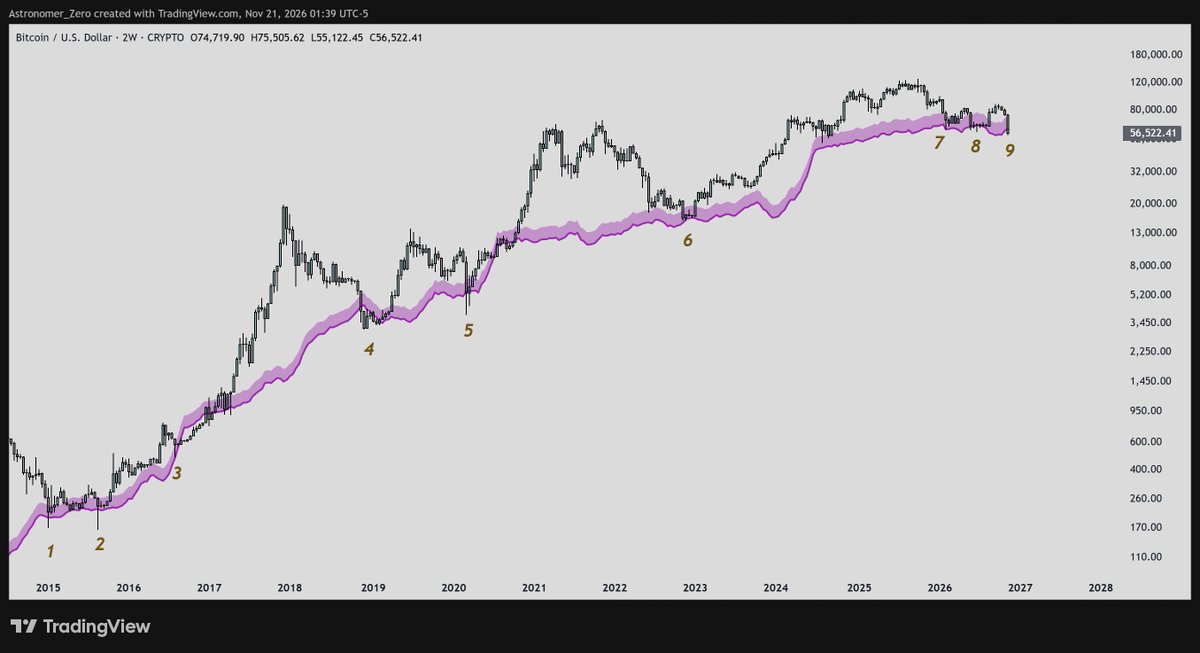
That reason, is "Bitcoin's production cost."
I talked about it a few times already and started it a little over two years ago, and how it always appears close at bitcoins most fearful times.
For good reason, because it's quite literally when the entire bitcoin network faces global economical constraint, as the biggest whales become compromised, and where the weakest "whale bitcoin businesses" get weeded out.
What does the above mean exactly?
Well, the biggest whales, are collectively, still to this day, the big mining companies mining bitcoin every day and every night. And if you think miners are irrelevant, keep reading because nothing is further from the truth.
They still control the majority of the supply (if you do the math, they gain more than micro strategy itself on a frequent basis, we can discuss the exact math on that in the comments, challenge this).
So bitcoin's economics is still driven by miners, just like any commodity is. For example, the same is true for gold and silver mining companies. And the same relation is true for oil and oil giants.
So how does this analysis work for bitcoin?
I'll keep it simple to not overwhelm but allow me to elaborate.
It all starts with the estimated electricity cost required to produce one BTC.
If we look at that exact cost, then the conclusion is rather remarkable.
Across more than 10 historical occurrences (of which the 8 most recent ones projected on the chart), in which Bitcoin traded close to or just below its estimated electricity production cost, these conditions had consistently coincided with exceptionally attractive long-term accumulation opportunities.
And given the current market conditions, I believe it is worth revisiting this metric, because the underlying economic reasoning is strong and current.
Let's put some logic behind it.
Bitcoin mining is, fundamentally, an economic activity. Miners deploy substantial capital into infrastructure, hardware, and electricity, with the objective of producing Bitcoin at a cost sufficiently below its market value to maintain a profitable operation.
But there are rare periods during which this relationship becomes inverted.
Meaning, the market price of Bitcoin falls below the estimated electricity expenditure required to produce one BTC.
This creates an interesting economic imbalance.
Not only does mining become increasingly unattractive for less efficient operators, but it also raises a rather obvious question:
Why would an operator continue spending more on electricity to produce one Bitcoin when that same Bitcoin can simply be acquired on the open market at a lower price?
Of course, the reality is somewhat more complicated. Mining operations involve fixed investments, contractual obligations, varying electricity prices, and substantial differences in operational efficiency.
Also, electricity expenditure represents only one component of total production costs.
Nevertheless, the underlying principle remains important because total electricity cost is the bare minimum of the opex of any big mining company. And that's why I believe it's a bottom signal and why it has worked every time.
See, as mining profitability deteriorates, marginal operators face increasing pressure to reduce production, improve efficiency, or temporarily shut down their equipment. This process can eventually contribute to a reduction in network difficulty, allowing the remaining operators to produce Bitcoin more efficiently (that's why the production cost may drop temporarily).
In other words, the mining industry has a built-in economic adjustment mechanism.
Now, why is this relevant to Bitcoin's price?
Because historically, periods during which the market price fell below the estimated electricity production cost have tended to coincide with conditions of substantial market stress.
And these conditions have rarely persisted indefinitely.
In my analysis, I documented 17 historical occurrences, all of which ultimately proved to be highly attractive long-term buying opportunities.
Some of the more notable examples included:
→ December 2018, around $3,500.
→ March 2020, around $4,700.
→ June 2022, around $18,000.
→ November 2022, around $16,500.
→ Feb 2026, around $60,000.
→ June 2026, around $60,000.
The historical consistency was remarkable, although it is important to distinguish between a recurring historical relationship and a statistically guaranteed outcome. These observations are not necessarily independent, and the precise conclusions depend on how individual occurrences are defined.
But bitcoin is at 56k right as we speak, and todays estimated E-cost is at 60.3k (this is a broad estimate).
So laying out 50k as a floor, that is about 17% excess which only has been exceeded once in the past.
But those times didn't last long and were simply very strong buying opportunities.
The E-cost eternally trends up broadly speaking, which is why, these prices may not last very long when viewed on a macro basis.
Conclusion
And so given the reasons above, that is why, I consider this metric valuable.
Not because it predicts the exact bottom, but because it provides an additional perspective on how far market valuations have deviated from the underlying economics of Bitcoin production.
Economics which never have been breached for an extended period of time.
Will history repeat itself?
That remains to be seen.
And as mentioned, this is just one of many metrics.
This one, certainly starts with a strong economical global backbone as to why bitcoin should find strong liquidity generation here, which, is of course tied to a (should I say the word...) "bottom".
Hence why I believe this is one of those indicators that deserves considerably more attention whenever Bitcoin enters periods of substantial downside pressure.
This, is the beginning of phase 3 in my personal bitcoin plan.
ethereum:0x455e53cbb86018ac2b8092fdcd39d8444affc3f6 — THE POLYGON VALUE-CAPTURE BET
⠀
A roughly $859 MILLION cryptocurrency.
⠀
More than 10.6 BILLION tokens circulating.
⠀
A network holding approximately $2.8 BILLION in stablecoins.
⠀
And a token trading approximately 94% below its tracked POL all-time high.
⠀
But here's the contradiction.
⠀
Polygon has meaningful users, liquidity, and transaction activity.
⠀
Yet network adoption must still overcome token issuance and competition to create lasting value for POL.
⠀
Is ethereum:0x455e53cbb86018ac2b8092fdcd39d8444affc3f6 an overlooked infrastructure turnaround?
⠀
Or does inexpensive blockchain execution remain difficult to monetize?
⠀
Let's examine the numbers.
⠀
01 | WHAT IS POLYGON?
⠀
Polygon is a blockchain infrastructure ecosystem.
⠀
POL replaced MATIC as the gas and staking token of Polygon PoS, now also described as Polygon Chain.
⠀
Its broader strategy includes connecting blockchain environments through aggregated infrastructure.
⠀
The investment thesis combines:
⠀
• Low-cost transactions
• Stablecoin activity
• Application infrastructure
• Staking demand
• Broader ecosystem expansion
⠀
But Polygon's products should not be treated as one automatic revenue stream.
⠀
Each product needs an identifiable mechanism connecting its activity to POL.
⠀
02 | THE NUMBERS THAT MATTER
⠀
November 17, 2026 snapshot:
⠀
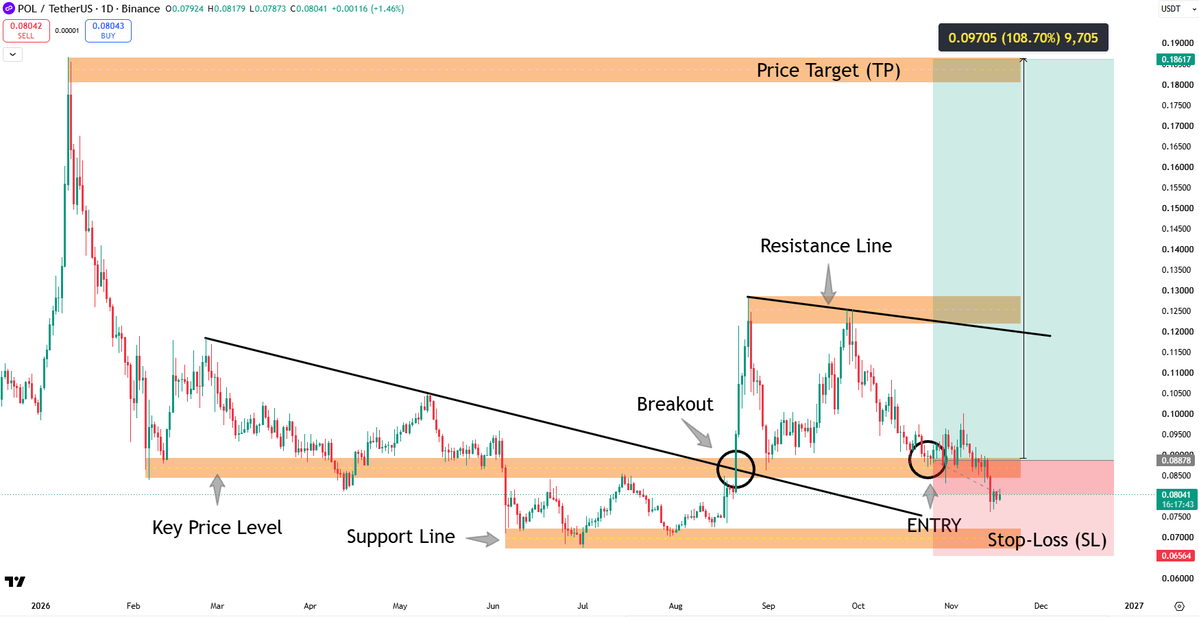
POL Price: ~$0.08065
Market Cap: ~$859M
Reported FDV: ~$859M
Circulating Supply: ~10.651B POL
Reported Total Supply: ~10.651B POL
Maximum Supply: No fixed cap
Circulating / Reported Total Supply: ~100%
24H Trading Volume: ~$41M
Tracked POL All-Time High: ~$1.29
Decline From That High: ~93.7%
⠀
NETWORK FUNDAMENTALS:
⠀
DeFi TVL: ~$605.4M
Stablecoin Market Cap: ~$2.797B
Daily DEX Volume: ~$61.9M
Daily Chain Fees: ~$41,380
Daily Chain Revenue: ~$28,642
Daily Transactions: ~4.06M
Daily Active Addresses: ~281,057
⠀
FDV matching market capitalization does not mean future dilution has ended.
⠀
POL has ongoing issuance.
⠀
03 | THE MATIC MIGRATION
⠀
POL's initial supply matched MATIC's 10 billion tokens through a 1:1 migration framework.
⠀
The change expanded the token's intended role.
⠀
It did not automatically increase the economic value of each token.
⠀
Investors should also separate price-history datasets.
⠀
The approximately $1.29 high quoted here belongs to CoinGecko's tracked POL series.
⠀
It should not be presented as the historical high of the entire MATIC-to-POL investment history.
⠀
A migration changes token infrastructure.
⠀
It does not erase the need to examine supply, usage, and valuation.
⠀
04 | THE STABLECOIN OPPORTUNITY
⠀
Polygon's approximately $2.8 billion stablecoin base is a meaningful starting point.
⠀
Stablecoins can support payments, trading, settlement, and application liquidity.
⠀
But balances and economic throughput are different.
⠀
A stablecoin can remain idle.
⠀
It can move frequently while paying very little gas.
⠀
Or it can generate substantial application revenue that primarily accrues to another business or token.
⠀
POL's investment case strengthens when stablecoin activity creates durable demand for its blockspace and security.
⠀
The size of the stablecoin pool alone does not establish that outcome.
⠀
05 | THE NETWORK REVENUE QUESTION
⠀
DefiLlama reports approximately $41,380 in daily chain fees.
⠀
Its reported chain revenue is approximately $28,642.
⠀
These figures are economically different from corporate sales and net profit.
⠀
Polygon's base-fee mechanism allocates fees toward burning.
⠀
Other fee components support network participants.
⠀
Application revenue should also be kept separate.
⠀
A successful application on Polygon does not necessarily distribute its profits to POL holders.
⠀
The useful question is:
⠀
How much of the activity creates token demand, fee-funded staking income, or permanent supply reduction?
⠀
06 | THE TOKEN VALUE-CAPTURE MODEL
⠀
POL has direct functional roles:
⠀
• Paying transaction fees
• Staking to support network security
• Receiving eligible staking rewards
⠀
Base-fee burning provides another economic channel.
⠀
However, these mechanisms work differently.
⠀
Gas requires spending POL.
⠀
Staking commits POL and exposes participants to operational and protocol risks.
⠀
Burning reduces supply.
⠀
Rewards can include newly issued tokens.
⠀
Passive ownership does not provide an automatic cash dividend.
⠀
Investors need to evaluate the combined result rather than treating every mechanism as equivalent income.
⠀
07 | THE INFLATION AND BURN BALANCE
⠀
The current emission-manager implementation specifies approximately 2% annual compounded issuance.
⠀
It splits new issuance between the staking layer and community treasury.
⠀
That funding can support security and ecosystem development.
⠀
It also expands gross supply.
⠀
Fee burning can offset issuance.
⠀
But a burn mechanism does not guarantee persistent deflation.
⠀
The comparison must use the same period:
⠀
New POL issued.
⠀
Against POL permanently removed, with careful treatment of fees collected for a later burn.
⠀
Counting fee accrual and its eventual destruction twice would overstate value capture.
⠀
08 | THE STAKING YIELD TEST
⠀
A staking reward percentage is incomplete without identifying its funding source.
⠀
Newly issued rewards redistribute ownership while expanding supply.
⠀
User-funded rewards come from economic activity.
⠀
PIP-85 allocates a share of post-commission priority fees to stakers.
⠀
PIP-92 describes distributing approximately 27.33 million POL of accumulated staker fees through the existing reward mechanism.
⠀
Its specified distribution window runs from October 1 to December 1, 2026.
⠀
That temporary distribution should not be extrapolated into a permanent yield.
⠀
Sustainable staking economics depend on recurring fees, issuance, commissions, and participation.
⠀
09 | THE SUPPLY AND UNLOCK QUESTION
⠀
CoinGecko classifies approximately 100% of its reported current total supply as circulating.
⠀
That reduces the usefulness of a simple low-float investment narrative.
⠀
It does not imply that every token is actively traded.
⠀
Nor does it eliminate future supply growth.
⠀
For POL, ongoing emissions and treasury deployment deserve particular attention.
⠀
Migration accounting also matters.
⠀
MATIC and POL balances should not be casually added together as independent economic supplies.
⠀
The relevant analysis follows the migration mechanism and avoids double counting.
⠀
10 | THE COMPETITIVE AND VALUATION TEST
⠀
Polygon competes for developers, liquidity, and users against Ethereum scaling networks and other execution platforms.
⠀
Its challenge is retaining activity while preserving useful economics.
⠀
Low fees help customers.
⠀
They can also limit token demand per transaction.
⠀
Broader infrastructure adoption only strengthens POL when its economic connection is demonstrated.
⠀
Using approximately 10.651 billion current tokens:
⠀
$0.10 POL implies ~$1.07B valuation.
$0.25 implies ~$2.66B.
$0.50 implies ~$5.33B.
$1.00 implies ~$10.65B.
⠀
These are valuation illustrations, not price targets.
⠀
Future issuance can increase the valuation implied by each fixed price.
⠀
A low unit price does not automatically mean a low valuation.
⠀
11 | THE BULL AND BEAR CASE
⠀
THE BULL CASE:
⠀
Stablecoin and payment activity expands.
⠀
Applications generate sustained demand for blockspace.
⠀
Fee-funded staking income becomes more meaningful.
⠀
Burning increasingly offsets issuance.
⠀
And broader infrastructure products demonstrate additional POL demand.
⠀
THE BEAR CASE:
⠀
Activity remains concentrated or incentive-sensitive.
⠀
Competing networks attract developers and liquidity.
⠀
Low transaction costs produce weak monetization.
⠀
Issuance continues to exceed supply removal.
⠀
And ecosystem growth benefits applications more than the underlying token.
⠀
A busy blockchain can still produce disappointing token returns.
⠀
12 | THE FINAL VERDICT
⠀
Polygon has measurable economic activity.
⠀
Billions in stablecoins.
⠀
Hundreds of millions in DeFi deposits.
⠀
Millions of daily transactions.
⠀
And users paying real network fees.
⠀
That gives POL an operating foundation to evaluate.
⠀
But the investment case depends on what remains after issuance, participant compensation, and competitive pressure.
⠀
A roughly $859 million market capitalization.
⠀
More than 10.6 billion circulating tokens.
⠀
Ongoing emissions.
⠀
And a value-capture model that requires careful accounting.
⠀
The next major catalyst is evidence that adoption produces sustained improvements in token economics.
⠀
More transactions create activity.
⠀
More paid usage creates fees.
⠀
Fee-funded security and lasting supply reduction strengthen the connection to POL.
⠀
The decisive question is whether that connection improves faster than the token supply grows.
⠀
Bookmark this analysis before the next Polygon rotation.
⠀
Which has the strongest long-term infrastructure thesis?
⠀
ethereum:0x455e53cbb86018ac2b8092fdcd39d8444affc3f6 , $ARB, or $OP?
⠀
And can Polygon turn its existing adoption into sustainable token value?
⠀
Drop your view below.
⠀
📊 Full analysis & trading setups ↓
https://t.co/1pDZVclbWY
$MSTR
Another brutal day in the market.
Nearly $3 billion in market cap wiped out, with mNAV creeping closer to 1X.
This post is for MSTR shareholders.
It has been a brutal year for Bitcoin, but especially $MSTR. There’s no two ways about it.
Common shareholders have been beaten down by critics, sentiment and Bitcoin’s price action, all while the company has had to rely on them to fund its next transition.
The MSTR shareholders have my utmost respect.
These are the same people who watched the stock climb from the teens to an intraday high of $543, then fall all the way towards $80…
They then witnessed a 100% recovery towards $160 and beyond, only to find themselves approaching those lows again.
And yet, very little seems to have shaken their conviction.
All this while @Strategy has raised billions through the common to build its USD reserve and is now tapping the common on a weekly basis to support $STRC buybacks.
The common shareholders have stood by the company through it all.
It’s genuinely remarkable to see the level of conviction this community has demonstrated.
These individuals have experienced the ultimate test of what it means to invest in amplified Bitcoin.
It could get worse from here. There may be more pain ahead, but I don’t think that’s going to faze this community.
For my part, I’m prepared to take on more risk as I look to expand my position.
One of the biggest lessons I’ve learned through this journey is the ability to separate emotion from conviction. It’s something every investor should strive to develop.
Look at the balance sheet Strategy has built.
It has had almost everything thrown at it this year and has continued to stand strong.
And ironically, that’s the power of Bitcoin.
I have little doubt we’ll be chasing those 100% moves again when Bitcoin finds its footing.
But for now, we acknowledge the pain, recognise the resilience, and accept that there may be more to come.
To all Strategy shareholders, you guys are legends.
Stay the course.
Mission: Strategy.
$BTC $MSTR $STRC
a massive pump has been due on Polygon ( $POL ) for whatever it’s been building over the last couple of years…
>$3T+ in cumulative stablecoin transfer volume
>$933B in stablecoin transfers during 2025
>Visa stablecoin settlement integration
>Mastercard payment infrastructure integration
>Revolut & Stripe adoption
>BlackRock’s BUIDL fund on Polygon
>TRON + Solana added to Polygon OMS
>Coinme acquisition
>Sequence acquisition
>Major Rio & Madhugiri upgrades
>POL staking, transaction fees & token burns
>Expanding global payments infrastructure
Polygon keeps building while $POL trades far below its ATH, not tor long
❤️ My beautiful boy deserves to be remembered with love, not hate. ❤️
Yesterday, a Coventry fan used a photograph of Bradley to taunt Sunderland supporters.
As Bradley’s mam, this is heartbreaking, especially as it’s one of my favourite photographs of him. Just look at that smile.
I remember that day like it was yesterday. He was so happy, having so much fun. Those moments were precious because they were few and far between. So much of Bradley’s short life was spent battling cancer and enduring treatments no child should ever face.
To see such a beautiful memory used in such a cruel way really does make my heart hurt. 💔
We are a football-loving family who follow Sunderland home and away. I’m all for football banter, but surely mocking a child who died from cancer is not banter?
I hope the club takes appropriate action and the young lad’s family help him understand how hurtful his actions were. I don’t want hatred directed towards him, so please please don't, just for him to learn from this.
Behind that photograph is a little boy who was loved beyond measure and a family who miss him every day.
Thank you to everyone who has defended Bradley and shown us so much love. It means more than you know. ❤️
What some people don’t realise is that Bradley’s story didn’t end when his life did.
Because of Bradley, children’s lives are being saved, hundreds of families have received vital support, and children facing unimaginable battles are being given hope.
Through Super Brad’s Pad, families can escape hospital life, spend precious time together and make memories that last forever.
That is Bradley’s legacy. The difference my little boy continues to make in this world. No amount of cruelty will ever take that away.
So rather than let this photograph be remembered for hatred, I want it remembered for what it truly represents.
My beautiful little boy, enjoying one of the happiest days of his life, with the biggest smile on his face. 💙
That is how I want the world to remember him.
#CancerHasNoColours ❤️💙🤍💚🩷🖤🧡
Kudos to @binance for how they handled this.
They moved fast, their comms team were always on.
They assured the market the losses are covered and user fund safe.
They mobilized their network to freeze funds fast.
The event may have been avoidable but it was well handled and prevented an I industry collapse.