My cancer case is n=1. I'm not holding it up as a model, because most of what I did is not specifically replicable or scaleable. But it is a proof of concept that fully personalized medicine, built around one patient's own biology, is viable in ways it simply wasn't a few years ago. I have lived a version of the future of cancer care that I think is worth aspiring to more broadly.
Many of the tools that made this future possible for me are getting better, faster, cheaper, and more accessible every year. I think what we need next is the infrastructure to deploy these tools, and the community willing to build this infrastructure, one patient at a time.
I want to help that future arrive faster. I wrote an article in The Cancer Letter https://t.co/ejel0unTvr for the physicians and researchers closest to the patients who could benefit most from this approach, who also believe in this future. If you are working towards building the systems and practices that will make personalized medicine operationally real, we want to collaborate with you too.
You could aspire to be an influencer who spreads misinformation…
Or to become a badass scientist who gets to play a role in the race to cure cancer.
If we want to lead the world, we must respect science and the people who do the job. It’s that simple.
this applies to so much more than just oncology. when in a new space, trying to bring in old mindsets and ways of doing things won't work well. ditch the outdated ways and think outside the box.
Here's a rant. One of the biggest problems I have with the oncology world today is that even the best oncologists don't seem to understand that they're treating cancer today in ways that may become quickly outdated. "That's what we used to do," they'll say. "Those were the best practices. I change when the data changes." And they'll be saying it to cancer patients whose AI programs are telling them that IF they had the right biopsy and IF they had been set up properly, there would be a Plan B (or C or D) treatment for them. I'm talking about the best of the oncology world, not the hacks treating the desperate herd in the clinic with something that's already outdated. Oncology as a rule is not good at tech adoption. For the bulk of the profession outside the academic centers, it's bad. Cancer patients are living longer. The cancer patient who's traumatized by a new Stage 3 diagnosis is not the cancer patient that will still be coming to them in 3 or 4 years. Someone who is still alive, but not cured. That cancer patient needs their oncologist to take things a few steps further. To think ahead. Be a Scout. Be prepared. To, gasp, think outside the box a little. That new patient you have won't be able to tell you that. But the vet that comes back to you in a few years will -- often when it's too late. That is all.
https://t.co/hWfVpWuyt1
Finally, a higher quality communication on AI in biology: 15 Challenges for generative AI applications to cell biology.
It covers the problems with the one protein/one drug to treat disease, the need to think at a systems biology level and the role of immune dysregulation in disease states. We really need better diagnostics to detect problems sooner, better treatments and less grandiose sweeping generalizations
The communication on AI has been kind of awful so far. Constantly hearing “disease cures in 5 years” gets old. Pharmaceuticals can only take us so far, the root cause of disease is complex. Trial and error and failures are expensive and time consuming.
AI has so much potential to be helpful in so many fields, esp with data and patterns, and math. It has saved me hours of time at work, and given me a lot of extra creative power elsewhere, but so not convinced of cures in 5 years
A futurist is one who strives toward the vision of the best possible future that STEM can give us, who peers over the horizon and envisions what could be in the greatest possible terms
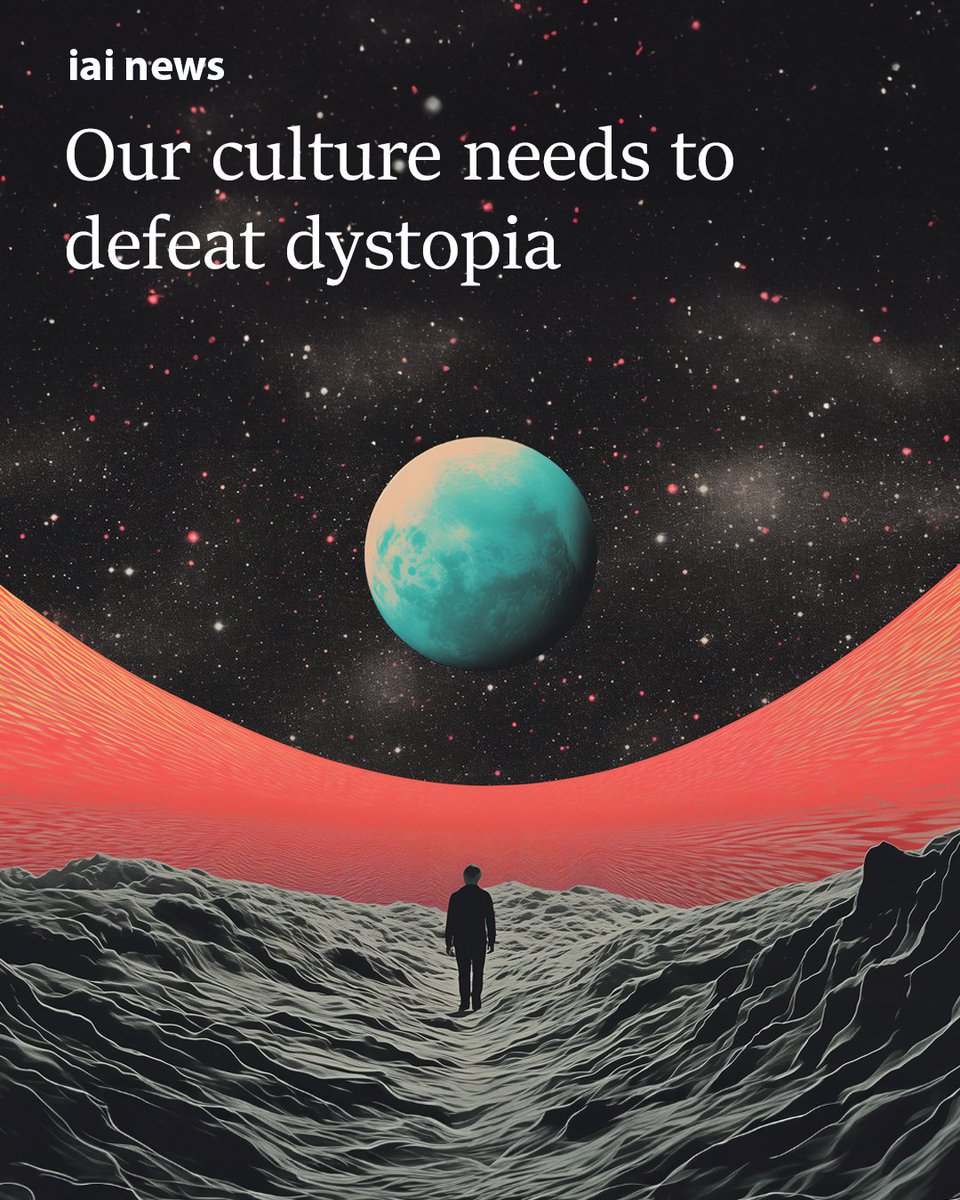
Visions of the future are dominated by dystopian anxiety, leaving us paralysed by despair. https://t.co/XBmV2G9LrU
But Samuel McKee argues this pessimism ignores our technological reality. We must translate today's breakthroughs into compelling cultural narratives, and should all become futurists.
We have a newer technology out that is growing more capable very quickly. There is no reason why we can’t use a great technology to advance many systems and structures in society. There are a lot of ways this could play out, but it shouldn’t be decided by just a few companies and people and shouldn’t be over or under regulated.
It would be nice to see more middle of the road examples, like how AI has played out in radiology. And less of the extremism views — like automating everything and saving the world vs 50% of people losing their jobs.
Surely we aren’t so incompetent as a society that people will lose their abilities to earn a living or have purpose and agency in life. The creativity and intelligence of humanity will always be needed.
I'm a cardiologist. I've held dying hearts in my hands in the cath lab at 3 AM. And I need to tell you something that changes everything about how we prevent heart attacks.
For decades, the entire field was built on one target: lower LDL cholesterol. Statins save lives — that's settled science. But too many of my patients did everything right — took their statins, hit their numbers, lived clean — and still ended up on my table with a ruptured artery.
We were treating the smoke while the fire kept burning.
The fire is inflammation. And the evidence is now overwhelming.
The CANTOS trial proved it first — lowering inflammation independent of cholesterol reduced cardiac events. But the newer data is what keeps me up at night.
AI-enhanced CT angiography can now detect inflamed arteries by measuring changes in the fat surrounding your coronary vessels — the perivascular fat attenuation index. Higher inflammation in the fat around even one artery independently predicts cardiac death. When multiple arteries show inflammation, the risk multiplies dramatically — even in patients whose cholesterol looks perfect.
This isn't theoretical. This is measurable. Right now. On a scan you can get this month.
Low-dose colchicine — a drug that's been around for centuries for gout — is now FDA-approved specifically for reducing cardiovascular events. It works by quieting the inflammatory cascade that destabilizes the plaque sitting in your arteries. A pill that costs pennies is saving lives the statins couldn't reach.
And the next wave is already in Phase 3 trials. Ziltivekimab — an IL-6 inhibitor — targets the central inflammatory pathway driving atherosclerosis. Phase 2 data showed a 90% reduction in hsCRP. The ZEUS cardiovascular outcomes trial is enrolling now, with results expected late 2026 into 2027. If positive, anti-inflammatory therapy will become standard in managing heart disease alongside lipid-lowering. The era of inflammation-targeted cardiology is arriving.
But it goes deeper than drugs. AI is now predicting heart failure and cardiac events 5+ years before symptoms — integrating CT imaging, electronic health records, and genetic data with accuracy that jumps far beyond traditional risk calculators.
And polygenic risk scores — a simple genetic test that flags inherited cardiovascular risk — are now formally recognized as a risk-enhancing factor in the 2026 ACC/AHA guidelines. A single blood draw can reveal risk that's been silently building since birth. Decades before the first chest pain.
Here's what this means for you right now — today:
Ask your doctor for a high-sensitivity CRP test. It's cheap, routine, and measures the systemic inflammation that standard cholesterol panels completely miss. You can have perfect LDL and inflamed arteries that are quietly preparing to rupture.
If your hsCRP is elevated, discuss low-dose colchicine with your physician. It's FDA-approved for exactly this.
Push for a coronary CT angiography with AI plaque and inflammation analysis if you have risk factors. This isn't the stress test your parents got. This is 3D visualization of your actual arteries — with AI quantifying not just how much plaque you have, but what kind it is and whether the surrounding tissue is inflamed.
Consider polygenic risk score testing — especially with a family history of early heart disease. It's now guideline-supported.
And the foundation that never changes: move daily, eat real food, sleep 7-9 hours, manage stress, and know your numbers — ApoB, Lp(a), hsCRP, fasting insulin.
I left Iran as a child with nothing. I rebuilt everything in a country that gave me the freedom to become a physician. I've spent twenty years watching patients get second chances.
The ones who haunt me aren't the ones who died on my table. They're the ones who survived but never acted on what the science was telling them — years before the event that didn't have to happen.
You can have perfect cholesterol and still have a heart attack. Inflammation plus genetics can drive plaque rupture in arteries that look "fine" on a standard panel.
The myth that normal cholesterol means you're safe has cost more lives than I can count.
We now have the tools to detect the fire — not just the smoke. AI to see it. Genetics to predict it. Drugs to quiet it. And the ancient basics — movement, real food, sleep, purpose — to prevent it from starting.
Prevention is the new cure. And the science to make it real is no longer coming.
It's here.
"Asking the right question is the hardest part of science. What’s the right hypothesis that’s worth exploring and worth doing science on? We don’t fully understand how that level of creativity works in human experts, and we certainly don’t have it yet in our AI systems."
AI as the Ultimate Tool for Science: A Conversation with Demis Hassabis https://t.co/WiiHvcoo2P
run a business, read a book, solve a problem, create things, think for yourself..... all necessary wonderful life skills. AI can assist, you can direct.
Prolonged AI use may make it harder to think critically and creatively, recent research suggests. But there are ways to keep the brain fit https://t.co/lx9TfHrG1C
💬 Perspective by Alon Bergman, PhD, @Bob_Wachter, MD, and @ZekeEmanuel, MD, PhD: As US health care faces workforce shortages and rapid advances in clinical #AI, existing FDA device regulation is inadequate for adaptive, general-purpose AI systems that make care determinations without per-case clinician review.
The proposed licensure framework for autonomous clinical AI includes standardized competency assessment, supervised practice, ongoing evaluations, clear accountability, and federal-state coordination, aiming to ensure safe use and mitigate regulatory fragmentation.
https://t.co/6tpAdQZTOY
I have been enjoying snowboarding and snowshoeing in the mountain west for over 30 years. Had avalanche training but wouldn't feel comfortable snowboarding backcountry without at least an airbag and other gear. It is really hard to understand and sad & tragic that even with guides, a group still went out in the storm. I was at Lake Tahoe last week and had multiple avalanche warnings on my phone early on. It would also be nice if ski resorts would more publicly share what avalanche mitigation is being done before we hit the slopes. We can take a calculated risk, but nothing is 100% guaranteed.
BREAKING: White House issues new policy that will require, by 2026, all federally-funded research results to be freely available to public without delay, ending longstanding ability of journals to paywall results for up to 1 year. Coverage coming on @ScienceInsider.
Small but mighty! This is a video of a killer T cell of the immune system destroying a monstrous ovarian cancer cell. I recently captured this data on a spinning disc confocal microscope.
Bittersweet announcement but after an amazing 2 years as an infectious disease expert I am moving on. I am now an expert in no-fly zones and Eastern European affairs. Excited to make the most of this new opportunity.
BC is just the worst. Chocolate chip cookies at 9am, long lift lines, the worst runs in the world, horrible parking……..everyone should go to Vail. We want it all to ourselves.
I’ve been thinking the last few days how it’s hard for non-specialists, watching a twitter spat between apparent experts, to know who to believe. Here are a few things I bear in mind when following people outside my own field. A far from exhaustive list 1/n
In this scenario, the cost of publication is covered by an Article Processing Charge (APC) paid at the time of publication. The APC for Nature Neuroscience in 2022 is €9,500/US $11,390/£8,290.