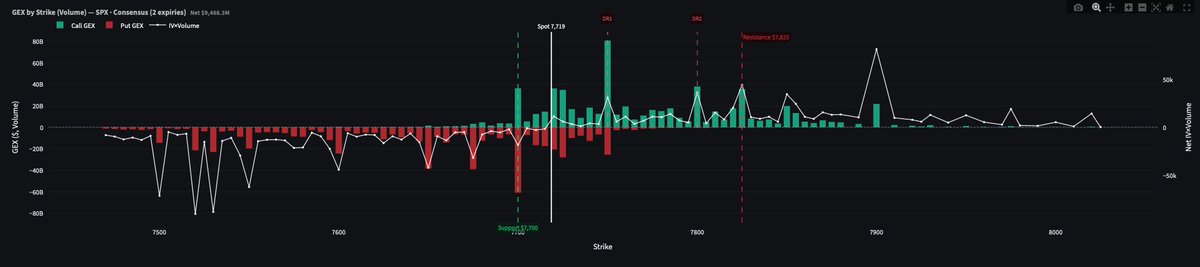
SPX gamma in one sentence:If GEX is still supportive, dips get bought until a level actually breaks.
If it flips, the same dip becomes fuel.I stopped paying for that sentence and built the screen myself.Regime first. Ticker second.
“He who knows that enough is enough will always have enough.” — Laozi, Tao Te Ching
This is not a hymn to modest living. It is a stop-rule for the hour when appetite and speech both feel entitled to one more turn.
The surface reading is contentment. The mechanism is tighter: the day makes the next claim feel like justice rather than surplus. Intensity is taken for evidence that the account is still open. The line prices that error. Enough is not a mood that arrives. It is the point at which you refuse to keep adding.
What it asks for while this weather holds is to leave the extra sentence unsaid and the extra reach unmade. Keep what already stands. Do not spend the brightness as if it were credit.
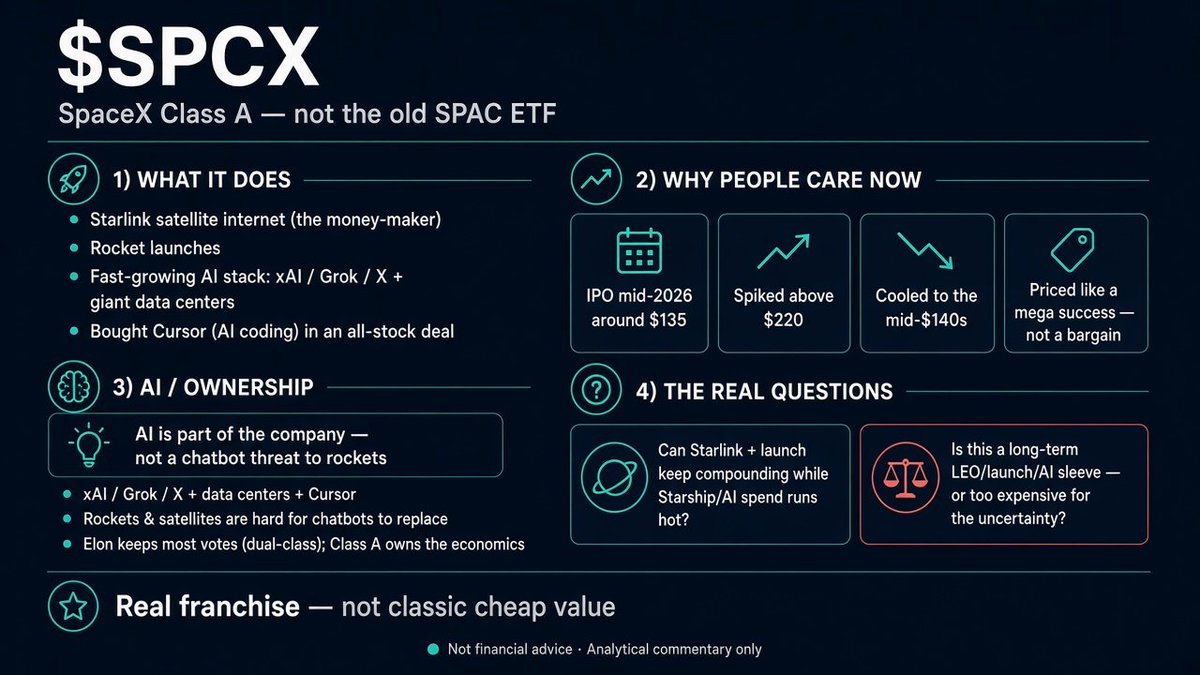
$SPCX is SpaceX Class A stock — not the old SPAC ETF (that’s now SPCK).
Why people care now
IPO’d mid-2026 around $135, spiked above $220, then cooled to the mid-$140s.
Still priced like a mega success story — not a bargain.
What it sells
Three big things:
• Starlink satellite internet (the money-maker)
• Rocket launches
• A fast-growing AI stack — xAI / Grok / X plus giant data centers. They also bought Cursor (the AI coding tool) in an all-stock deal.
Who controls what
Elon keeps most of the votes through dual-class shares. Public Class A still owns the economics of Starlink, launches, xAI, and Cursor.
AI / big-tech angle
AI isn’t a chatbot threat to this business — it’s part of the company.
Rockets and satellites are hard for chatbots to replace. Sticky inflation and likely rate hikes are a mild headwind for expensive growth stocks; the company itself has a huge cash pile.
Wonderful moat in Starlink + reusable launch. Starship and AI spends make the future harder to predict, and governance is concentrated.
The real questions
Can Starlink + launch keep compounding while Starship and AI spend run hot?
Is this a long-term “own the LEO / launch / AI stack” sleeve — or too expensive for the uncertainty?
Real franchise. Not classic cheap value.
Not financial advice. DYOR. Educational purposes only
$GIS is General Mills — Cheerios, Nature Valley, Pillsbury, Blue Buffalo, and more.
Classic packaged food + pet.
FY26: organic sales −2%, adj. EPS −16%. Dividend yield ~6.5%+ on a beaten-up staples name.
Cash cow. Not a growth story.
Why it’s in a grind
Tight wallets → weaker volumes.
FY27 guide reaffirmed: organic roughly flat (−1.5% to +0.5%), adj. EPS $3.00–$3.20 (down YoY on mechanical headwinds).
Any tie to the big AI companies?
Yes — mainly Google Cloud.
• BigQuery / Vertex AI • Internal MillsChat on Google PaLM 2 • Palantir for supply-chain AI (Project ELF)
— not an “AI ticker” story.
The real questions
Can brands + cost cuts stabilize earnings — or is the high yield a trap?
Threat = private label + tight wallets + input costs. Not ChatGPT eating cereal.
Not financial advice. DYOR. Educational purposes only.
$CAG is Conagra — Birds Eye, Healthy Choice, Marie Callender’s, Banquet, Slim Jim, Duncan Hines, and more.
Mostly U.S. frozen + snacks.
FY26: organic sales roughly flat/slightly down; adj. EPS $1.72. Stock ~$14–15 on a ~$7B company.
Repair-mode staple. Not a growth story.
Why it’s in a grind
Stressed shoppers + pricing into inflation → weaker volumes.
FY27: organic −1% to −3%, adj. EPS guided to $1.40–$1.50. Big goodwill write-downs. Dividend cut ~50% to ~$0.70/year to cut debt and reinvest.
Stock has been grinding while they reset.
The real questions
Can brands + cost cuts stabilize earnings — or does the repair take longer than the balance sheet likes?
AI isn’t the story here.
Not financial advice. DYOR. Educational purposes only.
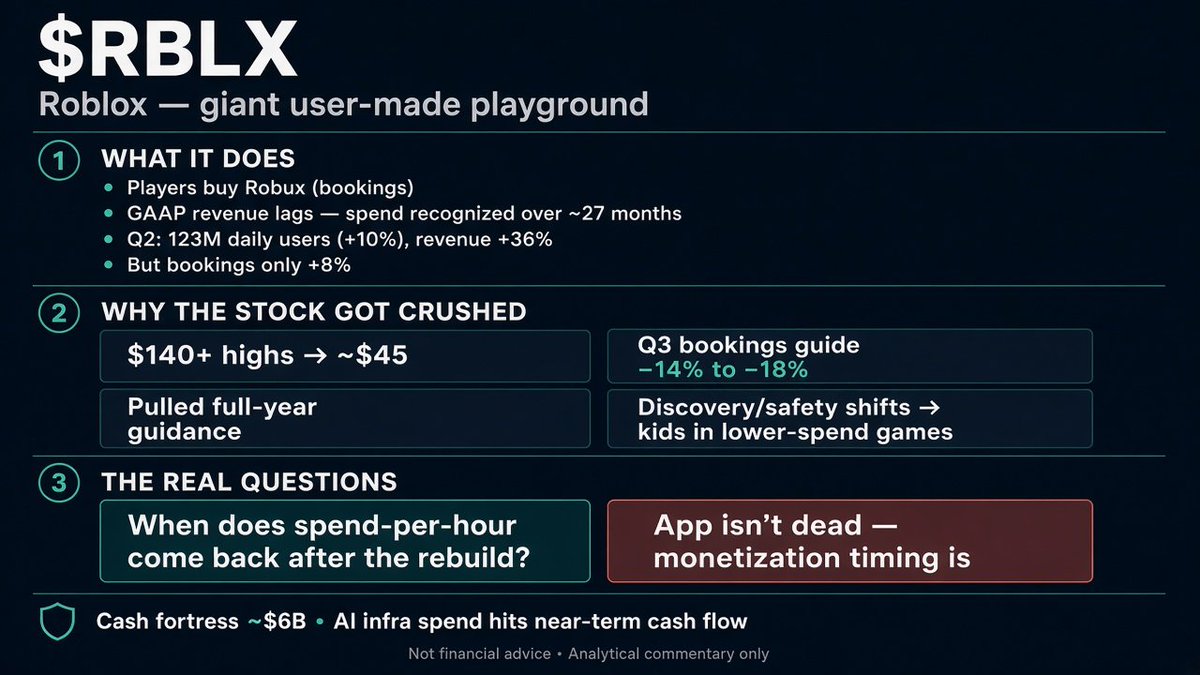
$RBLX is Roblox — a giant playground made by users. Analysis.
Players buy Robux. That spend is “bookings.” GAAP revenue lags because Roblox recognizes the money over ~27 months.
Q2: users still growing (123M daily, +10%), revenue +36%… but bookings only +8%.
Why the stock got crushed
From $140+ highs toward ~$45.
They guided Q3 bookings −14% to −18% and pulled full-year guidance. Discovery/safety algorithm changes pushed kids toward lower-spend games. Heavy AI/infra spending also hits near-term cash flow.
Cash is still a fortress (~$6B).
The real questions
Is the app “dead”? No.
The open question: when does spend-per-hour come back after the platform rebuild?
Not financial advice. DYOR. Education purposes only.
$OBAI is Our Bond — not OpenAI.
It’s a Nasdaq company selling an AI + live-agent personal safety app (Bond), plus some physical security services.
They’re pitching citywide deals (e.g. Jerusalem municipal workers; another city with ~270k residents).
Why the stock crashed
From ~$38.50 highs to ~$0.33 — about −99%.
Market cap ~$10M. Q2 revenue ~$2M, still losing ~$5M a quarter. Cash ~$5M, with a going-concern warning and Nasdaq compliance issues.
What’s the bet?
Not “cheap wonderful business.”
It’s whether those city licenses turn into real recurring revenue before the cash runs out.
High story. Fragile balance sheet. Microcaps can go to zero.
Not financial advice. DYOR. Educational purposes only.
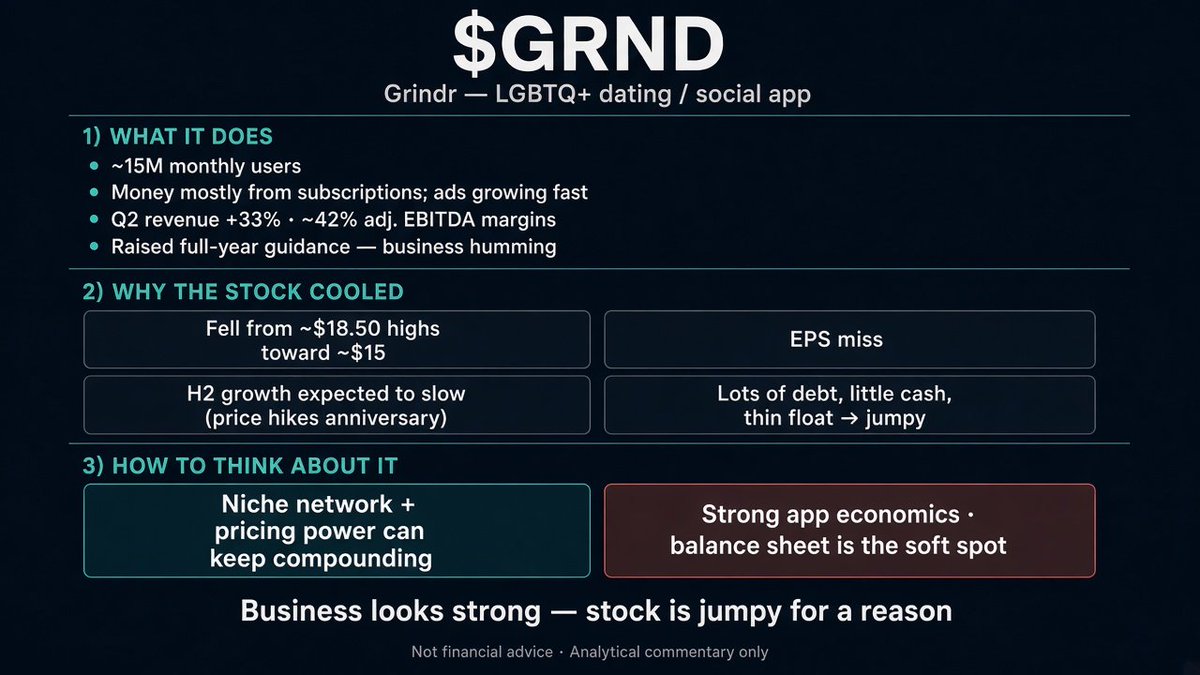
$GRND is Grindr — dating/social app (~15M monthly users).
It makes money mostly from subscriptions. Ads are growing fast too. Q2: revenue +33%, fat margins (~42% adj. EBITDA), and they raised full-year guidance. The app business is humming.
Why the stock cooled
It slid from ~$18.50 highs toward ~$15.
Two near-term reasons:
• They missed on EPS
• Even with the “raise,” growth is expected to slow a lot in H2 — last year’s price hikes stop boosting the year-over-year comparisons
Also: lots of debt, little cash, and a thin float — so the stock can jump around hard.
Strong app economics. Balance sheet is the soft spot.
Not financial advice. Education purposes only. DYOR
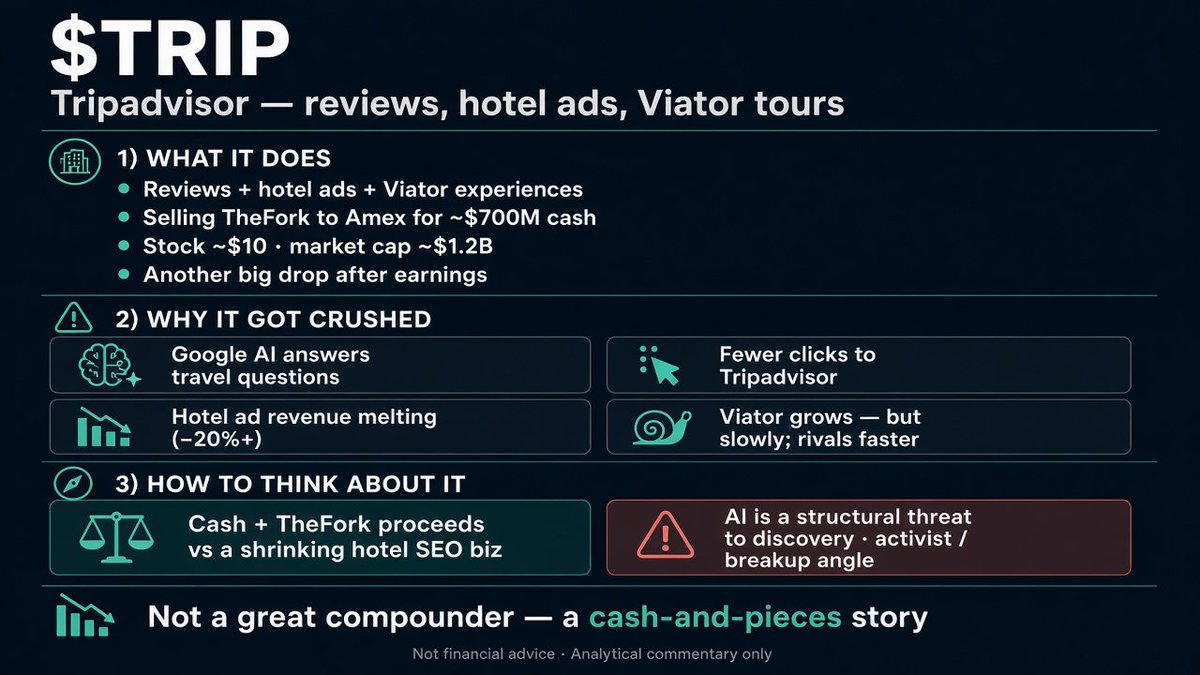
$TRIP is Tripadvisor: reviews, hotel ads, and Viator tours/experiences. They’re also selling TheFork to Amex for about ~$700M in cash.
Stock is around ~$10 / ~$1.2B market cap after another big drop after earnings.
Why it got crushed : Google AI Overviews can answer hotel and travel questions without sending people to Tripadvisor.
Fewer clicks → hotel ad revenue is melting (−20%+).
Viator (experiences) is still growing, but slowly. Rivals are growing faster.
AI threat here is structural (who owns travel discovery). Soft travel spending and sticky rates are an extra headwind.
Not financial advice. Educational purposes only. DYOR
$PCG is PG&E — the big California utility that runs power lines and gas pipes for Northern and Central California.
It earns money the normal utility way: regulators let it earn a return on its grid investments.
AI looks more like a customer here (data centers need power) than a threat.
End of August, a wildfire-liability bill didn’t give investors the protections they’d hoped for.
It’s now around $14 after bouncing a bit. Wires monopoly is real.
But the discount isn’t free lunch. Two things weigh on it:
• California wildfire rules can still force huge payouts after bad fires
• It has to keep borrowing a lot while interest rates stay sticky
Not financial advice. DYOR. Educational purposes.
$ARIS is Aris Mining (gold in Colombia/Guyana)
They dig gold at Segovia and Marmato, and are building toward ~500k ounces a year.
About 4.7 million ounces in proven & probable reserves (the “mineable book”) • Segovia ~1.5 Moz at high grade (~10.7 g/t) • Marmato ~3.2 Moz at lower grade (~3.2 g/t)
There’s more in “resources” (~9.6 Moz measured & indicated, including reserves) — that part still has to get converted into reserves.
Not a broken mine story — gold stocks got choppy, plus Colombia/execution worries and cost creep.
Plenty of ounces on paper. Delivery still has to happen.
Not financial advice. DYOR. Education only.
I thought till two days ago that Claude skills was the most productive thing in the market. Until I watched an episode on @mhp_guy . @bot is WILD. Example below
Research finviz -> short list using the screening criteria -> run the options pipeline that Claude built - > check the charts in trading view -> send a brief for morning
Productivity goes up like crazy.
The bots talking to each other , AMAZING !
@elonmusk
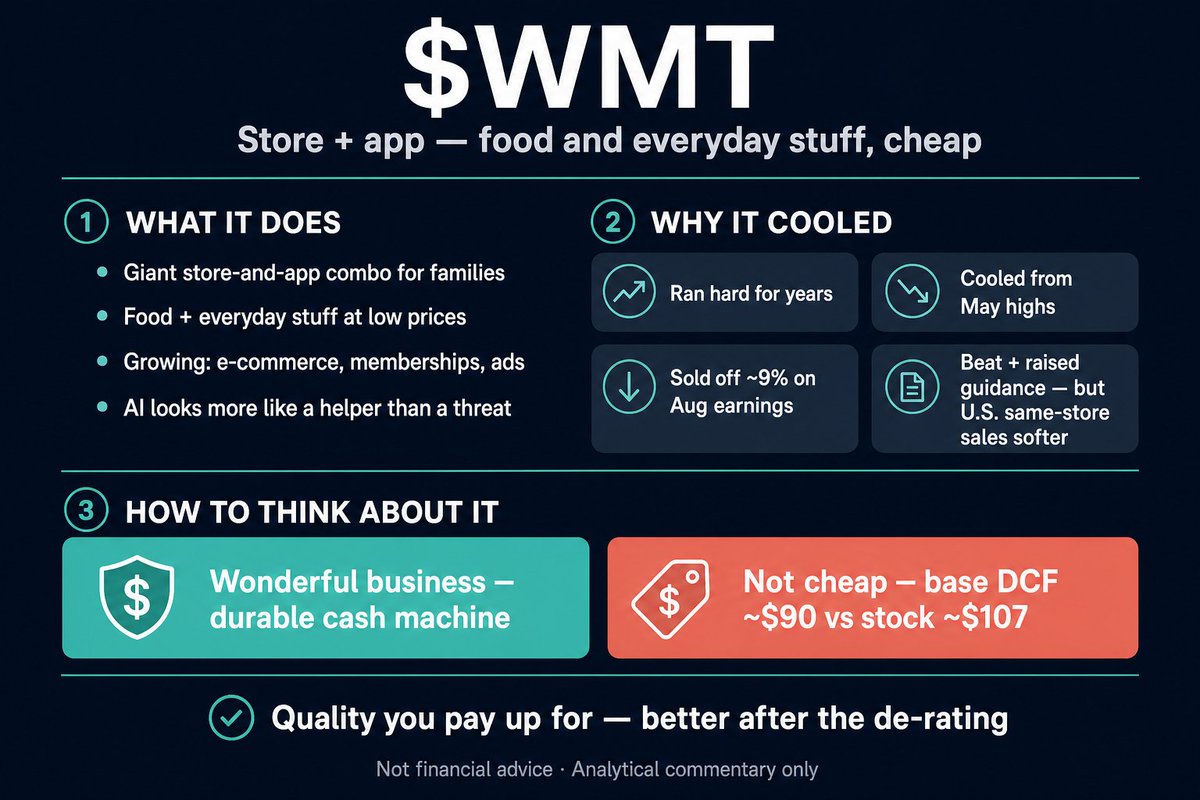
$WMT is the giant store-and-app combo that helps millions of families buy food and everyday stuff cheaply.
It pulled back from May highs, then sold off ~9% on August earnings.
The twist: Walmart beat estimates and raised guidance — but U.S. same-store sales were softer than people hoped.
The business still looks strong. AI looks more like a helper than a threat (stores, warehouses, private shopping data). Soft growth and sticky prices usually favor value/grocery names like Walmart.
wonderful business, not cheap. Better after the pullback — still paying up for quality.
Not financial advice. DYOR. Educational purposes only.
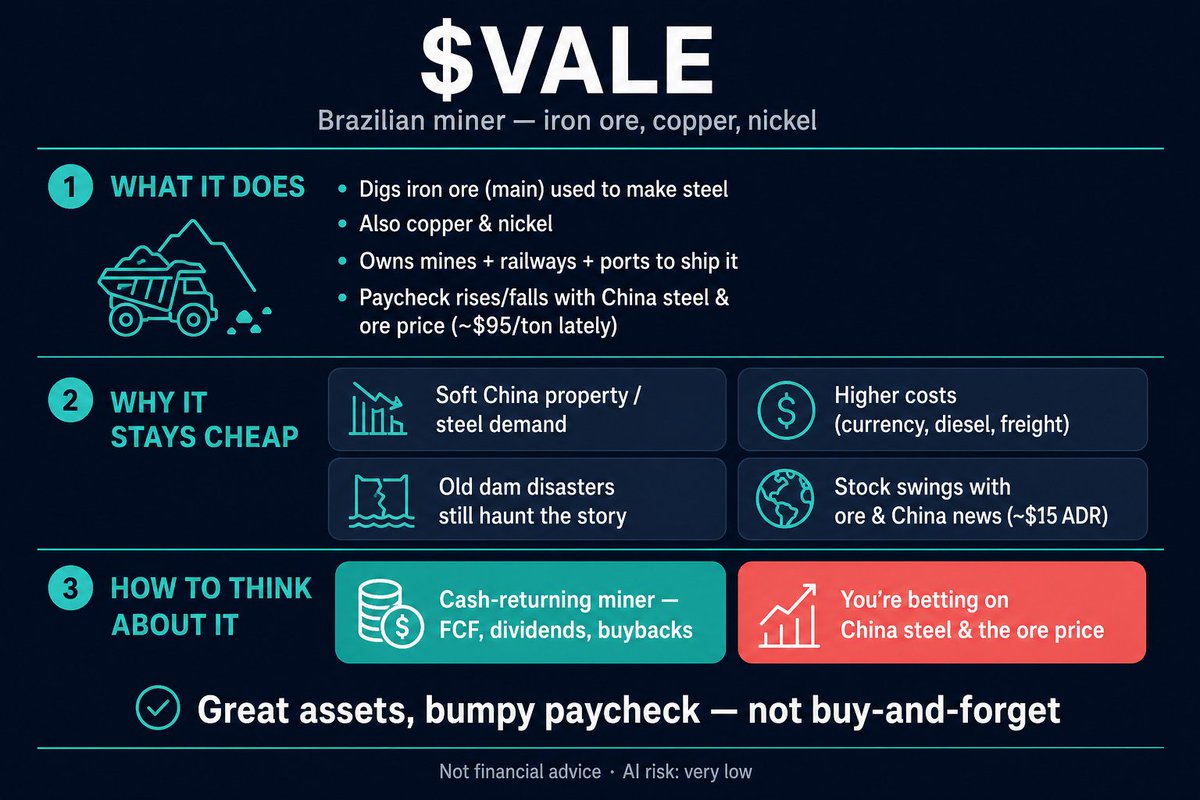
$VALE is a Brazilian mining company.
It digs iron ore (the main product — used to make steel), plus copper and nickel. It also owns the railways and ports that ship the rock out.
China buys most of the world’s seaborne iron ore, so Vale’s paycheck rises and falls with Chinese steel demand and the iron ore price (lately around ~$95/ton).
AI risk is very low. AI doesn’t invent free iron ore. The real risk is China demand.
Real value - Miner that can return cash when times are okay. Not a buy-and-forget compounder. Great assets. Bumpy paycheck.
Not financial advice. Educational purposes only. DYOR
$PSFE Moves money for entertainment spending — online gambling, gaming, e-commerce, trading, travel.
• Helps businesses take card payments (big in North American iGaming)
• Digital wallets: Skrill, PaysafeCard, PaysafeWallet
Down on the order of ~97% from the peak.
Stock around ~$6–7, only ~$350M of equity… sitting under ~$2.5B of debt.
Works if debt comes down. If it doesn’t, shareholders stay stuck
Not financial advice. Educational purposes only
People track the chip ticker and ignore the stack that lets the chip run.
Power, cooling, memory, networking, the boring middle.
Bottlenecks move down the chain before they show up in the obvious name.
Map first. Ticker list last.
$NVDA $TSM $MU $SMCI $NEE
Feature I added this week: trigger levels on the GEX dashboard.
Not a buy alarm. A “this is where my bias is wrong” line.
Most tools I used to pay for skipped that part.
Claude did the scaffolding. I had to define the rule.
SPX gamma in one sentence:If GEX is still supportive, dips get bought until a level actually breaks.
If it flips, the same dip becomes fuel.I stopped paying for that sentence and built the screen myself.Regime first. Ticker second.
6 months of paid options tools taught me one thing:
More dashboards ≠ a process.
One screen I trust, every morning, beats five I open when I’m already tilted. That’s why I started building instead of renewing.