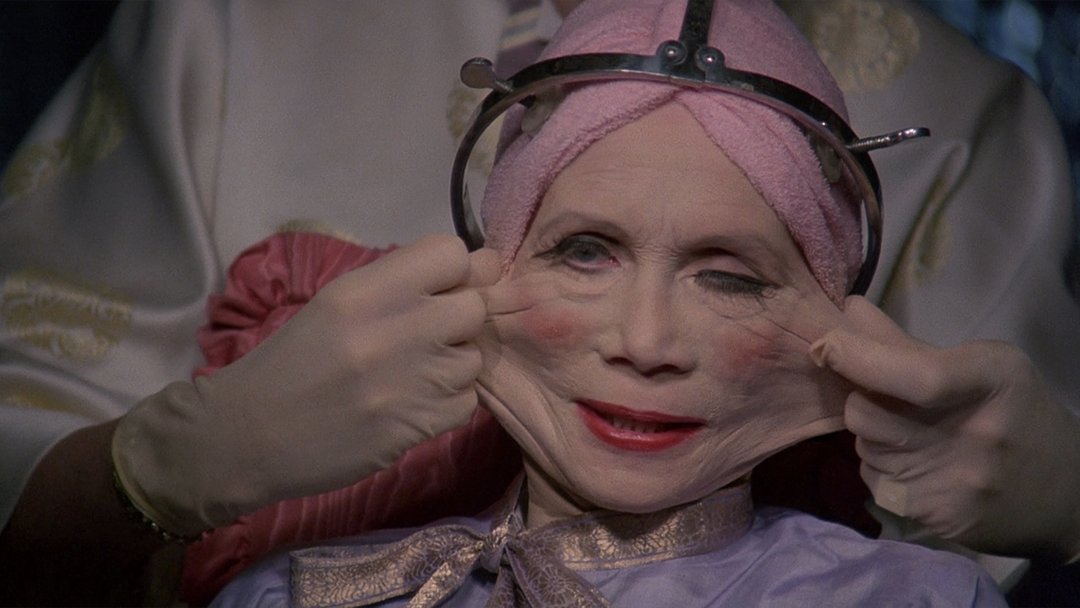
Our pal @ohboyson wrote and directed what @Variety is calling “One of the best movies of the year”. @joceydotcom sat down with Oscar to chat about the movies that inspired Our Hero, Balthazar — in theaters July 23 🎟️
https://t.co/gjy0c2Quk1
There is a somewhat strange tension in Republican messaging:
On the one hand, luxury trad wife, pro-natalist ideals sit at its core — have more kids, return to family values.
At the same time, its leaders insist that the United States cannot afford childcare, healthcare, paid leave, or other forms of material support for those same families.
We are broke. You must live with austerity.
The data, meanwhile, is not especially controversial: the primary constraint on whether young couples start families is financial.
So the combined message is something like: you should have more children, but also the system will not meaningfully de-risk that decision for you.
Which is honestly a pretty un-American pitch.
This is the wealthiest country in history — a place where the cultural identity is that everything is supposed to be bigger, better, more ambitious.
And yet the governing posture being offered is scarcity.
There’s an obvious political opportunity here, which is to just reject that premise entirely and say:
You are an American. You live in the richest country on earth. You should be treated like it.
You should have freer healthcare than the French.
You should have better paid leave than the Swedes.
You should have more affordable childcare than the Germans.
You should have better-funded schools than the Singaporeans.
You should be able to raise a family on a more livable wage than anywhere in the world.
Not as some aspirational program — as the baseline.
A pro-family agenda is not telling people to have kids.
It is making it economically viable to do so — and aligning the standard of living with the actual wealth of the country.
And I don’t mean the next Democratic candidate should say this once in a debate.
I think this should be the foundation of the entire platform — in the midterms, and more importantly, in the next presidential election.
Because right now, the public perception is something like this:
Democrats are neoliberal managers who capitulate to corporations, obsess over process, and confuse caution for virtue.
Republicans are willing to break rules, make Democrats look like pussies, tell them to go fuck themselves (which, to be clear, polls), and “get things done” — even when what they’re actually getting done is austerity for everyone below the oligarch class.
The only path forward is to reverse that polarity.
Democrats need to make the case that Republican austerity is not strength.
It is weakness.
It is asking the richest country in the world to behave like it’s broke.
Which is honestly more pussy than being a rule-following neoliberal.
The actually bold position is simple:
The richest country in the world should deliver the highest standard of family life in the world — and then govern accordingly.
Our old friend @joceydotcom spoke with director / CD @fbglima about the movies that inspired our Super Bowl spot for @wearehims & @wearehers. See how titles like Brazil and Eyes Wide Shut helped shape the tone and visuals of “Rich People Live Longer”💰
https://t.co/LD8jaDlGGM
“The fake town we shot in, they called ‘third world exterior’ on the website. It’s also where they shot AMERICAN SNIPER.”
Hailey Gates shares photos captured by Sinna Nasseri on the set of ATROPIA that reflect the wild satire of her Sundance prizewinner. https://t.co/7wUNRSgst1
Exclusive poster for ‘ATROPIA’, written & directed by Hailey Gates
• Follows a group of actors living in a simulation to train soldiers for the Iraq war
• Starring Alia Shawkat, Callum Turner, Jane Levy, Tim Heidecker, Lola Kirke & Chloë Sevigny
• In theaters on December 12
The Directors Bureau in this era was such a special place to be ✨ I feel so lucky to have started my career there alongside so many talented people ❤️ There would certainly be no @wysmns without The Directors Bureau and Roman Coppola 🙏🏼 But wait, @sbpardo you were getting paid?
Perhaps an overlooked element in the development of new filmmaking voices, lies in the step before film festivals. Before there is even anything to submit, there is a sorting of sensibilities, taste, influences, and talent that happens methodologically via institutions or organically through a kind of invisible hand of shared interests. In recent history we’ve sat back and trusted film schools and other established institutions to do that work via a process of applications, resumes, and quantifiable metrics that result in a series of programs, workshops, grants, and summits. And this very well might work for some, but I wonder if we’ve perhaps allowed the existence of these institutions to obviate the self directed curation of peers, or — maybe responsibility is too strong a word — but the responsibility of culturally powerful companies to help this process along.
In my experience the real value of these institutions historically is the peer group they curate “for you”, more so than the equipment they provide or the teachers placed in front of you. However, these institutions are not the only place your peers can be found.
I find myself thinking of this after a reunion of sorts with my fellow “alumni’s” not of USC, or Chapman — but of The Directors Bureau, a music video and commercial production company in Hollywood, CA founded by Roman Coppola. It produced some of the best, most innovative music videos and commercials of its era, and that is notable enough, however “The Bureau” should get credit for something even greater and more rare: it consciously created a space for young talent to gather.
With its cultural power acting like a great magnet, The Bureau attracted a group of like-minded, talented (and at times competitive) polymathic filmmakers, who were given the space to get experience in the field, with a little bit of wax-on, wax-off ordering of lunch in between. (A lunch everyone in the office would share at a communal table no less!)
What started for me as an paid internship, grew into a loosely defined roll within a division of the company called “Special Projects”, which I try to explain succinctly as a real life Nathan For You, before Nathan For You. In retrospect this was a holding place for young creatives, who did work tangentially and speculatively, but rarely connected to the company’s main mission of producing music videos, or commercials. There was no economic value to the business — quite the opposite!— but it provided a great cultural value, and birthed a notable “coaching tree” within the film industry. In just the 4 or so years I was there from 2009-2013, I overlapped with artist Kahlil Joseph (BLKNWS), DP Matthew J. Lloyd (Spiderman: Far From Home), Best Picture winner Jonathan Wang (Everything Everywhere All At Once), as well as future founders of Los Angeles Image Hall Now Instant, and the founders of boutique music video commercial production company Ways & Means. Nearly every young person while I was there has gone on to contribute in meaningful ways to visual cultural - as directors, editors, designers, founders and heads of other production companies. (And I’m sure there’s people before me and after, I’m not aware of.)
This is a total aberration, perhaps a fluke of history. Right time, right place. But I use it as an example of an respected production company using its financial and cultural power to create a space for young creatives, with no hook hidden in the bait to reel in this talent and tie it down. It was an alternative space, outside of traditional institutions that cultivated talent. I might just be ignorant of other places that work this way — there is always a natural version of this — but I think The Directors Bureau/Roman Coppola deserves a lot of credit for consciously and somewhat selflessly incubating young talent in a way that seeded more of the kind of work it championed. Memory certainly would not exist without the Bureau. I would not have met Gia Coppola and produced Palo Alto, nor met my co-founder Riel Roch-Decter, nor had the infrastructure to learn how to produce, and its very likely my career would be entirely different — or perhaps wouldn’t exist at all!
It was here that I found my peer group.
I know that 10-15 years ago the medium is not in the same financial place it is now, but I wonder if it really just comes down to financial will alone. There is no place on the ledger for culture, and thus only b.c the Bureau was “small” enough — actually lead by a person, and not a committee or series of spreadsheets — it was possible. Is this still possible? Is it just that the margins are just too narrow now? Do so few companies exist that have this kind allure to young talent? Are the incentives too abstract? Too selfless?
—
So you’re reading this and you’re not the head of some production company or film division — let the take away be that you have to find your peer group. An option that doesn’t depend on waiting for your favorite film company to post a creative and silly intern application on their website where they ask you to draw a dog? To you I say: “Baltimore.”
“Baltimore, you say?”
“Yes Baltimore.”
Not that you need to move to Baltimore, but its an example of self sorting into a community and finding your peers who have similar values, and creative ambitions. In Baltimore, you find people who prioritize being able to create on nights and weekends, pay cheap rent, and generally can get by making their work as a hobby. And as such, they’ve created a network of highly creative, output oriented artists who have produced some of the most interesting music, comedy, film festivals and films of the 21st century.
So, really its about diagnosing yourself and saying where would I find someone who wants to make the kind of stuff I want to make, and values it in ways similar to me, etc. And for many maybe that is an A.F.I., USC or Sundance program, I think those definitely work for people who want to make a certain type of film, but I’m of the opinion that we have plenty of those type of films. And relying on that kind of systematized stewardship leads to a more narrow film ecosystem than one made outside of those institutions, one that is a bit more self selecting, organic, flat, and open to possibility.
#another1000words