Your child's school has an assistant superintendent for curriculum, an assistant superintendent for instruction, a director of teaching and learning, and a coordinator of academic services. Your child's teacher has thirty-two kids and no copy paper. This is not a funding problem. It is a priority problem.
Hear me out:
Whenever I bring up suspensions or expulsions, the response is “but what are we going to do with those kids?” as if it’s the fault of the system
That’s on the parents. They bear final responsibility for that kid, not the school.
And other students shouldn’t have their own learning jeopardized because a few children were poorly parented.
Checking sources is a superpower--you would not believe the stuff people sneak into things.
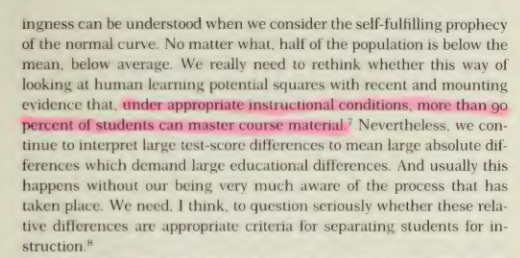
As one example: the book "Keeping Track" is by far the most influential anti–ability grouping book. Key to its argument is a claimed finding that 90% of students can master course material under the right circumstances to argue that all students should be placed into the same courses.
Where does that footnote - footnote 7 - lead? Benjamin Bloom's "All Our Children Learning." Not to a specific page. Not to a specific note within it. The entire book.
So let's dig in! What does Bloom say?
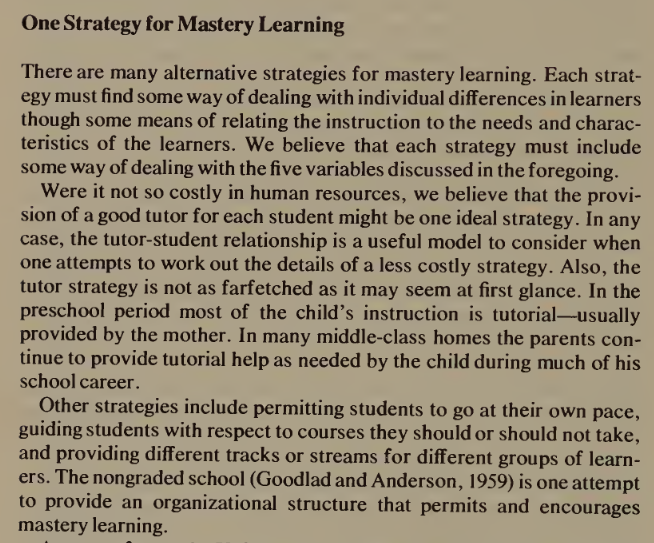
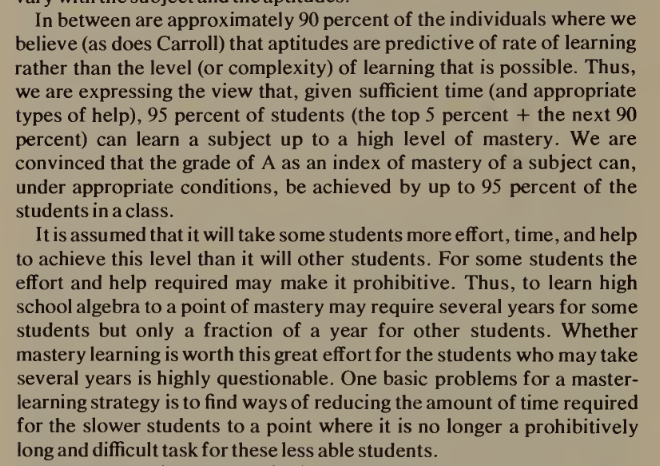
He notes his belief that around 90% of people differ in rate of learning rather than the level of learning theoretically possible, but that it will take some students more time, effort, and help to reach that level than others (sometimes prohibitively so). Some, he'll note, might take several years on high school algebra, while others can do it in a fraction of a year.
Then he provides suggestions. How do you structure a school so that students can learn at appropriate paces to meet his "90%" goal? He has a few ideas:
1. Give each student an individual tutor.
2. Let students go at their own pace.
3. Guide students towards or away from specific courses.
4. Provide different tracks for different groups of learners.
Did you catch that?
Bloom says: obviously kids learn at different paces, so if you want them to master the material, either let them rush ahead individually or group them by ability. If we do that, everyone's level will improve.
Oakes takes that, strip-mines the entire book down to a claim she paraphrases as "under appropriate learning conditions, more than 90 percent of students can master course material," and then uses it to argue that we should not let kids rush ahead individually or group them by ability.
This book has been cited more than 10000 times. It is by far the most influential single thing ever written on ability grouping. And it cites sources it knows nobody will examine to argue for the polar opposite of what those sources advocate.
Check sources.
So excited to have won this in a @goodreads giveaway! I have loved all of @OfficiallyAlly books and am looking forward to reading this sequel to The Blonde Identity. If you haven’t already, you need to read it. Romance, mystery and humor- a great read!
“Isn’t it more important that they learned than that they got it right on the first try?”
I mean, yes, to a certain extent.
But, you can’t give students unlimited time, unlimited tries, and unlimited forgiveness and then claim they “mastered the standard.”
They didn’t. You just stopped measuring.
Should we allow bullying in schools? No? Well, if you allow phones in school, you allow bullying.
Should we allow cheating in schools? No? Well, if you allow phones in schools, you allow cheating.
Should we allow porn in schools? No? Well, if you allow phones in schools, you allow porn.
Should we allow violent media in schools? No? Well…..
If a student misses 50, 60, 80 days of school, I’m sorry but they have no right to move onto the next grade and a school does them no good by promoting them
With less than a week before graduation, any senior who has done nothing for four years will earn their way to the procession by spending a couple of hours looking up answers on their phone to complete their online recovery classes.
When a state addresses its teacher shortage by lowering the standards to become a teacher, rather than focusing on making teaching a more sustainable and respected career, it signals a HUGE PROBLEM!