🔴 Diagnosis: Thromboangiitis obliterans (Buerger disease)
📍 Heavy smoker with distal ischemia → black dry gangrene/ulcers of digits
🔷 Smoking-triggered segmental inflammatory thrombosis of small–medium arteries/veins
💡 Absolute nicotine cessation is the only disease-modifying step; otherwise progressive ischemia → amputation
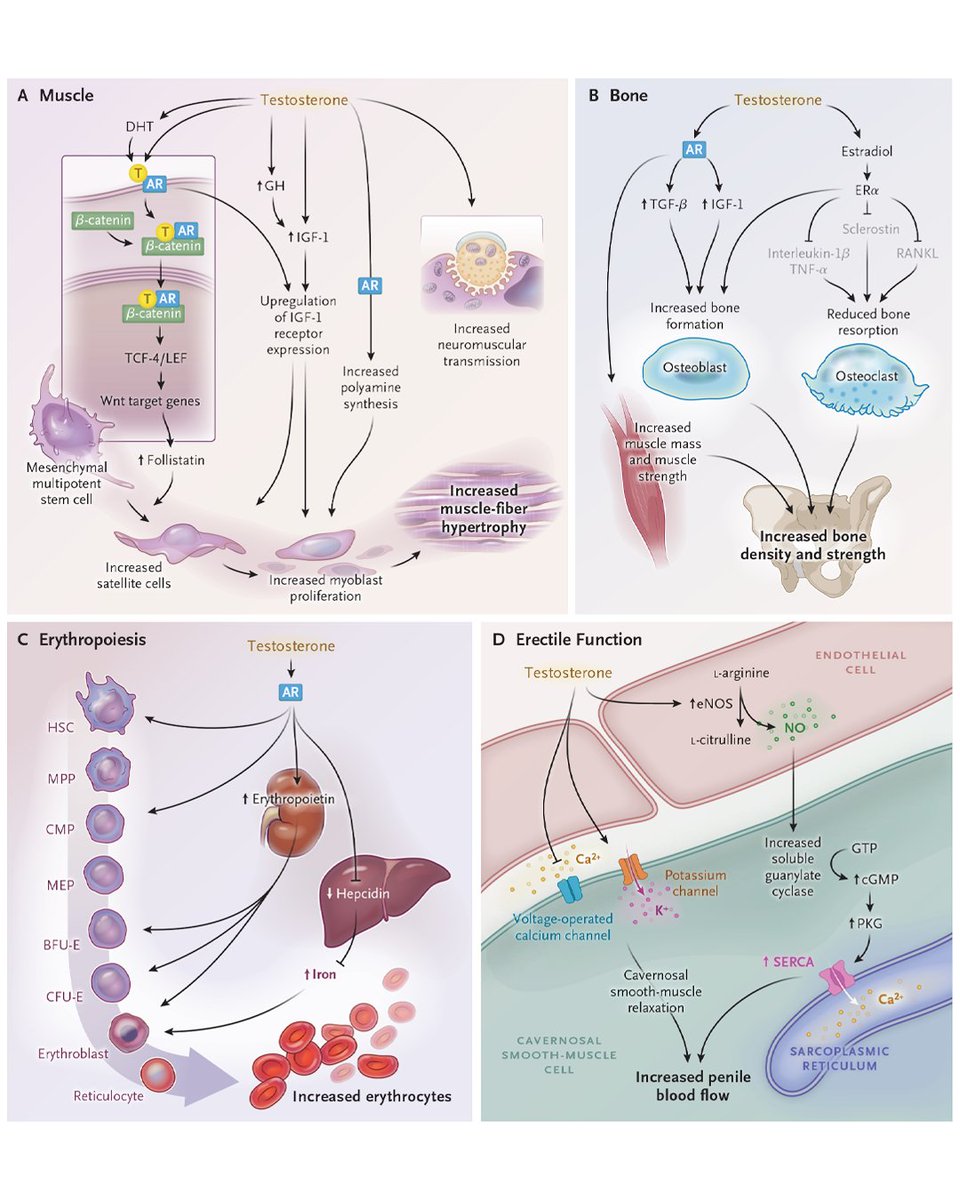
𝗠𝗲𝗰𝗵𝗮𝗻𝗶𝘀𝗺𝘀 𝗼𝗳 𝗔𝗰𝘁𝗶𝗼𝗻 𝗼𝗳 𝗧𝗲𝘀𝘁𝗼𝘀𝘁𝗲𝗿𝗼𝗻𝗲
Many of the benefits and some of the risks of testosterone treatment are mediated by the mechanisms through which testosterone acts. Testosterone has anabolic effects on muscle (panel A) and bone (panel B) and stimulates erythropoiesis (panel C) through androgen receptor–mediated mechanisms. Nongenomic mechanisms of action increase penile blood flow and improve erectile function (panel D). The effects of testosterone on sexual desire and bone are mediated largely through its conversion to 17β-estradiol. Testosterone is also converted to dihydrotestosterone (DHT), which stimulates prostate growth and has additional anabolic effects on muscle and bone. Testosterone and DHT increase penile blood flow and erections through a rapid increase in the production of nitric oxide, which is endothelium-dependent, as well as through inhibition of voltage-operated l-type calcium channels, activation of potassium channels on smooth muscle, or both mechanisms, which are endothelium-independent (panel D). A metabolite of DHT, 5α-androstane-3α,17β-diol, which is a ligand for the γ-aminobutyric acid receptor, has been linked to mood and affect.
Learn more in the Review Article “Testosterone Treatment in Middle-Aged and Older Men with Hypogonadism” by Shalender Bhasin, MB, BS, and Peter J. Snyder, MD, from @BrighamWomens, @harvardmed, and @PennMedicine: https://t.co/si8041BqpF
La escala de West Haven es la más utilizada para graduar la severidad de la encefalopatía hepática:
0: ninguna anormalidad
1: deterioro leve del estado de conciencia y humor, déficit atencional
2: desorientación en el tiempo, alteración marcada de la personalidad
3: somnolencia/estupor con respuesta preservada a estímulos, confusión, desorientación severa
4: coma
N Engl J Med 2016;375:1660-70
An abscess in this area, called the "danger triangle" of the face (the area from the bridge of the nose to the corners of the mouth), poses a serious risk for cavernous sinus thrombosis (CST), a rare but life-threatening complication. This region has venous drainage that connects directly to the cavernous sinus via the angular and ophthalmic veins - veins that are valveless, allowing retrograde flow of infection. When a bacterial infection, most commonly Staphylococcus aureus - spreads from a nasal or facial abscess, it can seed the cavernous sinus, leading to septic thrombosis, inflammation, and impaired venous return from the brain. Clinically, CST presents with symptoms like high fever, periorbital edema, proptosis (bulging eye), ophthalmoplegia (paralysis of eye muscles), and vision loss, often rapidly progressing. Bilateral symptoms may develop due to inter-cavernous sinus connections. Immediate treatment with IV antibiotics and sometimes anticoagulation is critical; delayed intervention can result in stroke, meningitis, or death.