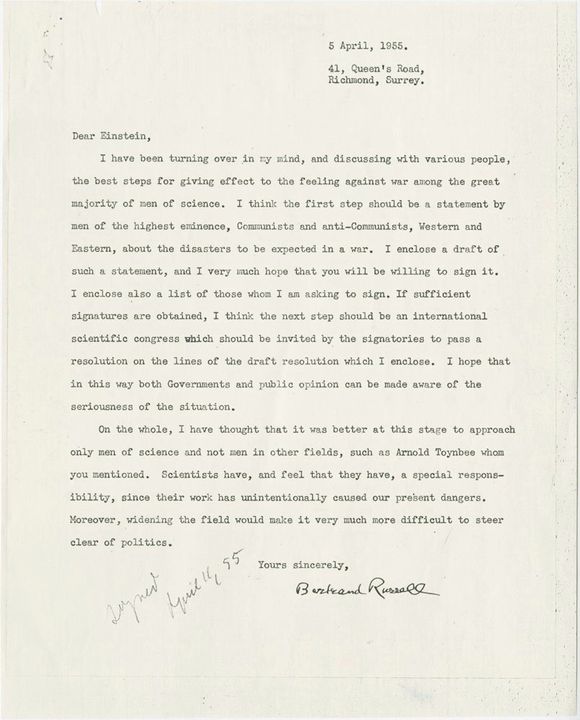
On 5 April 1955, literature laureate Bertrand Russell wrote to physics laureate Albert Einstein to ask for his support in standing up against nuclear weapons.
Einstein agreed. The letter led to the Russell-Einstein Manifesto, which Einstein signed days before his death.
"No me preocupa el grito de los violentos, de los corruptos, de los deshonestos, de los sin ética. Lo que sí me preocupa es el silencio de los buenos"
--- Martín Luther King
I asked physicist Jacob Barandes off‑air, “What is the most inspirational advice you’ve received?” He showed me this one page from this one book.
I’ll transcribe it:
The Camel had her heart set on becoming a ballet dancer. “To make every movement a thing of grace and beauty,” said the Camel. “That is my one and only desire.”
Again and again she practiced her pirouettes, her relevés, and her arabesques. She repeated the five basic positions a hundred times each day. She worked for long months under the hot desert sun. Her feet were blistered, and her body ached with fatigue, but not once did she think of stopping.
At last the Camel said, “Now I am a dancer.” She announced a recital and danced before an invited group of camel friends and critics. When her dance was over, she made a deep bow.
There was no applause.
“I must tell you frankly,” said a member of the audience, “as a critic and a spokesman for this group, that you are lumpy and humpy. You are baggy and bumpy. You are, like the rest of us, simply a camel. You are not and never will be a ballet dancer!”
Chuckling and laughing, the audience moved away across the sand. “How very wrong they are!” said the Camel. “I have worked hard. There can be no doubt that I am a splendid dancer. I will dance and dance just for myself.”
That is what she did. It gave her many years of pleasure.
Satisfaction will come to those who please themselves.
I hope you too find this inspiration.
Hang in there, and have at it.
https://t.co/9HHWJeJbKw
I’m 54, a physicist who’s spent decades unraveling the universe’s secrets—from quantum quirks to cosmic scales.
If you’re in your 20s and passionate about physics or science, please read this:
"La mort de l'empathie humaine est l'un des signes les plus précoces et les plus révélateurs d'une culture sur le point de sombrer dans la barbarie."
Hannah Arendt
Para Aristóteles, la felicidad no es un placer pasajero, sino el fin supremo de la vida, una actividad plena que solo se puede juzgar al final, que se alcanza viviendo virtuosamente (actuando según la razón) a lo largo de toda la vida, como un camino.
https://t.co/dPKSXLcy1H
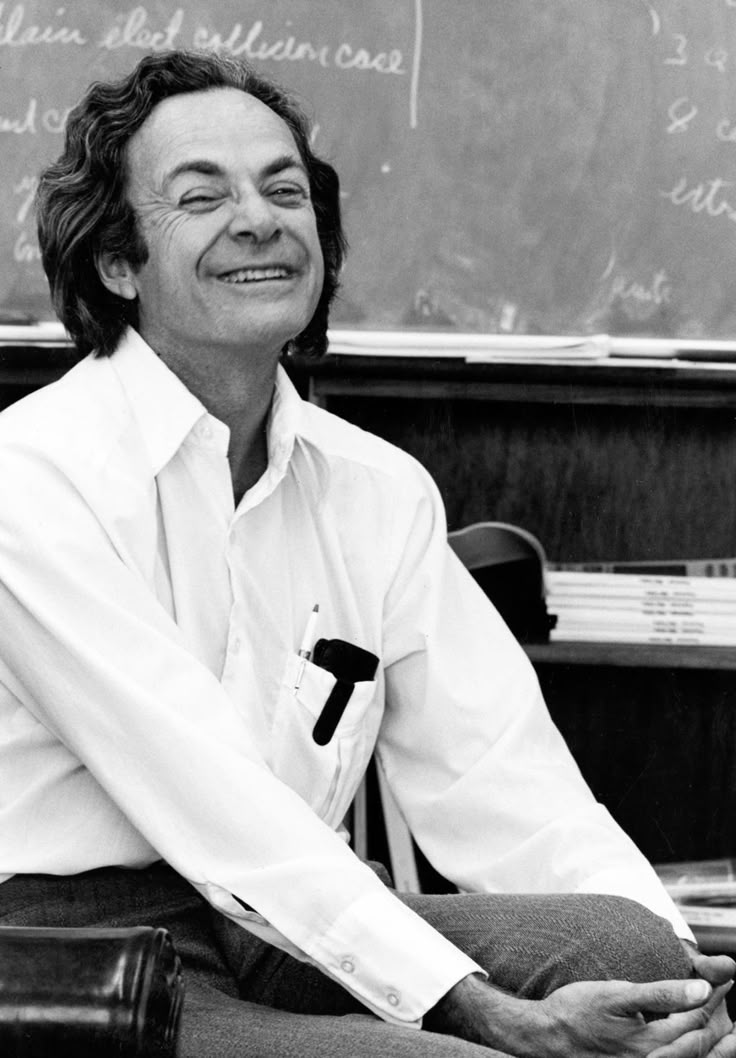
Fall in love with some activity, and do it!
Nobody ever figures out what life is all about, and it doesn't matter. Explore the world. Nearly everything is really interesting if you go into it deeply enough. Work as hard and as much as you want to on the things you like to do the best.
Don't think about what you want to be, but what you want to do. Keep up some kind of a minimum with other things so that society doesn't stop you from doing anything at all.
Richard P. Feynman
“...Schrödinger...gave a kind of derivation based on some heuristic arguments and some brilliant intuitive guesses. Some of the arguments he used were even false... ; the only important thing is that the ultimate equation gives a correct description of nature.” — Richard Feynman
100 years ago, in November 1925, Erwin Schrödinger attended a colloquium in Zürich where Louis de Broglie’s bold idea was being discussed: that every moving particle carries a wave-like nature.
After the talk, a colleague made a casual remark if matter behaves like a wave, shouldn’t there be a wave equation for it? For most people, it was a fleeting comment. For Schrödinger, it became an obsession.
By late December, Schrödinger wrote to Wilhelm Wien admitting he was struggling with a new atomic theory, even joking: “If only I knew more mathematics!” Yet he remained optimistic, convinced that if he could solve the problem, “it will be very beautiful.”
He was not the only one wrestling with the new quantum world. Around the same time, the great mathematician David Hilbert remarked, “Physics is much too hard for physicists,” capturing the difficulty of the era.
The breakthrough arrived quickly. On 27 January 1926, Schrödinger submitted the first of four papers titled Quantization as an Eigenvalue Problem. In it, he introduced the wave equation that now bears his name and solved the hydrogen atom with it, offering the first coherent picture of atomic structure.
Meanwhile, Wolfgang Pauli, using the matrix mechanics developed by Werner Heisenberg, Max Born, and Pascual Jordan, had already derived the hydrogen spectrum. Soon, Schrödinger proved that wave mechanics and matrix mechanics were mathematically equivalent two languages describing the same quantum reality.
By mid-1926, Schrödinger had applied wave mechanics to the harmonic oscillator, the diatomic molecule, the Stark effect in hydrogen, and the processes of absorption, emission, and scattering. What began as a struggle became one of the most productive bursts of creativity in the history of physics.
A century later, this moment reminds us of something timeless: great scientific revolutions are built not on certainty, but on persistence and the belief that something beautiful lies beyond the struggle.
"¿Os agradaría encontrar una nación con un temperamento tan bárbaro que, estallando con una violencia espantosa, no os proporcionase un hogar en sus dominios, afilase sus abominables cuchillos contra vuestras gargantas, os desdeñara como a perros"
-William Shakespeare:Tomás Moro
🚨Sir Ian McKellen is quoting Thomas More, writing in 1517 during anti-immigrant riots in London 🔥 when terrified foreigners were dragged from their homes and blamed for every social ill.
More asked the mob a simple question:
“What would you do, if you were the stranger?”
500 years later, those same words cut straight through the noise.
Because today we are again stirring hatred, again blaming the vulnerable, again pretending cruelty is “strength”.
If the great humanists of the 16th century could see the danger…
why can’t our politicians in 2025?
History is speaking louder than ever.
The only question is: are we listening?
Electron is everywhere until observed/measured is the worst myth in quantum mechanics, spread by so-called science YouTubers who oversimplify everything for clicks.
They make it sound like consciousness makes things come into reality. First of all, in Quantum Physics, "observed" does not mean some conscious being watching it.
In Quantum Physics, observed means interaction. Interaction with another particle like a photon, electron, or anything that exchanges energy or information.
Come back to our main topic.
The electron is not everywhere until observed or measured.
First we need to know, what actually is electron?
Electron is nothing but localised excitation in electron field at some location of space time fabric.
Electron is not a tiny ball.
Now you might think, what is the electron field?
Electron field is energy configuration at every location of space-time fabric (x, y, z, t).
x, y, z are Spatial dimensions
t is the Time dimension.
There are other fields also:
- Electromagnetic (EM) field
- Higgs field
- Many more
Photon is excitation in the EM field.
Mass arises due to excitation in the Higgs field.
The electron field itself is everywhere, but the excitation, that ripple which represents one electron, is not spread across the entire space-time fabric.
When we talk about where the electron might be, we don't talk about its location. We talk about its wave function.
Wave function is not something physical. It is a mathematical function that tells about the probability amplitude of finding the electron at each position if you were to check.
For example:
You visit three stores:
- Grocery store
- Medical store
- Electronics store
You come back home and realize you left your wallet in one of those stores but don't know which one.
You assign probability of finding the wallet to grocery, medical, and electronic stores.
We all know probability formula:
P = number of favorable outcomes / total outcomes
So P = 1/3 (33.3%)
You go to the electronics store and check the CCTV and find out this is not where you left your wallet.
Now probability of finding the wallet at the electronics store becomes 0.
And for the medical and grocery stores, it becomes 1/2 (50%) because the number of total outcomes decreased from 3 to 2.
Now you go to the medical store and find your wallet there. That means probability of finding your wallet at the medical store becomes 1 (100%) and for the grocery store it becomes 0, because there is no way you can find your wallet in two places at once.
That’s exactly how wavefunction collapse works.
Before measurement, the electron’s position is uncertain, it’s described by probabilities.
Once you measure it (meaning once it interacts with something), the probability at that point becomes 1, and everywhere else becomes 0.
You didn’t summon the electron into existence; You just forced the field excitation to reveal its position through interaction.
Electrons aren’t 'everywhere until observed', they’re localized excitations in a field. We just don’t know where until they interact.
No consciousness. No magic. Just physics.
"La violencia política es contagiosa. Se está extendiendo. No se limita a un solo bando o sistema de creencias. Debería aterrorizarnos a todos.
La base de una sociedad libre es la capacidad de participar en ella sin temor a la violencia."
---Ezra Klein, Periodista NYT
In the last few years we've seen:
- The plot to kidnap Gretchen Whitmer
- The Storming of the Capitol and pipe bombs left at the RNC and DNC
- The break-in to kidnap Nancy Pelosi and the brutal on Paul Pelosi
- Multiple assassination attempts against Trump
- The assassination of Minnesota House Speaker Melissa Hortman and her husband and the shooting of on State Senator John Hoffman and his wife
- Luigi Mangione's assassination of Brian Thompson
- The assassination of Charlie Kirk
Political violence is contagious. It is spreading. It is not confined to one side or belief system. It should terrify us all.
The foundation of a free society is the ability to participate in it without fear of violence. Political violence is always an attack against us all. You have to be so blind not to see that.
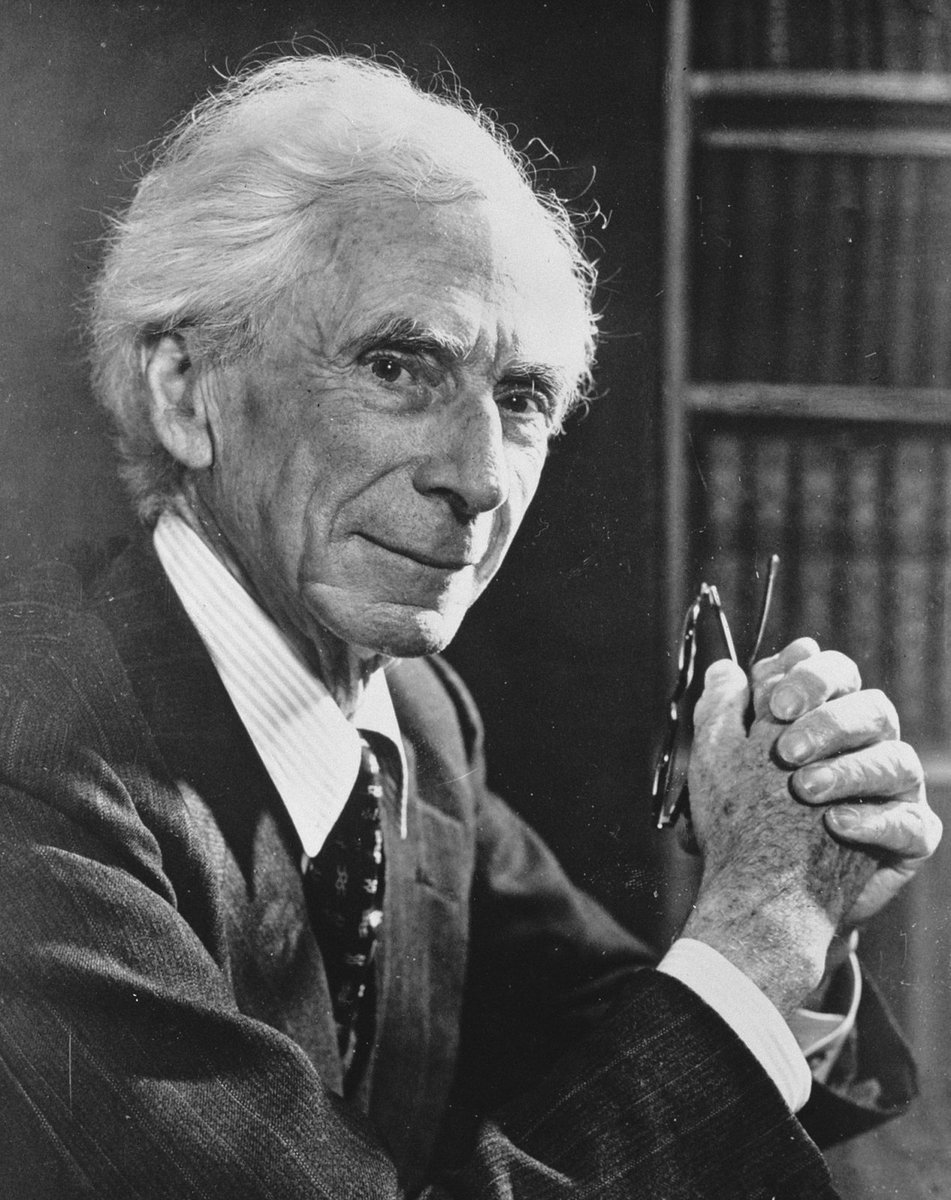
One of the biggest problems with the world is that fools are always so sure and certain about everything and intelligent people are so full of doubts and uncertainties.
- Bertrand Russell
"I imagine that whenever the mind perceives a mathematical idea, it makes contact with Plato's world of mathematical concepts. ... When one 'sees' a mathematical truth, one's consciousness breaks through into this world of ideas..."
---Roger Penrose