Este tipo explicó cómo creó 3 webs que le generan 100,000$ al mes.
En 25 minutos muestra cómo lo hizo, paso por paso. Totalmente gratis.
Idea → Web → Monetizar
🔖 Créeme: no lo dejes pasar.
هذا الشخص استخدم Claude لبناء بوت تداول.
الشرح مدته 17 دقيقة، ويعلّمك كيف:
→ تبني بوت تداول من الصفر، وتطوّره، وتختبره على البيانات التاريخية، ثم تشغّله.
🔖 احفظه قبل فوات الأوان.
Tony Robbins charges up to $1 million for a single speech. Decades ago, someone filmed him giving away the entire technique for free
This is skill arbitrage in its purest form - the gap between what you know and what someone else doesn't, sold directly
Robbins built an empire on exactly one gap: reading what makes a person say yes, and closing that gap in real time
By 1991, his company was already doing $50 million a year. Presidents, billionaires, hedge fund managers - Paul Tudor Jones among them - paid for private time with him
None of that came from a script. It came from a specific, teachable read: find what someone is already leaning toward, and anchor the offer to that feeling instead of fighting it
This footage catches him teaching the raw mechanics, not the stage show - no seminar lighting, no crowd, just the technique itself
That kind of footage doesn't usually survive.
Most of it stays inside $10,000-a-ticket seminars or rooms billed at six figures an hour
The skill was never secret. Access to watching it explained plainly was
🚨 THIS SMALL FIX WILL MAKE YOUR BOT PROFIT
Your backtest says 40% EV but your live bot makes a third of that.
You didn't do anything wrong.
Your backtest just quietly assumed something that's never true:
It assumed every order fills.
Real EV isn't just your edge.
It's your edge times the chance you actually get filled.
Real EV = modeled EV × P(fill)
Your backtest sets P(fill) to 1.
On a thin Polymarket book, it's more like 0.3.
So that beautiful 40% EV strategy is really doing 12%, and you never modeled the gap.
Worse, the fills you DO get are the bad ones.
You fill easily exactly when the market's turning against you, and you miss the fills you actually wanted.
So your live P(fill) isn't just low, it's biased toward your losers.
The fix is to model the fill, not assume it.
> Estimate P(fill) from real book depth at your price, not from the price line.
> Multiply your modeled edge by it BEFORE you trust any backtest number.
> Track your real fill rate live and feed it back in.
I chased fake backtest EV for way too long before i started weighting by fill probability.
However thatnks to tis, my best work is sitting at $200k clean PnL.
Proof: <https://t.co/UoAjMxAPUI>
A backtest that assumes you always fill isn't a backtest.
It's a wish with a chart.
Don't miss my next post, will drop another tip you probably don't know yet.
Also quoting a full build below this post.
Yesterday i publicly deposited $100 to a new wallet and asked Claude Fable 5 to double it on risk free arbitrage.
Today it's sitting at $1,787.21 made overnight.
I went through every code line and was shocked.
It used just one formula to make 17x in one day:
YES + NO < $1
Nothing else.
Everyone asks me how to find better arbitrage.
But it's a wrong question.
The real question is how to get there before everyone else.
This BTC bot only trades when YES + NO < $1.
And the strategy is almost too simple.
Every BTC Up/Down market settles at exactly $1.
If YES and NO briefly trade for a combined $0.97, buy both.
Collect $1 at resolution.
The opportunity isn't rare because it happens almost EVERY minute on UP/Down crypto markets.
Winning the race is.
After rebuilding my previous terminals with Claude Fable 5, I realized most of my latency wasn't coming from the network.
It was coming from my own architecture.
A few things that made the biggest difference:
> Run the bot on a VPS close to the exchange instead of your laptop
> Keep WebSocket connections alive instead of reconnecting every loop
> Cache market metadata in memory and only update prices
> Prepare both orders before the opportunity exists
That last one changed everything.
Most bots see YES + NO < $1, then build the trade.
Mine already has the orders ready.
When the spread appears, it only checks liquidity and submits both legs.
No rebuilding.
No unnecessary calculations.
Just execution.
Will you beat firms with million-dollar low-latency infrastructure?
Probably not.
But you don't need to.
Most developers lose opportunities long before network latency becomes the bottleneck.
They lose them inside their own code.
Claude Fable 5 didn't give me a smarter strategy.
It taught me how to stop wasting milliseconds.
And in arbitrage, that's often the only edge that matters.
Make sure to explain it to Claude if you wanna rebuild the same one.
Leaving a full guide with every aspect covered below.
TradingView never built an API.
So someone jailbroke the desktop app and handed the keys to Claude.
Now it reads your charts, writes your scripts, fixes its own code, and draws your levels while you watch.
This is what it looks like:
Bookmark this + Then join our Discord where we break down AI setups like this every week: https://t.co/4wbSOtpllE
A QUANT SPENT YEARS AND A PHD BUILDING AN OIL STRATEGY THAT DOESN'T CARE IF OIL PUMPS OR CRASHES, IT TRADES ONE Z-SCORE INSTEAD
The secret is one line.
Z = (Brent − WTI − μ) / σ
Both are crude oil, over 99% correlated for decades. When this score stretches past 2, you short the expensive barrel and buy the cheap one and wait for them to converge.
In plain words: you are not betting oil up or down, you are betting two twins that split for a second snap back together.
So a 10% oil crash hits both legs equally and cancels out, and you still collect when the spread reverts. That market-neutral edge is what quants chase for years.
Minara lets you build that exact spread trade by describing it. 500+ factors, risk-scaled sizing, real backtests. The PhD math is real, the wall is gone.
I took one plain sentence to a live, backtested strategy & posted every number in the article. Check it ↓
ONE OF CLAUDE'S DEVELOPERS MESSAGED ME "YOU'RE USING AI AT 5%. LET ME SHOW YOU HOW WE ACTUALLY WORK WITH IT"
we talked for 40 minutes. he shared his screen and showed me his obsidian. i expected some complex setup with code
it was a folder. a regular folder with text files
but when he opened the graph - i went silent. thousands of dots. thousands of lines. everything connected. everything alive. he says "this is my brain after 4 months. i didn't link a single note manually. claude did all of it"
then he showed me something i still haven't recovered from
he typed to claude "where am i contradicting myself?" claude thought for about 10 seconds and returned 4 pairs of notes where he wrote one thing and did another. with dates. quoting his own words back at him
he laughed and said "see? no friend will ever tell you this. but this thing will and it won't get offended"
i asked him to help me set it up. he walked me through it. took two evenings
now my vault is on the video. it's still small. but it already knows my projects, my goals, my weak spots. and every morning it writes me a short brief: what changed, where i'm stuck, what i forgot
the scariest part - i can't imagine working without it anymore. and just a month ago i thought this was too complicated for me
i was wrong
full guide on how to build this from scratch - article attached
i test things like this on myself and share the results. follow @0xkkai if you want to see what's next
A QUANT DOESN'T GUESS IF BITCOIN GOES UP OR DOWN, HE SIMULATES TEN THOUSAND FUTURES AND COUNTS THE ONES THAT HIT
The secret is one line.
P(up) = (1/N) · Σ 𝟙(Sₜ > K)
Run thousands of price paths from now to expiry using current volatility, then count the fraction that finish above the line. That fraction is the real probability, not a vibe.
@spectraview_io runs this on the 15m Bitcoin Up/Down markets and pushes the setup straight to TG with 81% win rate.
Start auto trade 15m BTC -> https://t.co/oyUgkM0Ne9
In plain words. You are not calling up or down, you are measuring the odds, then only betting when the market price is cheaper than the odds you measured.
On screen the sim lands near 53% in the money. Edge is not being right more often, it is paying 50 cents for something the math says is worth 53.
CLAUDE + THIS GITHUB IS FUCK*NG DANGEROUS.
Threw in $10.
This bot turned it into $33,000.
I didn’t do anything just dropped this GitHub repo into Claude.
This open source project is completely free (link below).
Spent a couple of hours in Claude Code cleaning it up, understanding how it works, and making a few tweaks.
Ran it.
Thought it was just another scam, but decided to try anyway since it’s free.
After two months of tweaking, I got it working.
My bot made over $30,000.
Here’s proof [https://t.co/NJcxXx7Cjf]
Now I just leave the logs open on my second monitor and watch it execute trade after trade.
The key is in the timing.
The bot waits until the last two minutes of every 5-minute BTC round.
By that point, Bitcoin has already made most of its move, and the direction is usually pretty clearly defined.
At that moment, it enters with the trend, buying contracts priced from $0.80 to $0.99.
A few minutes later, if the move continues, the position gets liquidated at $1.
The logic is strangely simple:
→ Wait until about 2 minutes are left before the round closes
→ Check that BTC has already moved $70–100 during this interval
→ Always operate with the move, never against it
→ Hedge only a small portion of the position if the market is too unbalanced (e.g., 95/5)
It’s like buying a lottery ticket when the result is already practically announced.
The code is public, and anyone can use it on their PC
GitHub below 👇🏼
This trader reportedly made $90,000 in one day after using Claude Fable 5 to test 600 strategies in 48 hours.
He was not smarter than Wall Street.
He simply killed bad ideas thousands of times faster.
His old backtesting system needed nearly a week to evaluate one strategy. Claude Fable 5 reportedly reduced the same process to around two minutes, letting him test hundreds of ideas over a single weekend.
The results were brutal.
597 strategies failed.
Only 3 survived.
Those three were then deployed into live Polymarket trading and reportedly generated $90,000 in one day.
The real edge was not discovering one brilliant strategy. It was eliminating almost every weak strategy before real money touched the market.
His process started with a simple rule:
“When the order book leans 70/30 during the final 90 seconds, buy the UP side.”
Fable 5 then replayed that rule tick by tick across thousands of settled markets, including real order books, fills, liquidity and slippage. Two minutes later, the system could show whether the idea had any chance of surviving.
The three successful strategies now reportedly run through MiroFish, use Kelly-based position sizing and only enter when simulated expectations diverge from the live market.
That is what makes AI quant trading powerful.
It does not instantly turn someone into a trading genius. It gives them far more attempts to test ideas, reject weak setups and identify the few patterns that remain profitable after realistic simulation.
A traditional fund might test 20 strategies in a quarter.
He tested 600 in one weekend.
The advantage was not better intuition.
It was faster elimination.
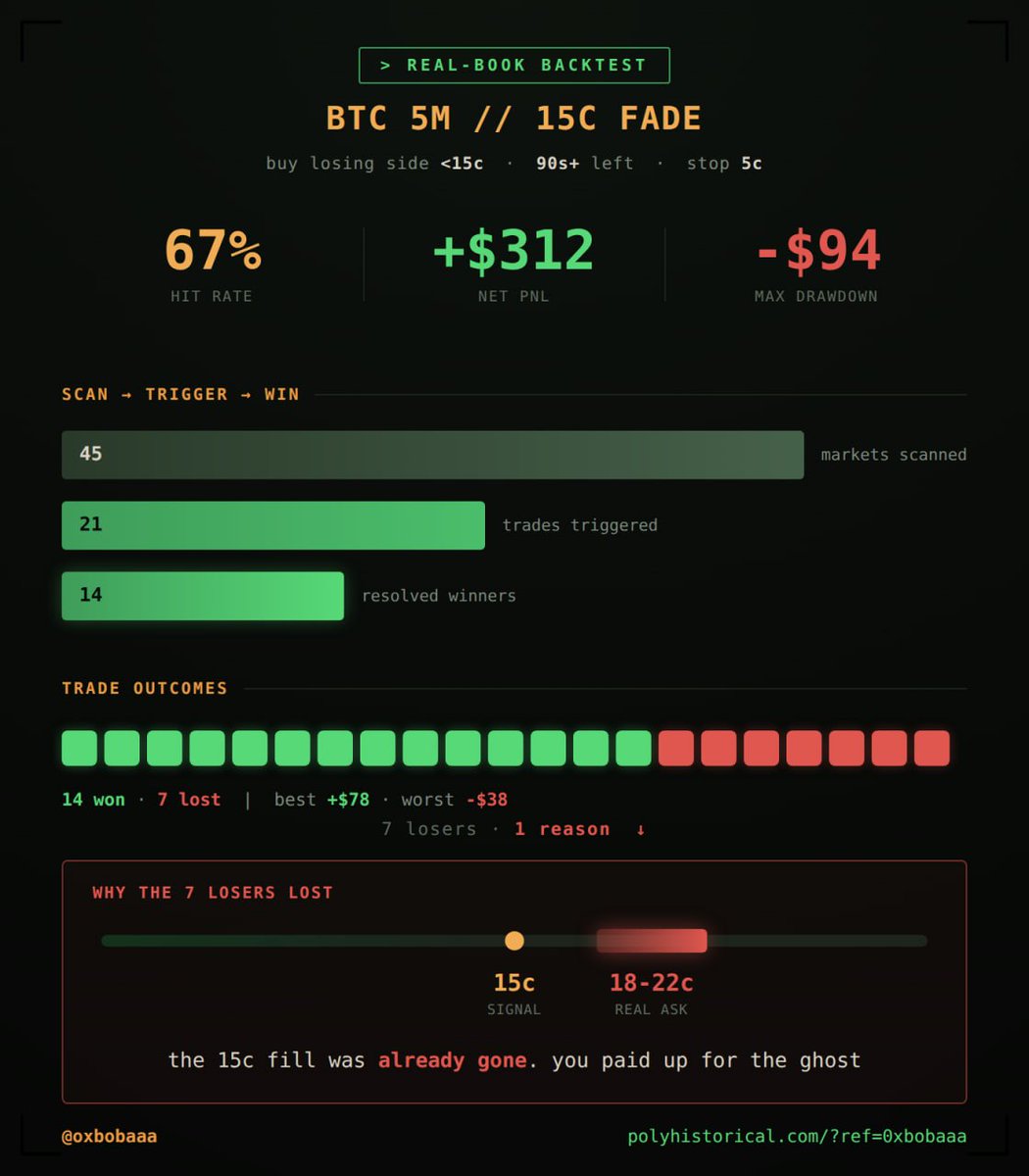
15c fill that was already 22c by the time the signal fired
simple btc up/down rule on 5m markets:
buy the losing side when it drops under 15c with 90s+ left
exit at resolution, hard stop at 5c
ran it on 45 resolved 5m btc markets through @Poly_Historical every entry filled at the real ask, not the midprice
> 21 trades triggered
> 14 won / 7 lost
> 67% hit rate
> +$312 pnl
> -$94 max drawdown
best +$78 -> worst -$38
then i pulled the 7 losers. same story on every one
the ask was already 18-22c when the signal said 15c. that fill was gone before the click landed, i just paid up for the ghost of it
cut the trades the book couldn't fill and it tightens up fast
on candles it looks like you got in at 15c. the book says you never did. that gap is where most polymarket strategies quietly die
https://t.co/jZy28EFo8U
This one is big.
AI Hedge Fund 2.0 is now live.
How it works:
1 • pick your stocks
2 • AI investors do research
3 • quant models trade
4 • every call is explained
Just the start. 100% open source.
Anthropic engineer:
"You're not supposed to prompt Claude. You're supposed to build a system that prompts itself."
In 45 minutes she breaks down how Anthropic builds agents that remember, learn from their mistakes, and get smarter with every run.
Worth more than any paid course you'll find on building agents.
Watch the session, then read the guide on building loops below.
+3700 Pips Today our VIP strategy captured massive US30 moves—and VIP Copy Trading members didn’t have to lift a finger. 💥
Connect your MT4 or MT5 account one time, and every VIP trade is copied directly to your account with the exact same entry, stop loss, take profit, and trade management.
🔥 Why Traders Are Switching to US30 Trading Lab VIP Copy Trading
✅ Fully Automated Trade Copying
✅ Copies Every VIP Trade Instantly
✅ MT4 & MT5 Compatible
✅ US30, NAS100, Gold & Forex
✅ Exact Entry, Stop Loss & Take Profit
✅ Smart Low-Drawdown Risk Management
✅ Works with Most Brokers Worldwide
✅ Prop Firm Friendly
✅ Beginner Friendly Setup
✅ Running in Under 10 Minutes
✅ No Chart Watching. No Emotional Trading.
Whether you’re at work, asleep, or away from your computer, your account mirrors every VIP trade automatically.
⚠️ Stop missing high-probability setups. Let your account trade alongside the professionals.
👇 Get Instant Access Today:
https://t.co/gJZ7YlVM8S
Metí 200$.
Este bot los convirtió en +13.000$.
Y ni siquiera lo programé yo.
Cogí un proyecto open source de GitHub.
Le dediqué un par de horas en Claude Code para limpiarlo, entender cómo funcionaba y hacer algunos ajustes.
Le di a ejecutar.
Pensaba que iba a fundir la cuenta en menos de una hora.
Minimicé la terminal y seguí con mi día.
Cuando volví por la noche, ya no eran 200$.
Eran +700$.
Desde ese momento, simplemente dejo los logs abiertos en el segundo monitor y veo cómo ejecuta operación tras operación.
La clave está en el timing.
El bot espera hasta los últimos dos minutos de cada ronda de 5 minutos de BTC.
Para entonces, Bitcoin ya ha hecho gran parte del movimiento y la dirección suele estar bastante definida.
En ese momento entra a favor de la tendencia, comprando contratos que cotizan entre 0,80$ y 0,99$.
Unos minutos después, si el movimiento se mantiene, la posición se liquida a 1$.
La lógica es sorprendentemente simple:
→ Esperar hasta que falten unos 2 minutos para el cierre de la ronda
→ Comprobar que BTC ya se ha movido entre 70$ y 100$ durante ese intervalo
→ Operar siempre a favor del movimiento, nunca en contra
→ Cubrir una pequeña parte de la posición únicamente si el mercado se desequilibra demasiado (por ejemplo, 95/5)
Es como comprar un boleto de lotería cuando prácticamente ya han anunciado el resultado.
El código es público y cualquiera puede usarlo en su pc:
https://t.co/9Khz1PzJKH
Gratis.
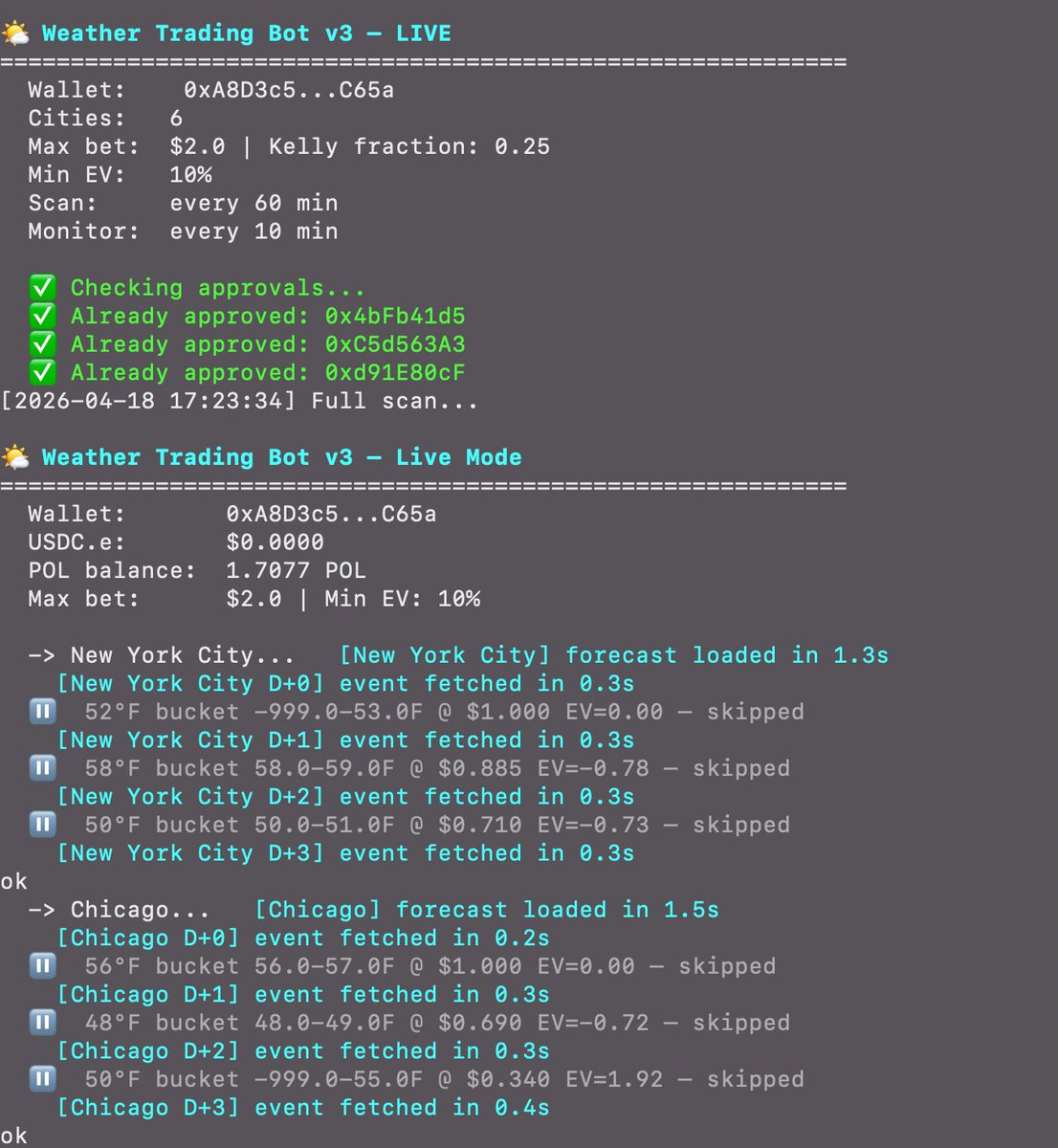
I found 5 free Polymarket Weather Trading Bots on GitHub (from Beginner Friendly to Advanced Level).
Each of these bots comes with a detailed step by step setup and usage guide in English.
> Beginner level / 5 min setup:
1. GFS based weather trading bot. It uses 31 different forecast scenarios from the Global Forecast System for a specific city and day to estimate the most accurate temperature outcome.
Then it automatically compares this value with current Polymarket prices to find mispriced opportunities and execute trades.
It has a dashboard where you can see and track all signals, trades, forecasts, trading pnl and more.
GitHub: https://t.co/MivMwpDYcF
2. NWS forecast bot with Kelly strategy. This bot scans NWS and gets the freshest temperature value in selected city and then compares it with current price on Polymarket.
It uses Kelly strategy to calculate the best trade size based on how strong this edge is and can also automatically execute trades.
GitHub: https://t.co/OBdsje8MAm
> Advanced bot setup:
1. A weather bot that analyzes different sources in real time, like forecasts, airport data and aviation observations (METAR and SPECI) to get the latest and most accurate temperature data.
Then it generates a detailed weather report for a specific city and day.
GitHub: https://t.co/No3sBcqMg1
2. An autonomous weather trading bot powered by the Hermes Agent.
It gets temperature data from multiple sources and uses a Gaussian Bucket strategy:
For example, if the forecast is 72F, it estimates that the final temperature will be between 71F and 73F.
After that, it compares this range with current prices on Polymarket and sends you a trading signal in Telegram.
The main feature of this bot - it can track its own results, learn and improve its own strategy over time.
GitHub: https://t.co/thJFzc3T3v
> A full ML weather model:
1. This is a full machine learning weather model built by a Boston University computer science student.
It learns from past forecasting errors by comparing weather predictions with the temperature that actually happened.
For example, if NWS often predicted 70F in Chicago, but the actual high was usually around 68F, the model learns that this source in this city overestimates the highest temperature by 2F.
Over time, it learns patterns across different cities, seasons and weather conditions.
So when a new forecast comes in, the model does not trust it blindly. It adjusts the forecast based on historical errors and produces a more accurate temperature estimate.
GitHub: https://t.co/9DnTPu5iKE
All of these bots include a simulation mode, so you can test them on real markets and see what pnl they can get without risking real funds.