@HPM_Univ_Iowa Good point. Again, I feel that solely using video platform would likely be short of the mark. Augmenting the conversation and DESIRE to fill out ACP would be my goal. #JCHPMIowa
A1T3: How could our patient population and that of Iowa benefit from video-based learning? How would you implement it (i.e. Native app, web app, video link to YouTube, webpage to UIHC PC resource page, outsource etc.)? #JCHPMIowa
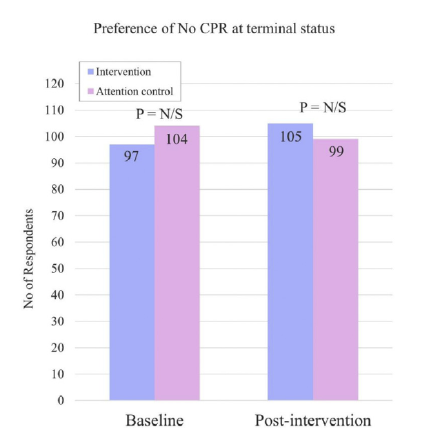
A1T2: Opposition to CPR in video group increased while the brochure group showed a significant decreased (i.e. in favor of EOL CPR) group difference 10.4%; P=0.24. Surprising results! Do you postulate it was content or the medium? #JCHPMIowa
A1T2: The sample had >80% power to detect a 15% difference at the 5% significance level, using the two-sample t-test for the difference between groups. They also compared pre and post intention to treat using Pearson’s X2 test. #JCHPMIowa
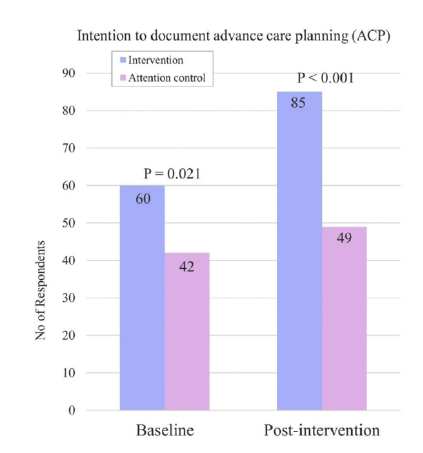
A1T2: While intention to document ACP is honorable, by the admission of the paper 46.2% of Koreans hoped for an APC documentation, only 1% have it done. Intention does not equal results. How would you design the study differently? #JCHPMIowa
A1T2: RESULTS: Primary outcome of the study was the change of the percentage of participants with positive intention to document an ACP. Secondary outcomes of the study were intention to refuse CPR at terminal status. #JCHPMIowa
A1T1: Willingness to undergo CPR in terminal status was measured with 1) Yes 2) No 3) Not sure. Other knowledge-based questions on palliative care, CPR, as well as anxiety/depression involving hospitals was gathered. #JCHPMIowa
A1T1: Do you think that the research aid may have contributed to response bias? How would you design the study differently to not include a research aid to administer per/post intervention survey? #JCHPMIowa
A1T1: A research aid went to participants and administered a pre and post intervention survey. Pre then post intervention surveys asked, “Are you willing to write an ACP?” with intention ranging from 1 (strong rejection) to 4 (strong intention).#JCHPMIowa
A1T1: 832 people were randomly selected by a computer from the public. 250 (125 in each group) completed the study. No statistically significant difference was found between the two populations #JCHPMIowa
@lorinfisher Great question. I honestly feel that video based learning with only augment a discussion rather than take the place of one. I only see it helping. #JCHPMIowa
@empressoftheair, it was in Korean so it was not posted (to my knowledge). I have heard of some videos that have shown a code. Do you think that would be helpful or too traumatic? #JCHPMIowa