The rescue coordinator called to tell me the cat I'd applied to adopt had been adopted by someone else.
Her: I'm so sorry. He went yesterday.
Me: Oh.
Her: You were second on the list.
Me: That's okay.
Her: You don't sound okay.
Me: I really wanted him.
Her: I know. Your application was the most detailed we've ever received.
Me: I did a lot of research.
Her: You included a floor plan of your apartment.
Me: I wanted them to see he'd have space.
Her: With furniture labeled.
Me: For context.
Her: We have another cat.
Me: I'm not sure I'm ready to....
Her: She's been here fourteen months. She's older. She's not getting looked at.
Me: Why not?
Her: She's not a kitten. She just sits in the back and waits.
Me: Does she like people?
Her: She likes quiet people. I think she'd like you.
Me: Why?
Her: You made a floor plan. That's a quiet person move.
I went in on Saturday.
She was in the back.
Walked directly to me.
Sat down.
Didn't perform.
Just chose.
Her: She's never done that.
Me: (already crying)
Her: Yeah. Take her home.
The thing you wanted and the thing you needed are not always the same cat.
A 4-year-old boy whose father left him, stood outside every single day for months waving at strangers... just hoping somebody would say hi back, in North Carolina.
Then one neighbor walked across the street to meet him.
Now an ENTIRE NEIGHBORHOOD shows up for his soccer games, his swim lessons, his birthday parties.
Roman Butzlaff is 4 years old, from Concord NC, just outside Charlotte.
His mom says he wakes up every single morning excited to say "hi" to somebody. It's the very first thing he wants to do.
But behind that big smile was a hurting little heart. His parents split about a year ago and his dad moved away.
Then a neighbor named Wade Fulgum did the simplest, most powerful thing in the world.
He just walked across the street... and met the little boy who was always waving at him.
And it spread.
Now about a DOZEN neighbors, people who barely knew each other's names, show up for Roman's soccer games.
His basketball games. His swimming lessons. Even his preschool open house. His birthday party guest list was basically a map of the block.
One neighbor said it best: "If the world was like this child, what an awesome, awesome place it would be."
Update: UPS put out an official statement on the video saying: "We're aware of the video. We have taken appropriate action with our driver and also have followed up with our customer."
In other words? They’re not going to do a damn thing to him. And if that owner had kept yapping, he was about to get popped right along with the package.
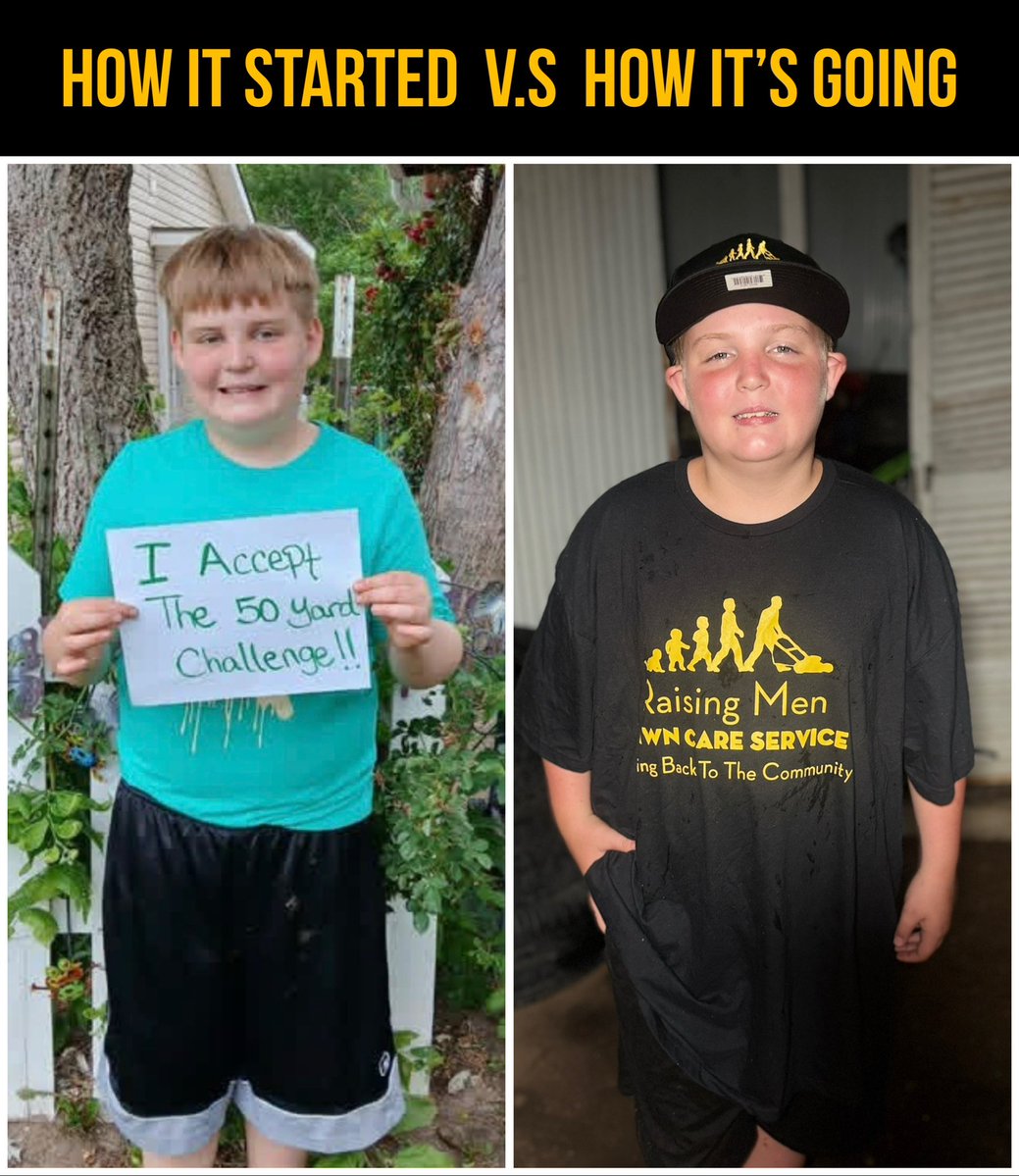
Braden, congratulations on completing The 50 Yard Challenge! This is an accomplishment you should be incredibly proud of. Many kids accept the challenge, but only a few have the dedication and determination to see it all the way through. Completing 50 free lawns says so much about your heart, your work ethic, and your character. You made a commitment, stayed focused, and finished what you started. Carry that same determination with you as you grow older, because it will take you far in life.
I saw that you signed up in May and completed the entire challenge in less than two months. Every year, a few kids stand out because they hit the ground running, and you are definitely one of them. Braden, I truly believe you are going to accomplish great things and continue making a difference wherever life takes you. Always remember: “Your character is not shown by what you start, but by what you have the courage and determination to finish.”
Obstacle difficulty:
Duckling determination:
Watching the final 6-day-old duckling of the Gg family get repeatedly washed down a brutal rocky weir, only to regroup and try over and over until he finally scaled the peak, is the ultimate Monday motivation. The whole squad made
A friend of mine a couple years ago was complaining that his fiancé stopped sleeping with him recently. We're all asking him "what did you do??" And he said he hasn't done anything, which obviously none of us believe. Then we go to his house to play some card games one night, and I get kinda thirsty so I walk to the kitchen to grab a drink from the fridge.
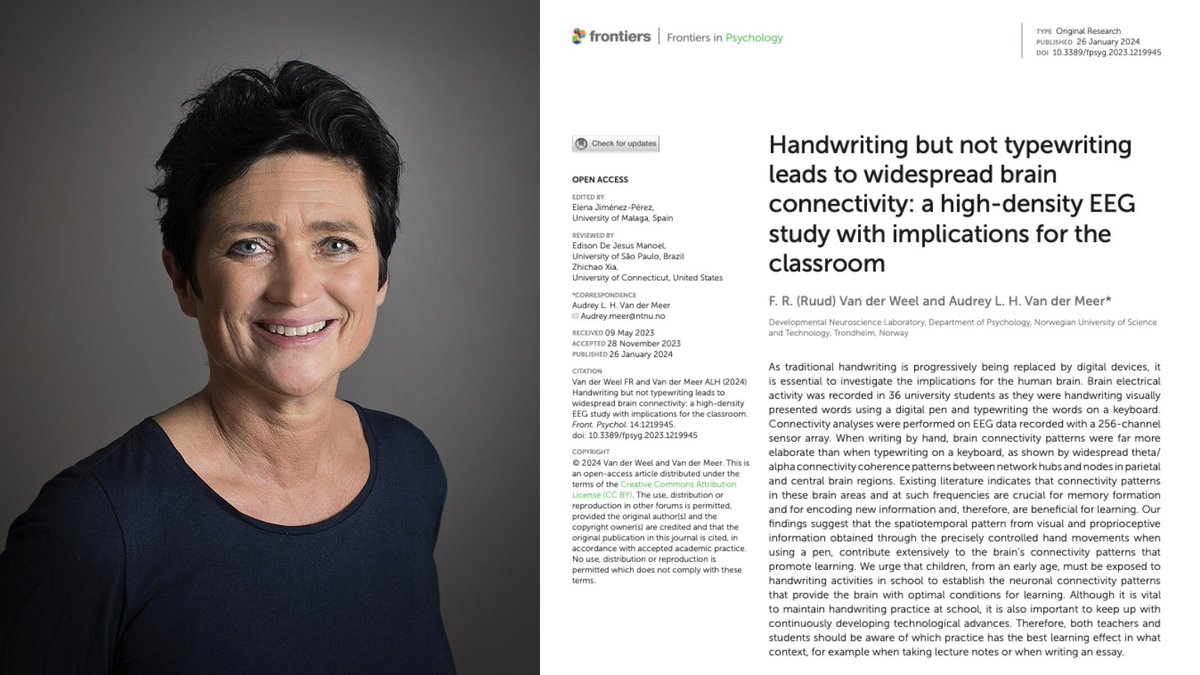
A Norwegian neuroscientist spent 20 years proving that the act of writing by hand changes the human brain in ways typing physically cannot, and almost nobody outside her field has read the paper.
Her name is Audrey van der Meer.
She runs a brain research lab in Trondheim, and the paper that closed the argument was published in 2024 in a journal called Frontiers in Psychology. The finding is brutal enough that it should have changed every classroom on Earth.
The experiment was simple. She recruited 36 university students and put each one in a cap with 256 sensors pressed against their scalp to record brain activity. Words flashed on a screen one at a time.
Sometimes the students wrote the word by hand on a touchscreen using a digital pen, and sometimes they typed the same word on a keyboard. Every neural response was recorded for the full five seconds the word stayed on screen.
Then her team looked at the part of the data most researchers had ignored for years, which is how different parts of the brain were communicating with each other during the task.
When the students wrote by hand, the brain lit up everywhere at once.
The regions responsible for memory, sensory integration, and the encoding of new information were all firing together in a coordinated pattern that spread across the entire cortex. The whole network was awake and connected.
When the same students typed the same word, that pattern collapsed almost completely.
Most of the brain went quiet, and the connections between regions that had been alive seconds earlier were nowhere to be found on the EEG.
Same word, same brain, same person, and two completely different neurological events.
The reason turned out to be something nobody had really paid attention to before her work. Writing by hand is not one motion but a sequence of thousands of tiny micro-movements coordinated with your eyes in real time, where each letter is a different shape that requires the brain to solve a slightly different spatial problem.
Your fingers, wrist, vision, and the parts of your brain that track position in space are all working together to produce one letter, then the next, then the next.
Typing throws all of that away. Every key on a keyboard requires the exact same finger motion regardless of which letter you are pressing, which means the brain has almost nothing to integrate and almost no problem to solve.
Van der Meer said it plainly in her interviews.
Pressing the same key with the same finger over and over does not stimulate the brain in any meaningful way, and she pointed out something that should scare every parent who handed their kid an iPad.
Children who learn to read and write on tablets often cannot tell letters like b and d apart, because they have never physically felt with their bodies what it takes to actually produce those letters on a page.
A decade before her, two researchers at Princeton ran the same fight using a completely different method and ended up at the same answer. Pam Mueller and Daniel Oppenheimer tested 327 students across three experiments, where half took notes on laptops with the internet disabled and half took notes by hand, before testing everyone on what they actually understood from the lectures they had watched.
The handwriting group won by a wide margin on every question that required real understanding rather than surface recall.
The reason was hiding in the transcripts of what the two groups had actually written down.
The laptop students typed almost word for word, capturing more total content but processing almost none of it as they went, while the handwriting students physically could not write fast enough to transcribe a lecture in real time, which forced them to listen carefully, decide what actually mattered, and put it in their own words on the page.
That single act of choosing what to keep was the learning itself, and the keyboard had quietly skipped the choosing and skipped the learning along with it.
Two studies. Two countries. Same answer.
Handwriting makes the brain work. Typing lets it coast.
Every note you have ever typed instead of written went into your brain through a thinner pipe. Every meeting, every book highlight, every idea you captured on your phone instead of on paper was processed at half depth.
You did not forget those things because your memory is bad. You forgot them because typing never woke the part of the brain that would have made them stick.
The fix is the thing your grandmother already knew.
Pick up a pen. Write the thing down. The slower road is the faster one.