Do you work with OPM-MEG for neuroimaging 🧠? If you want to DIY your own PCB field nulling coils, check out our new preprint:
https://t.co/MiaYSdxzm6
With @mainakjas, Jack Kamataris, @abbas_neuro, Teppei Matsubara, @mshamalai and others from @MGHMartinos MEG.
Our latest studies on the decoding text from brain activity, reviewed by MIT Technology Review @techreview:
https://t.co/H6LLshI1FI
Research done at @AIatMeta and @bcbl_
- Blog: https://t.co/UnwK8YO6dt
- Study 1: https://t.co/KT9egURLRl
- Study 2: https://t.co/NBUuBb6Unm
https://t.co/q1B8spCxdS
Our new preprint on calibration methods for OPM MEG is now online at arxiv! We use two methods to determine location, orientation, and gain of OPM sensors and assess the change in source reconstruction compared to using assumed geometries
Is your research area in circuit, systems or computational neuroscience? Excellent opportunity for research focused PI positions @UH_Neuro @HiLIFE_helsinki. Superb environment & access to cutting-edge neuroscience infrastructures. Apply by 31.5 https://t.co/Suhvno7rZ8
Our recent OPM gradiometer paper has been covered in
@PhysicsWorld!
Follow the link below, or head to the front page(it is there as of this post)!
https://t.co/Rg57TsBalH
@TheCHBH@QN_lab @OleJensenCHBH
I’m not as active on X/Twitter as LinkedIn, but if you do anything with instrument design that requires sensing or manipulating magnetic fields, check out this GitHub repository!!!
For example, the sensor has improved electromagnetic coils designed using state-of-the-art stream-function methods freely available in our Python software package (https://t.co/xQ8sADV4j8).
I am delighted to share that our article "Four-channel optically pumped magnetometer for a magnetoencephalography sensor array" has been published in Optics Express. We demonstrate second generation optically pumped magnetometer for MEG. #quantum#meg.
https://t.co/gzhhzIs9ae
@JuhanaBrotherus Näin USA:ssa asuvana ja täkäläistä uutiskeskustelua seuraavana, niin tuntuu että valtamedian mielipide on päinvastainen: oman kodin ostaminen vaikeutunut.
One hundred years of wave equations of physical systems from Schrödinger's model of the atom to neural field theory of the brain
Both formulations predict that the system's expressed energy is constrained into natural modes - "eigenstates - determined by the system's geometry
We are recruiting!🥳 Interested in improving reliable interpretation of #EEG#MEG#HRV etc in understanding individual's psychophysiological #wellbeing? Developing #ML appl to design novel solutions to monitor mental health? Stay tuned/DM me! @JKLBrainMind https://t.co/vQtM6VL4Xb
Kriging (aka Wiener interpolation) is a method for kernel interpolation that accounts for uncertainty using Gaussian processes. https://t.co/Q2lWOt22yJ
We are so excited about our OPM ribbon cutting tomorrow! We'll make sure to share some behind-the-scenes from it here on social. Learn more about the #OPM in this video. #StayTuned
Postdoctoral position on developing and applying OPM for MEG @TheCHBH . We have excellent facilities and a supportive+experienced research team developing and testing OPM sensors with a focus on paediatric applications and combination with TMS
https://t.co/ur9HgjvWVD
Playing Brain Pong using only 7 MEG sensors without perceiving any stimulation? It's possible with Rapid Invisible Frequency-Tagging (RIFT)! Happy to share our new paper on RIFT for Brain Computer Interfaces @TheCHBH https://t.co/1O8AALWMxE
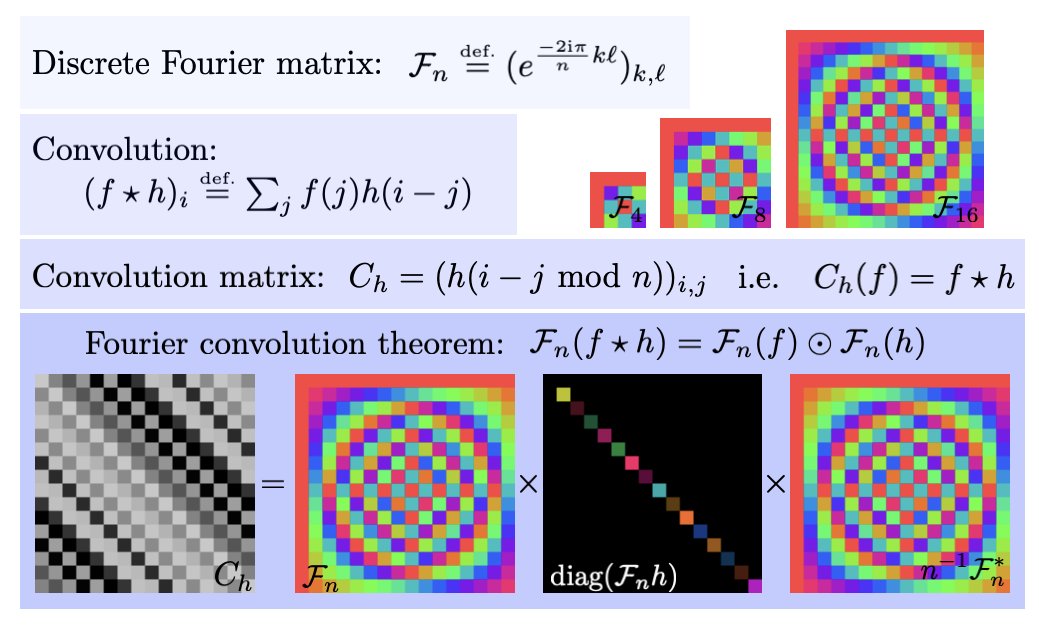
The Fourier transform diagonalizes convolution operators aka circulant matrices aka linear operators which commute with translations.
The foundation of linear signal processing. https://t.co/A8RlE7BTFe
Together with Dr. Gianvito Lucivero @ilGiambo we are serving as guest editors for a Special Issue in "applied sciences" on optically pumped magnetometers. For more information about the special issue, please see https://t.co/vKX1P8Irnn Looking forward to your contributions!
- theoretical modeling of biomagnetic signals for optimizing the geometry of OPM-based sensor arrays for efficient source modeling and/or interference rejection 2/3