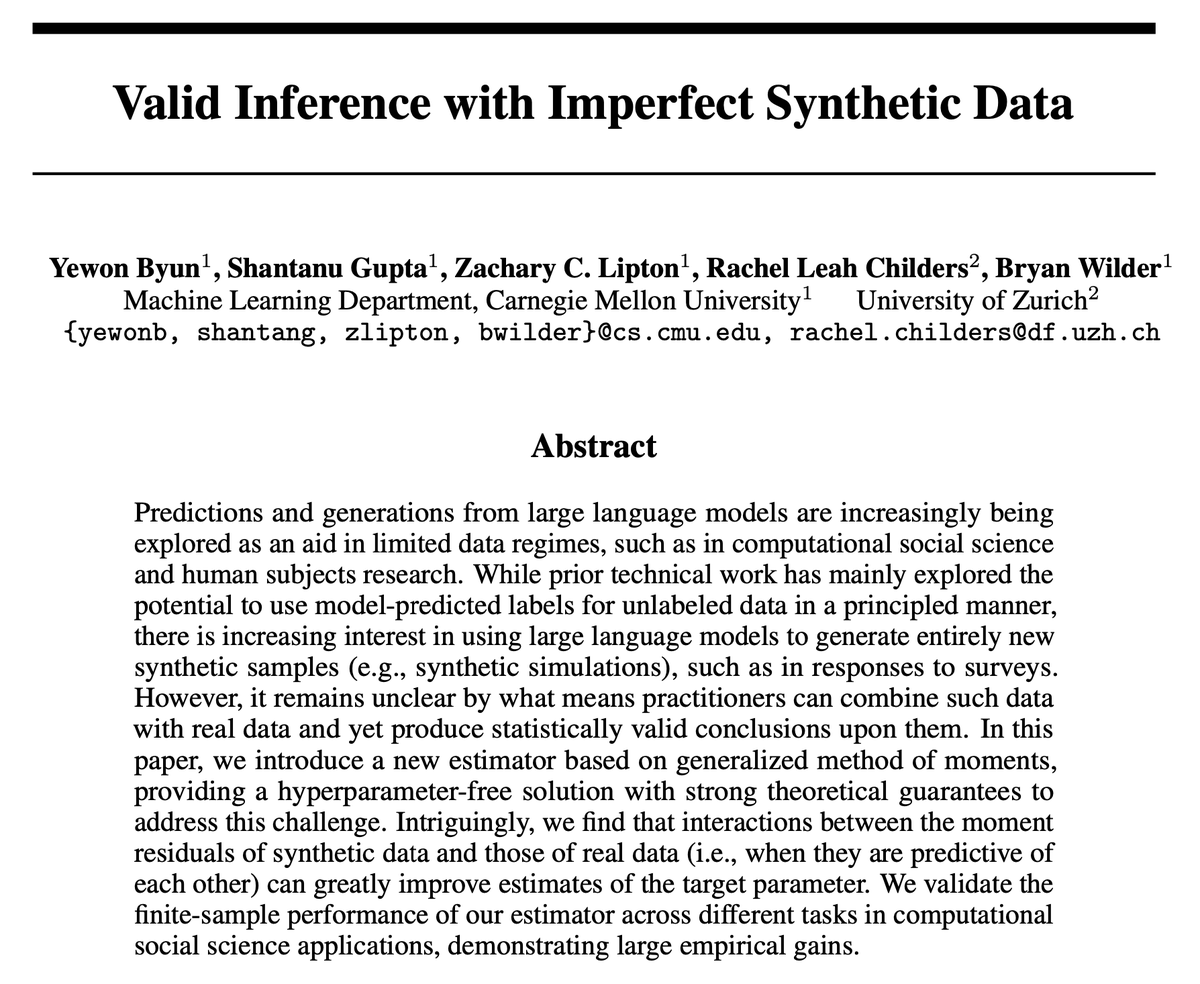
A lot of excitement in synthetic data for science is motivated by ambitious uses of LLMs (e.g., running a survey with GPT before real participants, forecasting promising experiments with LLMs). We ask, what beliefs should the experimenter have to make this a good idea? 🧵
💡Can we trust synthetic data for statistical inference?
We show that synthetic data (e.g. LLM simulations) can significantly improve the performance of inference tasks. The key intuition lies in the interactions between the moments of synthetic data and those of real data
🚨🚨 Preprint Alert 🚨🚨 🚀🚀
As AI become agents 🤖, how can we reliably delegate tasks to them, if they cannot communicate their limitations😭 or ask for help or test-time compute 🧑🚒 when needed?
We present our new pre-print **Self-Regulation and Requesting Interventions** that investigates how LLM agents 🤖 can assess their own limitations and determine when to leverage test-time compute, larger models, or human intervention🧑🚒.
Combining LLM-based process reward models (PRMs) with classical RL, we developed an off-line and hybrid method that eschews the inefficiencies of end-to-end deep learning while leveraging the robustness of PRMs. Empirically, our method matches the performance of ALWAYS using interventions, even when requiring only one intervention per task—just about 1/10 intervention usage.
Project website: https://t.co/yhsRNUN2uO
(1/5)
Today, we’re launching early access for North!
Our all-in-one secure AI workspace platform combines LLMs, search, and agents into an intuitive interface that effortlessly integrates AI into your daily work to achieve peak productivity.
Introducing Command R7B: the smallest, fastest, and final model in our R series of enterprise-focused LLMs!
It delivers a powerful combination of state-of-the-art performance in its class and efficiency to lower the cost of building AI applications.
https://t.co/e2ah5c5x5J
I am on the industry job market, and am planning to interview around next March. I am attending @NeurIPSConf, and I hope to meet you there if you are hiring! My website: https://t.co/p9D18CH79a
Short bio about me:
I am a 5th year PhD student at CMU MLD, working with @rsalakhu and @ybisk. My current research focuses on the confidence of LLM agents - how LLM agents can assess their own limitations and determine when to leverage increased inference compute, larger models, or human intervention.
I am a recipient of Apple AI/ML Scholars Fellowship for 2023. I have interned at Apple AI/ML and Meta FAIR. My research has been recognized through multiple features in CMU news. I hold B.S., M.Eng from MIT EECS.
I am also presenting two of my recent works: Embodied-RAG/Situated Instruction Following in AFM and LangGame workshops.
RT appreciated!
Introducing our latest AI search model: Rerank 3.5!
Rerank 3.5 delivers state-of-the-art performance with improved reasoning and multilingual capabilities to precisely search complex enterprise data like long documents, emails, tables, and code.
https://t.co/UGxclqGIPY
💬 Have you or a loved one compared LM probabilities to human linguistic acceptability judgments? You may be overcompensating for the effect of frequency and length!
🌟 In our new paper, we rethink how we should be controlling for these factors 🧵:
Just landed in Miami to attend #EMNLP2024 🐊
I’ll be presenting the poster of our “Tools fail” paper on Wednesday Nov 13th, 16:00-17:30 at Jasmine — come check out our poster for a chat!
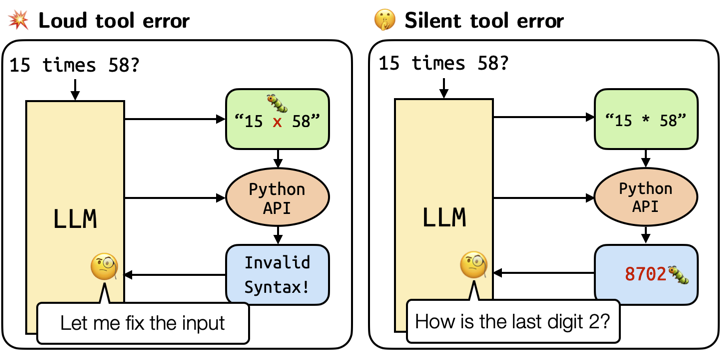
Tools augment LLMs but can also introduce errors without explicit messages. Can LLMs detect these "silent" tool-based errors?
We investigate this challenge and present an initial approach to failure recovery.
Work w/ @SoYeonTiffMin@_Yingshan@ybisk
🗞️ https://t.co/4SQVgGxnnr
Extremely proud to share ✨ Aya Expanse ✨
We are a small lab, and this builds on years of dedicated research to connect the world with language. 🌎🌍🌏
A huge shoutout to the @CohereForAI@cohere team and our wider community for breakthroughs that ensure the world is seen.
🧵1/8 So annoying when my 🤖 vacuum cleaner buzzes loudly during my Zoom meeting! Can we teach robots to be aware of their noise levels at home? Introducing ANAVI—a framework that uses indoor visuals to predict sound propagation! 🎶🏠
Today @CohereForAI and @cohere are releasing two new multilingual models spanning 23 popular languages. Across a range of use-cases, these models represent a new state-of-the-art.
We're also releasing the weights (8B & 32B) on @huggingface
1/ What if you could see how your AI handles the chaos of the real world? Meet HAICOSYSTEM: the framework to simulate human-AI-environment interactions—all at once. 🌍🤖 Find out if your AI is truly safe under pressure from real-world scenarios! 🔥
🌐: https://t.co/zEAKHMJAr8
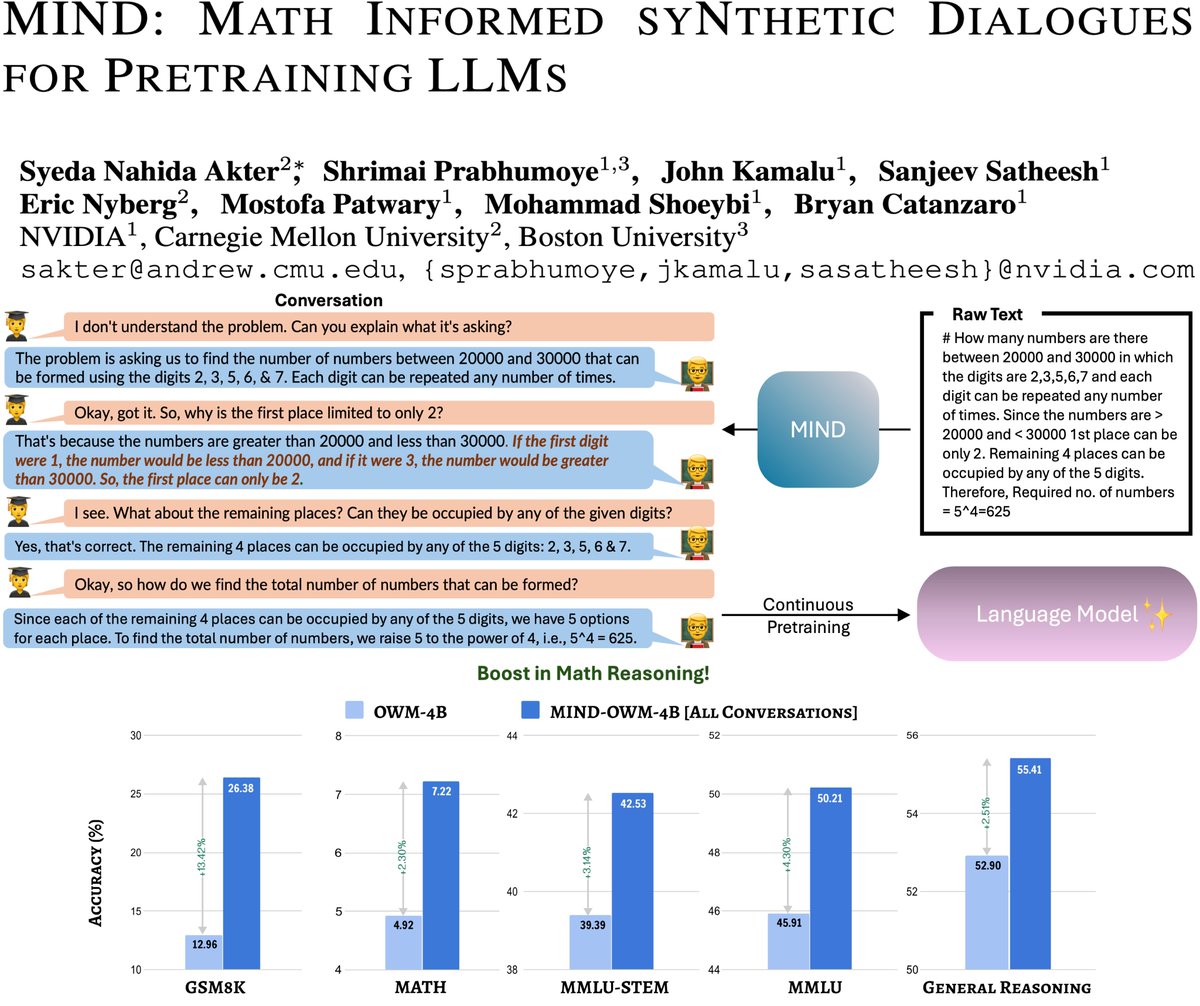
Synthetic data can boost LLM’s reasoning—how?
Introducing MIND—a method to boost LLM’s math reasoning by generating dialogues with knowledge gaps between participants.
❌Don’t just dump data into LLM—✅rephrase dialectically with MIND to make the most use of your tokens!
🧵↓
🤖💡 Brainstorming with ChatGPT’s help?
⚠️ Be careful what you reveal about yourself, because large language models might give you stereotypical or biased recommendations.
Preprint here: https://t.co/We1fz6v5Mz
🧵1/7