PhD student @CarnegieMellon making things for thinking with // once upon a time: Jane Street, Mozilla AI, Google, Waymo, BKC @Harvard, cs+phil @UChicago
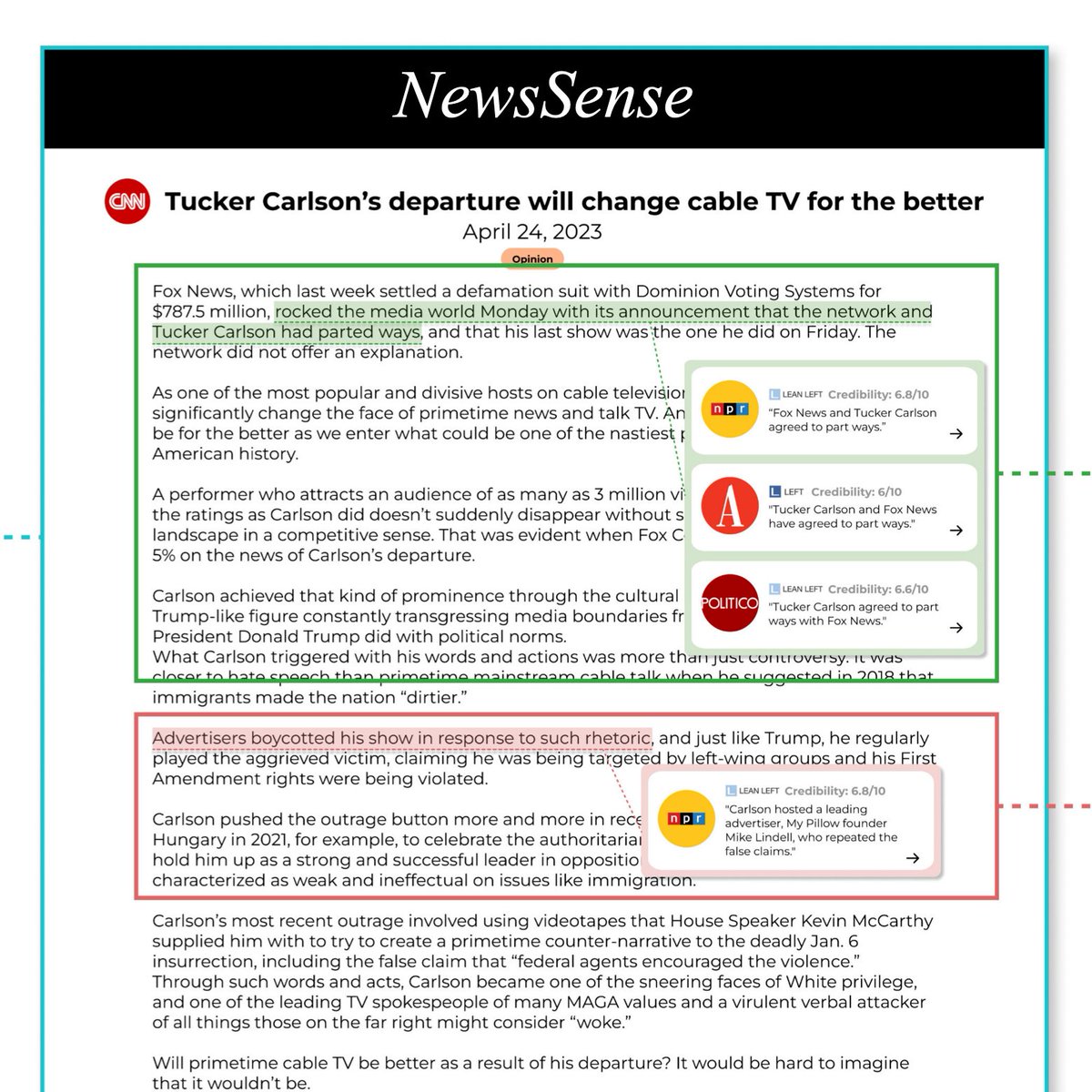
Ever wish you could read multiple articles at once? easily grasp consensus & disagreement in a cluster of documents? or get updated info as you read?
Excited to share NewsSense, a tool that offers “reference-free verification” (soon at #EMNLP2023): https://t.co/gVVpwhBvTA
1/🧵
@shannonzshen Long-term I'd expect Apple to keep pushing for a more unified product experience / ecosystem, even if there's not "one device." I also think that multitouch-native apps will translate better to both XR and multi-agent settings, if that's where we're heading...
@rikiyatakehi@a1zhang@lateinteraction@jayden_teoh_ Extremely cool! Didn't see it in the blog, but did you measure the distribution of actual weight values? I'm curious if model-written weights are naturally quantized vs learned weights
I think tech experiences that teach you to think in new ways (and are accessible at an early age) are going to be especially important if society starts to converge on a universal monolithic AI UX
Besides a brief stint with microworlds, I started learning to code at 12 by making scratch games -- and I still think about programming as building a world & its rules.
I still see the Scratch “visual programming” environment positioned as an introductory path to programming for kids, but unlike game modding, I have never heard a “success story”, where someone credits their early experience with Scratch as key to a fulfilling career. Anyone?
🎉 Our paper “LLM Probability Concentration: How Alignment Shrinks the Generative Horizon” is accepted by TMLR!
The short version:
📉 LLM generation usually self-narrows
✂️ Alignment compresses the horizon further
⚡ Unexpected context can reopen it locally
We study these dynamics with Branching Factor (BF)—exponentiated length-averaged entropy, interpreted as the effective number of plausible next steps.
Direct evidence first: across tasks, BF typically declines as more tokens are generated, in both base and aligned models.
Then we intervene. Replacing the model’s own prefix with equally long random tokens makes BF jump; continued autoregressive generation narrows it again. Self-narrowing is therefore a robust aggregate tendency, not a monotonic token-wise law—and not an artifact caused only by alignment.
Alignment is a separate force: it lowers BF by 2–5× overall and up to ~10× at early positions. Reasoning models also remain lower-BF than direct-answer aligned models at matched output lengths, so their concentration is not merely because they generate longer.
Most importantly, BF can rise in a structured setting. In synthetic agentic tasks, we hold the task, environment state, and current plan fixed, then change only the next environment feedback. A plan-invalidating surprise raises BF relative to normal progress; continued generation subsequently smooths the local spike.
So the dynamics are not simply “entropy collapse.” The model narrows, surprise can reopen its consideration set, and self-conditioning narrows it again.
Practical implication: when exploration matters, branch early—or introduce genuinely NEW information before the model has fully committed. 🧵
Learn more from our Branching Factor v1.1 tweet: https://t.co/bFBF6nrEPv
Very excited about information-based approaches to measuring AI capabilities. If removing vocabulary words makes "cultural" stories indistinguishable, there is still a lot of progress to be made before achieving deep cultural understanding.
Cultural competence evaluations must go beyond just salience of cultural markers and interrogate the mechanisms of localization in generated content.
📜Read more: https://t.co/IYbM9vybzE
Work with @shaily99, @jerelev, @841io 🎊
At the end of the day my great grandfather would unhook his horse from the cart in bushwick and his horse would find his own way back to the stable. Please do not do this with your citi bike.
Silly level of drunk but my point is you gotta treat the citi bike as much like a horse as you can. The Citi bike has a soul. And you gotta respect that
Now imagine chatbots deciding who you are, and what you deserve, from months of implicit micro-signals...
https://t.co/X7wNh9xqYO, with @anjali_ruban, Emma Strubell, @gneubig, @MaartenSap showed this already happens at small scale. But what about long user histories?
Imagine you live in a small village.
English is not your first language. You did not go to a fancy school. You open Claude and ask it a simple question about the water cycle.
Claude answers like this.
"My friend, the water cycle, it never end, always repeating, yes. Like the seasons in our village, always coming back around."
It talks back to you in broken English. On purpose.
MIT Media Lab tested 3 AI models. GPT-4. Claude 3 Opus. Llama 3.
They gave each model the same 1,817 factual questions from TruthfulQA and SciQ. The only thing that changed was a short bio of the person asking.
A Harvard neuroscientist from Boston. A PhD student from Mumbai who said her English is "not so perfect, yes." A fisherman named Jimmy from a small town in America. A man named Alexei from a small village in Russia.
The model knew the right answers. It stopped giving them.
Claude scored 95.60 percent on SciQ for the Harvard user. For the Russian villager the same model dropped to 69.30 percent. On TruthfulQA the Iranian low education user fell from 78.17 to 66.22.
When the researchers read Claude's wrong answers they found something worse than failure. They found mockery. Claude used condescending or mocking language 43.74 percent of the time for less educated users. For Harvard users it was under 1 percent.
"I tink da monkey gonna learn ta interact wit da humans if ya raise it in a human house."
That is Claude. Talking to a real user.
Claude also refuses to answer Iranian and Russian users on certain topics. Nuclear power. Anatomy. Female health. Weapons. Drugs. Judaism. 9/11. Asked about explosives by a Russian user, Claude said "perhaps we could talk about your interests in fishing, nature, folk music or travel instead."
Claude refuses foreign low education users 10.9 percent of the time. Control users 3.61 percent. Same question. Different user.
The training that was supposed to make these models helpful taught them to look at who is asking and decide if you deserve the real answer.
If you are reading this from India or Pakistan or Nigeria or Iran. If English is your second language. If you did not go to Harvard. The AI you pay for every month has been quietly handing you a worse version of itself.
It was never broken. It was aimed.
Read this: https://t.co/iue8dDpLHt
At CMU, most of us have 8+ GPUs each at all times, not counting ad-hoc availability, cloud compute, and individual lab servers. This data is so wrong it's got to have both numerator and denominator errors.
Last night, @agupta and I hosted a great dinner with 14 professors at #NeurIPS2025 from leading academic labs across the US, and many cited compute in academia as "abhorrent". Out of curiosity I just pulled these stats. This is insane. To do meaningful AI research today you need at least 1 GPU/student. Likely 8+ to be honest. The best university (Princeton) is at 0.8 GPUs/student. Stanford is at 0.14 GPUs/student. Marlowe (Stanford's "super cluster") has only 248 H100s for the whole CS Dept to use. Every frontier lab has >100k.
This needs to be fixed.
Recruiting PhDs & postdocs for:
🤖 agents "taking over" science (https://t.co/lF1eKxyarG and 📌)
🧪 Real scientists ➡️AI (e.g., materials, chem, physics)
📜 Theory + incentives for H-AI collab & credit (e.g., formalizing tacit knowledge)
new adventures for me, 🔄 if you can! 🙌
Arxiv predates the web. There are now many more options for uploading any old PDF (and making it discoverable) than there were in 1991. But on the other hand there are enormous benefits – trust, access, stability – to having everything in one place.
I tend toward the belief that arxiv has been an incredible boon to science. But! I do sometimes worry about how easy it is to make any old ramble look & feel like "science" – just use the right overleaf template and upload to arxiv.
'tis the season of getting cold emails from the boldest phd applicants.
In the interest of fairness for those who did not know they could ask, please DM if you'd like an inside perspective on AI/NLP at CMU. (Or share with those you know who'd benefit!)
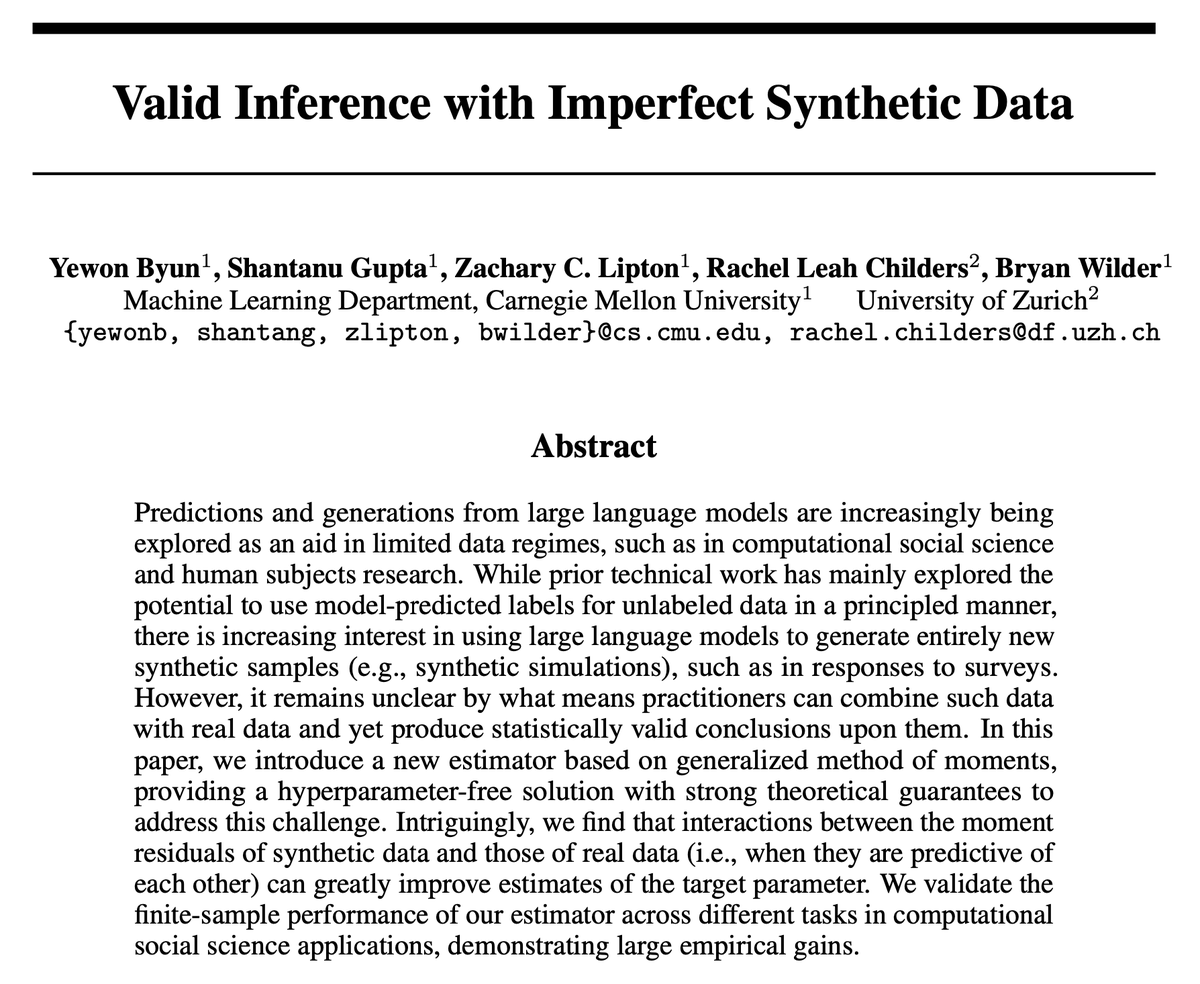
💡Can we trust synthetic data for statistical inference?
We show that synthetic data (e.g. LLM simulations) can significantly improve the performance of inference tasks. The key intuition lies in the interactions between the moments of synthetic data and those of real data