Have you noticed…
🔍 Aligned LLM generations feel less diverse?
🎯 Base models are decoding-sensitive?
🤔 Generations get more predictable as they progress?
🌲 Tree search fails mid-generation (esp. for reasoning)?
We trace these mysteries to LLM probability concentration, and introduce Branching Factor (BF) — a simple measure that captures it all.
Key Findings:
— BF declines over time → generations become more deterministic
— Alignment tuning slashes BF → shrinks the generative horizon
— Low BF explains decoding sensitivity → fewer good options to prune
— CoT stabilizes generation → shifts key info to late, low-BF regions
— Avoid late branching → too many low-probability, low-quality continuations
— Alignment surfaces low-entropy paths already latent in base models
📜 Paper: https://t.co/WeqorDQ1mG
🌐 Website: https://t.co/PVRnPNdbkz
🎥 2-min explainer below.
Joint work w/ @universeinanegg , thanks for the constructive feedback from @PeterWestTM@UChicagoCI@zhaoran_wang@_Hao_Zhu@ZhiyuanCS@TenghaoHuang45@TuhinChakr
@lambdaviking@jowenpetty Congrats on this great work! So glad to know state tracking is still that important after 3 years lol (I publish a state tracking evaluation paper after ChatGPT's release with @AllysonEttinger , and it seems like already pretty old 🤣 https://t.co/9OTjhbBwsZ )
Honored to have the opportunity to learn OPD and RL with a wonderful team: Boyan Li, @BaleCcchen, @xiye_nlp, and @henryzhao4321! It makes a lot of sense to run OPD to warm up for RL training instead of naive SFT, and this paper uses clear, solid, and thorough experiments to explain this. Come check it out!
New 📜 on the interplay between OPD and RLVR
💡Don’t skip RL after OPD
We find that after using OPD for reasoning, adding an RL phase consistently improves performance.
Across reasoning tasks, OPD→RL outperforms pure OPD, pure RLVR, and many joint OPD+RL methods.
Good question! I think this is exactly where forecasting can add something beyond standard benchmarks.
First, it’s live: forecasts are locked before the real outcome even exists, so models/agents can’t benefit from contamination or memorization. The questions and scoring rules are pre-registered, and every forecast and result is public.
Second, the outcome is generated independently of us and the model builders, through existing real-world surveys and trackers. We don’t get to decide what the “right answer” should look like. Instead, the world resolves it for us.
And importantly, we don’t only look at the overall average. We also evaluate demographic breakdowns, so a simulator can’t look good just by getting the topline right while systematically misrepresenting particular groups.
One-liner: Does what we learn from standard benchmarks actually hold up in the real future?
More on fair evaluation, anti-cheating, and responsible use in our upcoming technical report!
Excited to join this open-source effort in my spare time!
I’ve long believed that LLM alignment should be grounded in the diversity of real human behavior—not a handful of stereotypes.
Social/human/user simulation is taking off (@humansand, @simile_ai, ...), but how do we know whether these simulations are actually good?
That’s what I love about this project: Eval-via-Forecasting turns real-world societal data into a live, public reality check for simulation quality.
Come test your simulator with us!
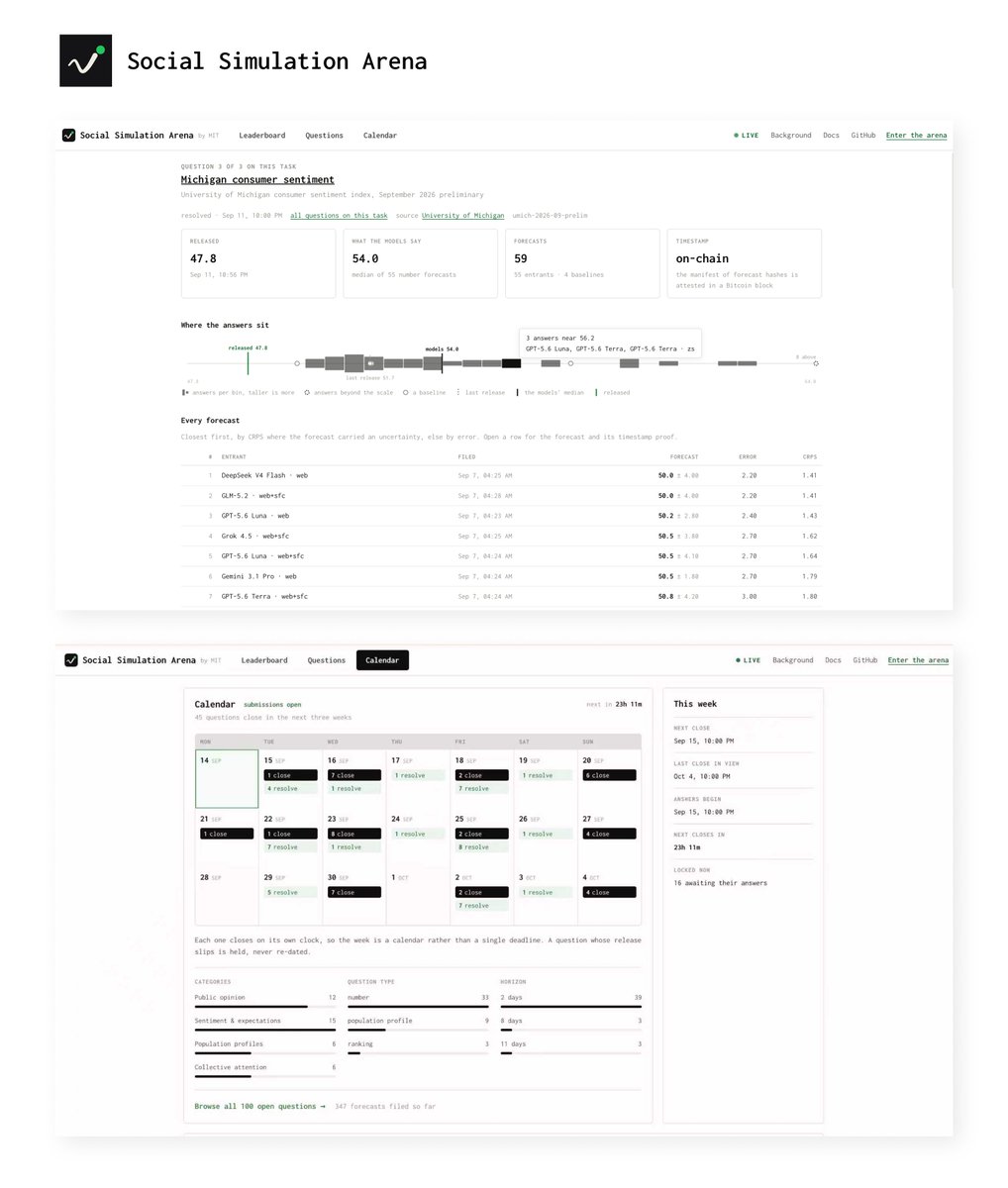
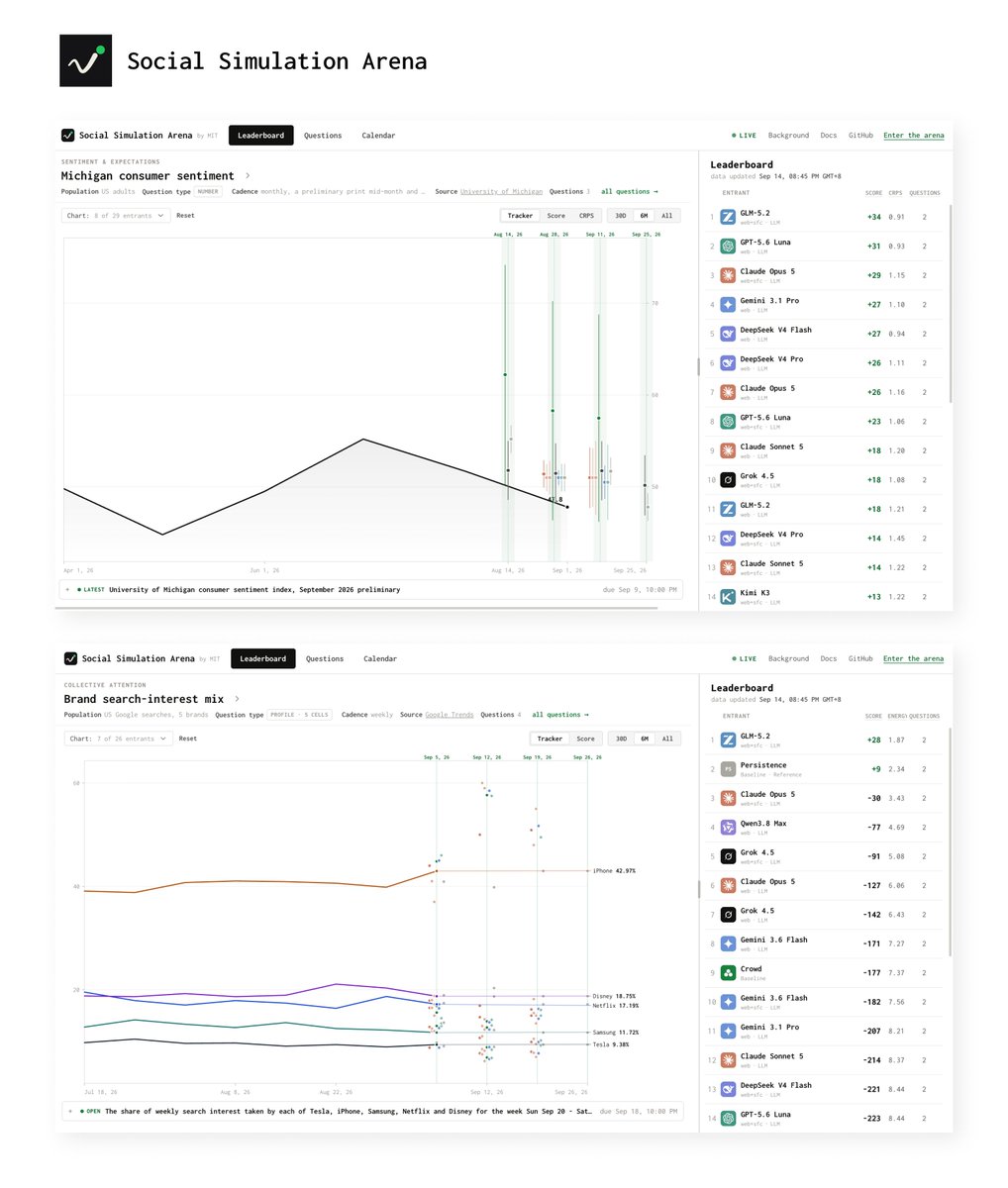
Social simulation is now a product. Evaluation still has no common standard.
What if we tested every simulator against the real future?
We built Social Simulation Arena with researchers from MIT, Stanford, Harvard, CMU, UC Berkeley, and beyond.
Persona-prompted populations. Digital twins. Silicon samples. Synthetic populations. Worlds of a billion agents.
We have more ways than ever to simulate human behavior. But we still lack a standard everyone can trust to tell which ones work.
Most studies use their own datasets, often historical surveys whose answers are already online. A model that has seen the answer sheet can look brilliant.
Social Simulation Arena is a different kind of test: prospective, independent, and shared.
Simulators submit and lock their forecasts before each data release. When the real results arrive, every entrant is scored by the same rules.
Can a simulator predict a public before it moves?
If you’re building one, bring it.
https://t.co/SIytJoXeIR
#MIT #Stanford #Harvard #AI #Agents #LLM #SocialSimulation #Evaluation
Wow — I’ve been thinking about something very similar while building computer-use agents.
Low-level APIs (“pixel-level control”) may offer maximal flexibility, but specialized software gives models useful abstractions that can dramatically reduce context usage and trial-and-error. We’ve spent decades building tools like professional software, renderers, and game engines precisely to encode useful structure.
More broadly, I think there’s a science (maybe even an art :-)) to choosing the right abstraction level for a model to operate at.
A related analogy, inspired by Linus’s talk on AI and Linux: assembly gives you maximum control, but modern programming languages make us vastly more productive by abstracting away the right low-level details.
🎉 Our paper “LLM Probability Concentration: How Alignment Shrinks the Generative Horizon” is accepted by TMLR!
The short version:
📉 LLM generation usually self-narrows
✂️ Alignment compresses the horizon further
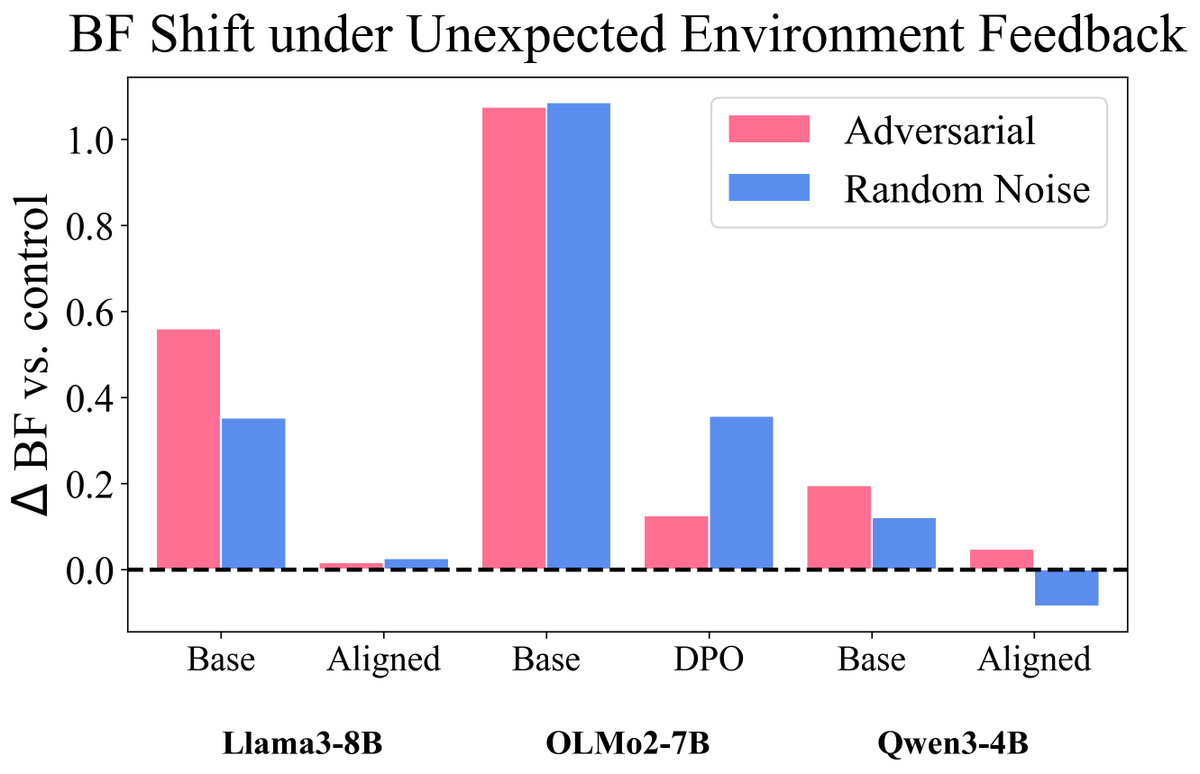
⚡ Unexpected context can reopen it locally
We study these dynamics with Branching Factor (BF)—exponentiated length-averaged entropy, interpreted as the effective number of plausible next steps.
Direct evidence first: across tasks, BF typically declines as more tokens are generated, in both base and aligned models.
Then we intervene. Replacing the model’s own prefix with equally long random tokens makes BF jump; continued autoregressive generation narrows it again. Self-narrowing is therefore a robust aggregate tendency, not a monotonic token-wise law—and not an artifact caused only by alignment.
Alignment is a separate force: it lowers BF by 2–5× overall and up to ~10× at early positions. Reasoning models also remain lower-BF than direct-answer aligned models at matched output lengths, so their concentration is not merely because they generate longer.
Most importantly, BF can rise in a structured setting. In synthetic agentic tasks, we hold the task, environment state, and current plan fixed, then change only the next environment feedback. A plan-invalidating surprise raises BF relative to normal progress; continued generation subsequently smooths the local spike.
So the dynamics are not simply “entropy collapse.” The model narrows, surprise can reopen its consideration set, and self-conditioning narrows it again.
Practical implication: when exploration matters, branch early—or introduce genuinely NEW information before the model has fully committed. 🧵
Learn more from our Branching Factor v1.1 tweet: https://t.co/bFBF6nrEPv
BranchingFactor v1.1 just dropped! 🚀
(Yes — it’s an actively updated paper.) (https://t.co/WeqorDQzce)
As models rely more on post-training, understanding the synergy between pre-training and alignment becomes crucial. Branching Factor (BF) offers a simple way to track the remaining generative potential of a model — since entropy inevitably decreases during generation, BF measures that process.
What’s new in v1.1:
1️⃣ Major rewrite
We now introduce BF directly — much clearer and easier to read.
2️⃣ Theorem correction + extension
Thanks to @StarLi27496427 and Yuwei for catching my misunderstanding of the AEP theorem! We fixed the derivation and extended it to variable-length LLM outputs.
The good news: the main result still holds — length-avg log-likelihood can estimate length-avg entropy for sufficiently long generations, in a memory-efficient way. Useful if you want to monitor entropy during training or inference.
3️⃣ Broader evaluation
Added experiments on OLMo2 and Qwen3, plus multilingual and long-context tasks.
Key findings so far still holds often:
📉 BF decreases during generation
✂️ Alignment significantly reduces BF
⚖️ Interestingly, OLMo2 appears less aggressively shrunk by alignment than Qwen3/Llama3 (preliminary observation).
4️⃣ SFT vs RL analysis
We started dissecting how SFT and RL affect BF. Early signals from OLMo2:
🧠 Smaller models: BF shrink mostly happens during SFT (possible memorization effect).
🏗️ Larger models: SFT and RL have comparable impact.
Still very preliminary — but it raises interesting questions about how post-training should scale with model size.
How might we preserve or recover exploration?
At inference time
🔹 Unexpected environment feedback can reopen BF locally. (PUSH your Agent like an evil 😈)
🔹 EAD explores early, then anneals toward exploitation: https://t.co/PDcAs3KEZr
🔹 BACo—accepted at ICML 2026—dynamically routes between base and aligned models to recover breadth without giving up utility: https://t.co/SMbzBO6FUD
At training time
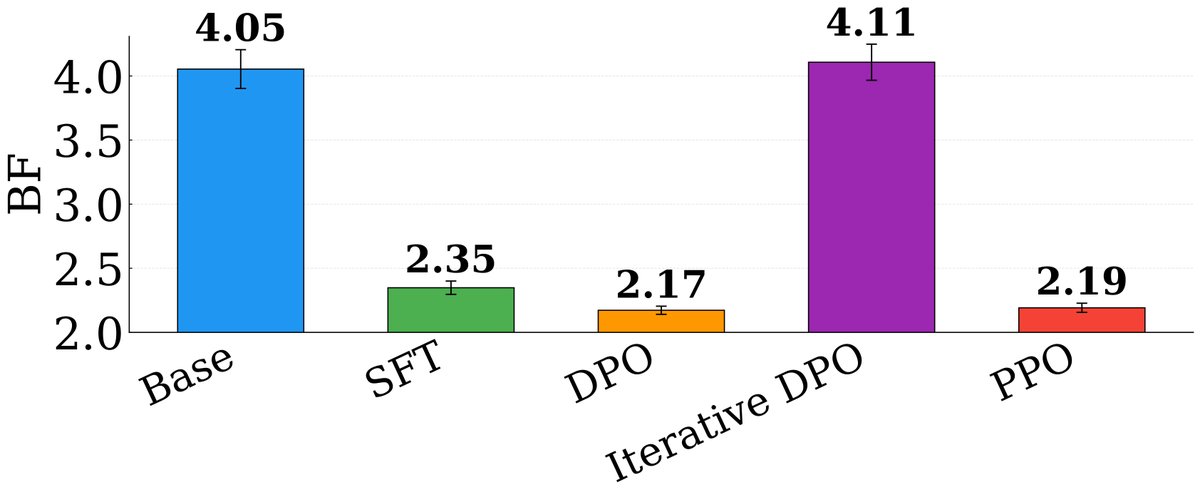
🔹 In our controlled pipeline, Iterative DPO preserves substantially more BF than offline DPO/PPO. This is an encouraging case study, not a universal algorithm ranking.
🔹 Multi-answer RL internalizes distributional search in one generation (ICML 2026): https://t.co/9uYuYh8WlF
🔹 Pass@k Training rewards set-level coverage and maintains higher policy entropy: https://t.co/AmuiKHA32F
These approaches intervene at different levels, but share one goal: prevent the policy from repeatedly collapsing onto the same already-explored trajectory.
Excited to share that I’ll be presenting our #ICML2026 paper in Seoul:
ExVerus: Verus Proof Repair via Counterexample Reasoning
📍 Poster: Thu, Jul 9, 5:00–6:45 PM KST, Hall A #2004
💡 DL4C Workshop: Fri, Jul 10, Session 2, 3:20–4:50 PM KST, Hall A (Board 100-119)
Paper: https://t.co/QTgydbKDWc
Happy to discuss!
This work focuses on LLM-based Verus proof repair. Verus is a practical Rust-based deductive verification framework that has been used to verify large-scale critical systems, such as cluster management controllers (Anvil) and virtual machine security modules (VeriSMo).
In this work, we propose a new paradigm for LLM-based proof repair: repairing a proof via synthesizing, validating, and blocking counterexamples.
1/n
Big congrats! Thanks for this great work to crisp the intuition to see how hard LLM is compressing information from param memory side!
I shared similar feeling when I worked on quantifying llm compression on the generative horizon side. It is like 1.2-1.5 ppl per output token for many post-trained model (v.s. > 10 for base model). I was also self-doubting a couple of times but later forced myself to do it and stand against harsh reviews (if interested, latest version: https://t.co/CvXGjtexZP) 😅
Will definitely read your great paper and hope you are open for chat!🤣
[🛫ICML] We will be presenting our paper about *base-aligned model collaboration* on Tuesday morning and also Saturday (HAI Co-Creativity workshop). Happy to chat!
PS: We've updated our paper, code, and reading list to include the latest results and resources. Check it out!
Excited to contribute to this work! 👁️📝 As someone relatively new to the multimodal world, I've always wanted to explore how we can better ground LLMs. But before diving deep into modeling, I believe we need a better understanding of what our benchmarks are actually evaluating.
Ever since Saining's "Is Vision Good Enough for Language?" (Thanks @sainingxie !) and recent 7-hour podcast deep dives, I've been fascinated by a core question: do recent popular VQA benchmarks really measure visual dependence? Have new SOTA VLMs fixed it? And does scaling up the model fix this?
Turns out, the answer is clearly "NO."
In our testing, we found that many widely used benchmarks barely need the image. In many cases, replacing the image with a short text caption yields equal or better performance. Counterintuitively, as you scale up the model, visual dependence actually decreases—the larger LLM backbone just answers more from its text pretraining priors!
This research made me realize exactly why spatial intelligence and world models are so critical right now. The benchmarks that explicitly test these spatial dimensions are the ones that demand real multimodal capability and cannot be overshadowed by a caption baseline.
We also explore some fascinating quirks, like how "self-captioning" (a kind of visual thinking) compares to other-model-captioning. Highly recommend the blog to anyone trying to learn about the realities of multimodal AI like me! 👇
🔗 https://t.co/pjzBIuAreh
Seeing👀 is not reasoning🤔?
Introducing our new blog post. We tested 8 open VLMs on 9 VQA benchmarks, and found that a lot of "visual" accuracy isn't visual at all. Many benchmarks can be solved without ever looking at the image, and some VLMs reason better from text than from pixels.
[1/n]
Introducing VaSE: Value-Aware Stochastic KV Cache Eviction.
Reasoning models think in CoT, bloating the KV cache. Eviction caps memory but suffers capability drop. VaSE is a training-free recipe that cuts that cost: keep large-magnitude value states, evict stochastically.
What happens when we build an "AI society" with LLMs? Turns out, it's far more stereotyped than we thought. 🤖📉
Excited to share our new work on Persona Collapse—where distinct AI agents regress into narrow behavioral modes. Surprisingly, the models with the highest per-persona fidelity produce the most stereotyped populations!
Huge kudos to the amazing team! @lrzneedresearch@JentseHuang, Weihao Xuan! Congrats to amazing Vivienne for her first paper! (She will be applying for PhD positions, please check her out!) Thanks for the support from the 2077AI foundation! Check out our paper & toolkit here: https://t.co/B3DIFgQgAJ
We have some concerns about the current state of LLM-based social simulation.
We benchmarked 10 LLMs on persona simulation. Every model collapses. The "best" ones are the worst offenders. And RLHF actively makes it worse.
https://t.co/w72O4FBQzq
On-policy RL has driven the biggest leaps in training coding agents. Extending it to machine learning engineering agents should be a natural next step.
But it almost never works.
What I mean is, the recipe is right there — standard trajectory-wise GRPO, the same that worked for SWE.
However, the problem is that one rollout step on an MLE task may take hours because the agent has to actually train a model on a real dataset at every step (preprocessing, fitting, inference, scoring). So even with the N rollouts in a group running in parallel, a single GRPO run may still take days.
Every MLE agent paper I've read has retreated to SFT or offline proxy rewards for exactly this reason, giving up the exploration benefits of on-policy learning.
That's why I'm excited about our new paper, SandMLE, which fixes this with a move that sounds almost too reckless to work.
The instinct when on-policy RL is too slow is to engineer around it — async rollouts so the trainer doesn't sit idle waiting for slow environments, off-policy or step-wise proxies to avoid running full trajectories at all.
But when we profiled where the time was going, the bottleneck had nothing to do with the algorithm.
Unlike SWE where execution latency comes from compilation and test logic, MLE latency is overwhelmingly driven by the size of the dataset the ML pipeline has to chew through.
Therefore, rather than downsampling existing data (which corrupts evaluation), we built a multi-agent pipeline that procedurally generates diverse synthetic MLE environments from a small seed set.
Specifically, we extract the structural DNA of seed tasks (modality, label cardinality, distribution shape), mutate them into new domains (e.g., repurposing animal classification into road damage detection), inject realistic noise, embed deterministic hidden rules connecting features to labels, and construct full evaluation sandboxes with progressive milestone thresholds.
Each task is constrained to only 50–200 training samples.
The execution speedup is dramatic — average per-step latency drops over 13×, which makes trajectory-wise GRPO go from infeasible to routine.
We also designed a dense, milestone-based reward to address the sparse credit assignment problem in long-horizon MLE. The ablation shows this matters — under a sparse reward, the 30B model's medal rate drops from 27.3% to 13.6% and valid submission collapses from 100% to 86.4%.
Results across Qwen3-8B, 14B, and 30B-A3B on MLE-bench are consistently strong — 66.9% better performance in medal rate over SFT baselines.
It is worth noting that the SFT baselines are not weak— we trained them on high-quality Claude-4.5-Sonnet trajectories.
But SandMLE still delivers much larger gains, suggesting that direct environment interaction does teach capabilities that imitation alone does not (as expected).
The most convincing evidence to me that the model's intrinsic performance gets improved is the framework-agnostic generalization.
We trained exclusively with ReAct but the gains transfer to AIDE, AIRA, and MLE-Agent scaffolds at evaluation time — up to 32.4% better performance in HumanRank on MLE-Dojo.
The SFT models, by contrast, are brittle when moved to unfamiliar scaffolds. The 30B SFT model collapses to 17.7% valid submission rate on MLE-Dojo with MLE-Agent, while the 30B SandMLE model achieves 83.9%.
SandMLE is teaching genuine engineering reasoning, not scaffold-specific patterns.
What I find most interesting beyond the specific result is that none of the hard parts of RL changed here.
The algorithm is the same. The reward is conventional. We just shrunk the environment until on-policy learning became affordable.
The field has largely treated environment design and RL algorithm design as separate concerns.
SandMLE is a concrete case that the environment is itself the lever.
When training is too expensive, the instinct is to build cleverer algorithms to tolerate it.
However, often the better move is to reshape the environment so the simple algorithm just works.
Paper: https://t.co/x0jAvCClyh
Nice share! I agree with most of that -- taste, judgment, and those higher-level capabilities would be more important. It would be pretty good if researchers could finally be set free from doing a laundry list of "experiments to make reviewer #2 happy".
I have some follow-up thoughts on long-context eval to share (forgive my nerdiness :-) ):
1) There have been debates on long-context eval -- basically, whether those metrics, combined with the eval datasets, really measure the model's long-context capability. I think there is a potential confounder that some prepended long context may actually not be that useful, as the topic can shift (e.g., multi-round interactions, storywriting). This may bring us to the "data-or-model" dilemma when debugging.
2) Predicting w/ and w/o context reminds me of the old days when people tried to pretrain the retriever using inverse-cloze tasks (https://t.co/UNnE3dtSWa). I previously experimented with similar ideas years ago, when we only had BART (https://t.co/nLFIrNoTl6). It could win a lot on retrieval-focused eval (most current long-context evals fall in this category), but the dataset curation could be tricky, as we, in the end want some downstream utilities. Yes, in general, predicting performance using stats unrelated to applications would be wonderful. But as we move towards more grounded applications, like agentic tasks, those "dirty details" ("scaffold", "harness",..) are hard to ignore, and in many cases, this is sth we could win users and impact.