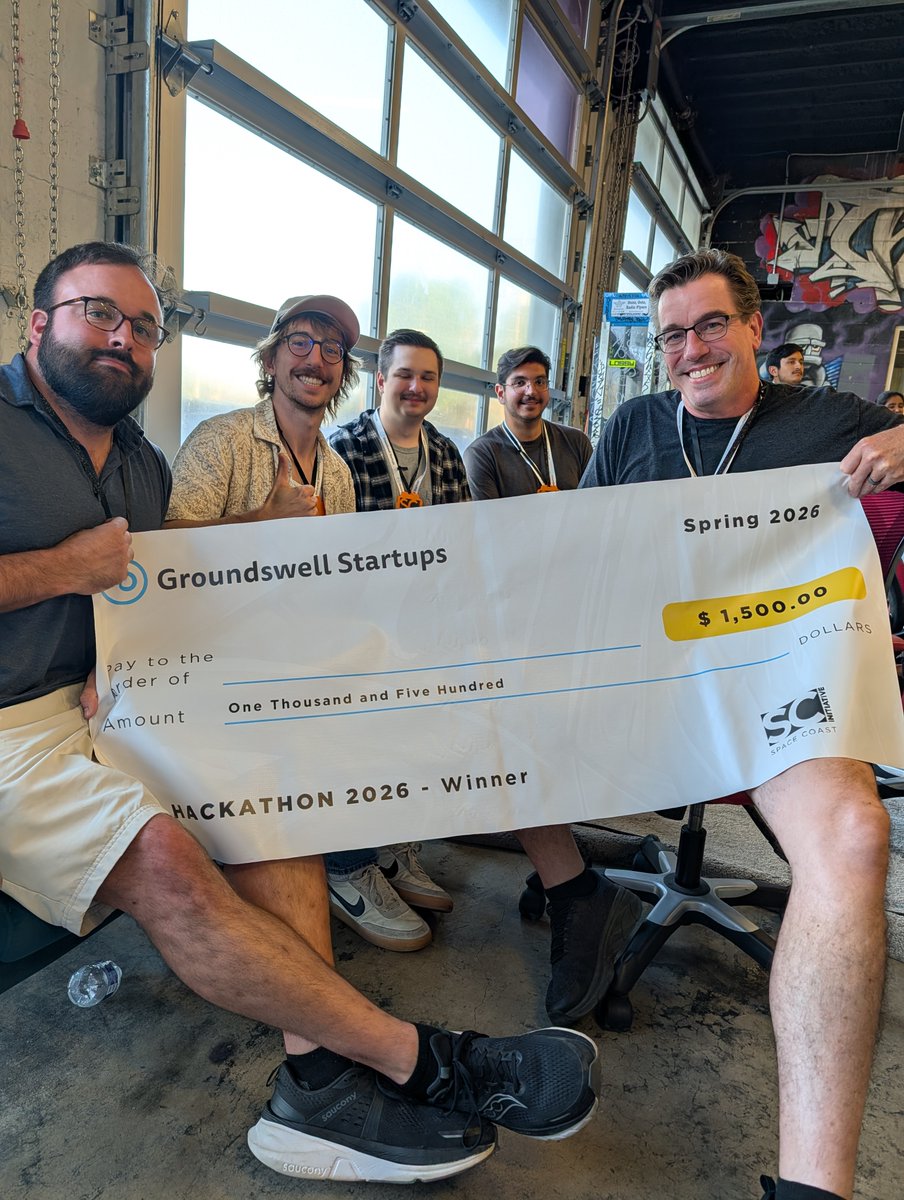
Just wrapped up an incredible 3-day Space Coast Initiatives Hackathon at Groundswell Startups!
Our team came together in under 72 hours and built an AI-powered data engineering + data science solution for ECG analysis to support @WHOWEPLAYFOR mission.
Grateful for the organizers, sponsors, and collaborators — excited to bring this forward in Florida and beyond!
#MachineLearning #HealthcareAI #Hackathon #ECG #SpaceCoast
#Java #SpringFramework
They say "comparison is the thief of Joy".
In this case, looks like "comparison is the cause of defeat."
Just remember that there's Walmart and Target. There is Lyft and Uber. For search there is Google, Bing and Yahoo. That list of examples goes on and on.
So keep working on product XYZ and get it to completion and get those customers. Because in a "year's time" someone else is going to be sitting at home stopping their development because product XYZ exists!
These all started as a vision and through perseverance became what they are today.
It has been several weeks using AI tools like Gemini for my Flutter/Dart frontend development. For the most part it has been rather great: offering up solutions to discussions about using mixins when it comes to having two types of screens: extend ConsumerWidget or ConsumerStatefulWidget (yes, I’m using Riverpod for state management).
However, that is the positive side. The not-so-great side, sometimes feeding Gemini an existing File_1.dart file and describing in 2-3 human sentences of what needs to be changed produced very incorrect output. Unfortunately, it’s output updated File_2.dart with a question I asked 20 minutes earlier about File_2.dart. It got confused! Even explicitly re-stating the prompt with more description and emphasizing an answer within the confines of File_1.dart? Gemini still got it wrong and re-did File_2.dart. File_1.dart and File_2.dart contained orthogonal concepts.
The solution? Simply starting a new chat window and do the original 2-3 human sentences with File_1.dart got Gemini back on track. This does seem to start the chat session over; however, I’m using AI on an AI-needs-to-only-know basis.
Building complex SaaS systems with a mix of Flutter/Dart, Java/SpringBoot, and AWS using IntelliJ Ultimate, Android Studio IDEs often requires specialized tools—here’s how I’ve structured my AI-assisted workflow to tackle frontend, backend, and cloud challenges.
Gemini (monthly paid): flutter dart
Grok 4 (yearly paid): Java, Spring, AWS
ChatGPT (free): miscellaneous
Ollama (local): for all the above when desired
I know there are plugins for each of my IDEs, but I'm managing each of the verticals (frontend, backend, cloud) as 3 walled-off 5000-piece puzzles. When I need to get the next piece in a particular puzzle placed, I only give the AI what it needs to answer based on my knowledge of any given puzzle. I leverage my extensive experience to understand the hallucinations and gaps then correct and complete as I paste into my IDEs.
How do your AI tool choices align with your stack and development philosophy?
Happy to have made the sacrifice and commitment to earn AWS Developer Associate Certification. Now onto the AWS Architecture Associate Certification..... #aws#developer#certification
@redbrogdon Just like you walk to mtgs at work and left for those X minutes early, learn what is X/2 minutes of walking and do that: X/2 minutes away from home and X/2 back to home to sit at laptop.
@redbrogdon Bigger problem will be learning the skillset how to articulate over a screen share and phone call versus being in a meeting room and a whiteboard.
@Splaktar Yes, work at the speed of thought/creativity and your laptop needs to keep up with that. There is a great ROI on fast laptops costing an extra $1k to $2k