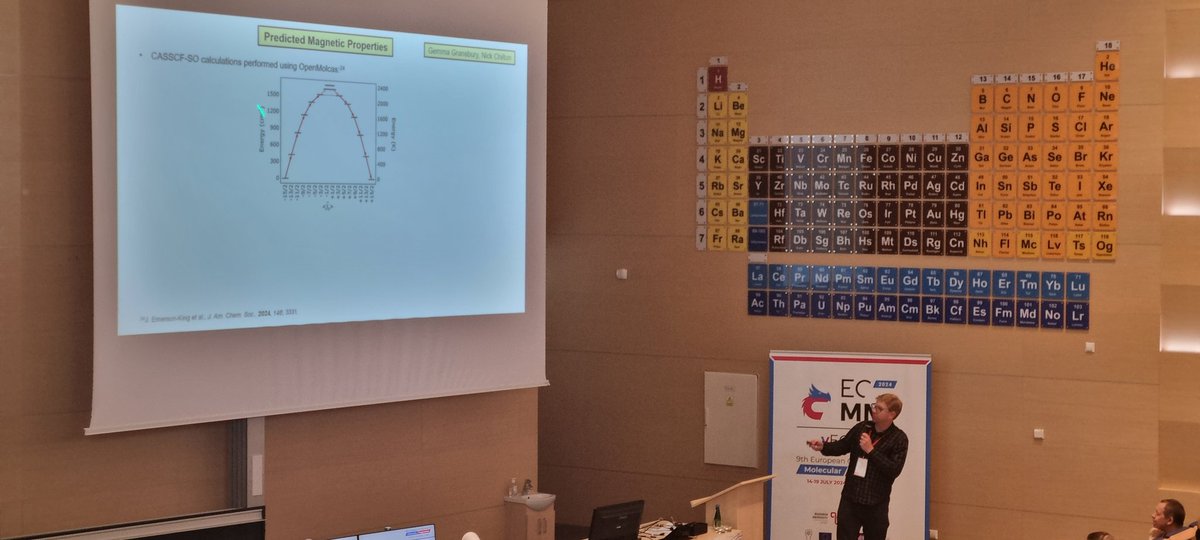
The new season of our 24-lecture Magnetic Resonance course for undergraduate chemists is now ready (https://t.co/oQtLuTVUfJ). Mostly chalk and blackboard, but the first two lectures are PowerPoint because there's some history of physics to cover. All handout PDFs are in the usual place at https://t.co/u6y0bndmEv
The interaction between defect spin qubits and magnons (the quasiparticles of spin waves) in a magnetic material offers opportunities both for control and coupling of qubit states, and for use of the spin qubit as a probe to study magnon phenomena. In the prototypical system, negatively charged nitrogen vacancy (NV) defects in diamond are placed in proximity to a ferromagnetic structure. An AC magnetic field is then used to drive dynamics of the NV spin, the magnon modes of the ferromagnet, or both. Meanwhile, the NV spin state can be initialized and monitored optically. I’ll be posting about my research using NV defect centers as quantum sensors to study the magnetization dynamics of ferromagnetic disks in a vortex state in future posts. This is a short thread to introduce you to the sample I use for this research.
This is a picture of the diamond sample I use for my research. It is electronic grade single crystal diamond from @ElementSix_. We grew an additional layer of diamond onto the sample and engineered a layer of NV defect centers 15 nm below the sample surface (through facilities at @qnextquantum@argonne@doescience). On the surface of the sample I fabricated an array of magnetic disks in a vortex state, as well as a gold waveguide. (I will also be posting about the fabrication processes used to make these samples).
@PhysicsCWRU
Thanks a lot but I am confident that you got in because of your own sheer hardwork, congrats to you mate!! I wish you all the best for your future endeavours!
Our beautiful university! 😍
UofG has been named as one of the top ten most beautiful universities in Europe, according to the golden ratio.
https://t.co/wXqX2lIlBY