He is Navin Chawla.
The Shah Commission Report (1978) recommended that he was unfit to hold any public office.
The L.P. Singh Committee (1979) advised his dismissal under Article 311.
N. Gopalaswami, the sitting Chief Election Commissioner, recommended Navin Chawla’s removal, alleging that he was passing information from CEC meetings to the Congress.
Yet, Navin Chawla was subsequently appointed Chief Election Commissioner.
He went on to conduct the 2009 Lok Sabha election.
Someone sent me this and asked me how come reservation came if Nehru was against it.
Well, allow me to present the full truth, which Congressi handles won't present.
And buckle up, as you are going to learn a lot about the Indian Constitution.
26th Jan, 1950 — The Indian Constitution comes into force. It contained reservation for jobs (British India also had this) with its coexistence with the Right to Equality. But it didn't contain a provision for reservation in education. Article 15(1) said that the State cannot discriminate against its citizens. And Article 29(2) said that no citizen can be denied admission to an educational institution on account of any parameter, including caste.
So, now states started implementing reservation in education. The Madras government was the first one to do this. But it was challenged in the judiciary on account of Article 15(1).
The judiciary studied the Constitution and declared that reservation cannot be implemented in education at all.
This created a critical problem for Congress governments across all states and for Nehru. Given that elections were scheduled for October 1951, this became a major worry for the Nehru government.
Nehru then immediately wrote to all Chief Ministers that, “It is impossible to hang up urgent social changes because the Constitution comes in the way. We shall have to find a remedy, even though this might involve a change in the Constitution.”
And hence, Nehru decided to amend the Constitution itself. The same Constitution which was not even 18 months old by then.
Nehru quickly rushed for the First Amendment of the Indian Constitution, where the Constitution cannot stop the government from making reservation provisions in any area and reservation policies can override Article 15(1). (The First Amendment had many areas, but that is the story of some other day.)
The Constitution was amended on 18th June 1951. And now you know why educational institutions have reservations.
Hence, rather than watching what Nehru said on reservations, see what Nehru did on reservations. You will get the answer.
(And read about the First Amendment of the Indian Constitution.)
Rahul Gandhi said
You will lose citizenship after CAA
You will never get vaccine
No elections if Modi won in 2019
Bullet train won't be built
Economy is dead
You won't get gas & petrol after Iran war
World leaders won't come to India
SBI, HAL & LIC will collapse
Exactly opposite happened
Now he is lying you will pay UPI charges
Are people aware of what is happening in the new Nalanda university? I have received a very unsettling mail from a student studying there.
He says "I am approaching you in a desperate attempt to find a way to somehow dismantle the misinformation and false narratives being propagated. While the central government claims this new structure to be the 'revival' of ancient Nalanda University, nothing could be further from the truth."
It's a long email, so I am just listing the important points.
1. He alleges that one professor K.T. Sarao delivered a talk to the whole university on how Brahmins/Hindus might have burnt the ancient Nalanda, after a conflict between Buddhist monks and Brahmins. The prof also conjectured that another possibility could be that Khilji mistook the ancient university for a fort and similarly dressed monks as soldiers; hence he might have mistakenly attacked the university.
2. He alleges that another professor, one Shailendra Raj Mehta, who visited the University couple of days back said in his lecture that the ancient Nalanda was purely Buddhist, as there was no system of building education institutes in Hindu tradition.
3. Prof Mehta also allegedly claimed that the traditions of Vaada and Samvaada were unique to ancient Nalanda, as earlier Hindus had no such tradition.
4. He alleges that one Prof Pranshu Samdarshi in a lecture stated that Upanishads were written after the emergence of Buddhism, and he quoted some western scholar.
5. Prof Pranshu Samdarshi also allegedly claimed that since Hindus could not defend their philosophical position against Buddhist Shunyata, they came up with Advaita Vedanta.
Lastly, the student has informed me that all the classes on Buddhist studies are being taught by monks and nuns. However, Hindu studies are being taught by profs who have no expertise in Hinduism or Vedanta.
I am deeply disappointed. If the new Nalanda is truly meant to revive the spirit of the ancient Nalanda, then it must revive its intellectual honesty as well. A university worthy of that name should be a place of Vaada where competing interpretations are examined against texts, inscriptions, archaeology and historical evidence, not presented to students as settled fact merely because they diminish the Hindu intellectual tradition.
Buddhism deserves to be taught by those who know it deeply and sympathetically; Hindu traditions deserve exactly the same scholarly seriousness.
A government-funded institution cannot call itself a civilizational revival while allowing one tradition to speak in its own voice and requiring another to be explained largely through the assumptions of its critics. If these allegations are accurate, the question that must be asked is - what exactly is being revived at Nalanda?
@narendramodi@EduMinOfIndia@DrSJaishankar@PralhadJoshiOfc
Can you guess what this number is: 43 crore?
That is 430 million. Not vaccine doses. Not Aadhaar cards. Not UPI txns this time.
That is the number of free doctor consultations delivered by a govt telemedicine platform most urban Indians have never even heard of.
It is called eSanjeevani.....
And it might be the most quietly massive digital health system on the planet, bigger, by consultation volume, than any telemedicine platform any country has ever built, public / private.
Look at how fast this scaled, most people assume govt tech moves at govt speed.
This one did not....
- 2019: platform rolled out, mostly experimental.
- Mid-2020: crossed 3 million consultations, right as COVID lockdowns hit and OPDs across the country shut their doors.
- Within a couple more years: past 120 million.
- By January 2025: past 250 million.
- By November 2025: 430 million.
That is not linear growth. That is a curve that bent hard upward because a health worker sitting in a primary health centre in rural Chhattisgarh, with zero specialists for a 100 KMs, suddenly had a video line straight to a doctor at a district hospital.
How it actually works and why the model is smart:
- It runs on a hub & spoke system. 131,000+ rural health centres (the "spokes") connect to ~17,000 hospital hubs.
- A nurse / health worker at a village level centre does the first line consultation and if it needs a specialist, they do not send the patient on a bus ride to the nearest city. They connect them, live, on video, right there.
- And this is not a niche pilot anymore, 93%+ of all usage runs through this doctor to doctor model, meaning it has become genuine day to day rural healthcare infrastructure, not a COVID-era stopgap.
A few more fascinating data points for people mostly doubting any govt run schemes:
- 57% of beneficiaries are women, the demographic that has historically had the hardest time physically travelling to a city hospital for a routine consultation.
- 12% are senior citizens. This is reaching exactly the population that private telemedicine apps, built for smartphone literate urban users with credit cards, were never going to reach.
1 of the largest single interventions in healthcare access in human history, built quietly, by an Indian govt lab (C-DAC), running almost invisibly in the background of "Digital India" headlines that usually go to UPI and Aadhaar instead.
Bharat is rising. 🙏🙏
Picture a room in 1964. Robert Noyce, the genius who co-invented the microchip, sits across from a bureaucrat in New Delhi. He has a simple offer: Let us build the future of silicon right here, on Indian soil.
The answer? Stifling red tape, endless forms, and a blunt no. Noyce packs his bags, flies to Hong Kong, and eventually builds Intel.
Fast forward to 2005. Millions of dollars in cutting-edge semiconductor equipment arrive at an Indian port. It sits on the damp concrete. Weeks turn into months. Papers rot, approvals stall, and the machinery gathers dust until the foreign partners throw up their hands, load the crates back onto cargo ships, and leave.
For 60 years, this was our story.....
We were the back office of global tech, holding 20% of the world’s elite chip design talent, while 100% of our silicon fabrication was outsourced across the oceans. Every single piece of physical silicon that powered our defense radars, our satellites, our smartphones, and our power grids was bought from someone else.
Then came the global supply chain freeze (all thx to COVID), and a sudden, quiet realization: a country that does not control silicon does not control its own destiny....
In Dec 2021, the switch flipped. Bharat launched the India Semiconductor Mission (ISM) with an initial fiscal war chest of ₹76000 Crore.
The global cynics called it ambitious; the skeptics called it impossible.
They forgot what happens when Bharat decides to move at full scale...🇮🇳🇮🇳
- Go to Sanand, Gujarat. What was once open soil is now a $2.75B advanced memory packaging fortress operated by Micron. Groundbreakings that used to take 6 years in bureaucratic limbo were compressed into < 90 days.
- Micron went from groundbreaking to commercial production in just 29 months. Kaynes OSAT stood up in a record 14 months.
- Travel east to Jagiroad, Assam. Deep in India's Northeast, Tata built a ₹27000 Crore OSAT facility designed to pump out 48M automotive and AI chips every single day.
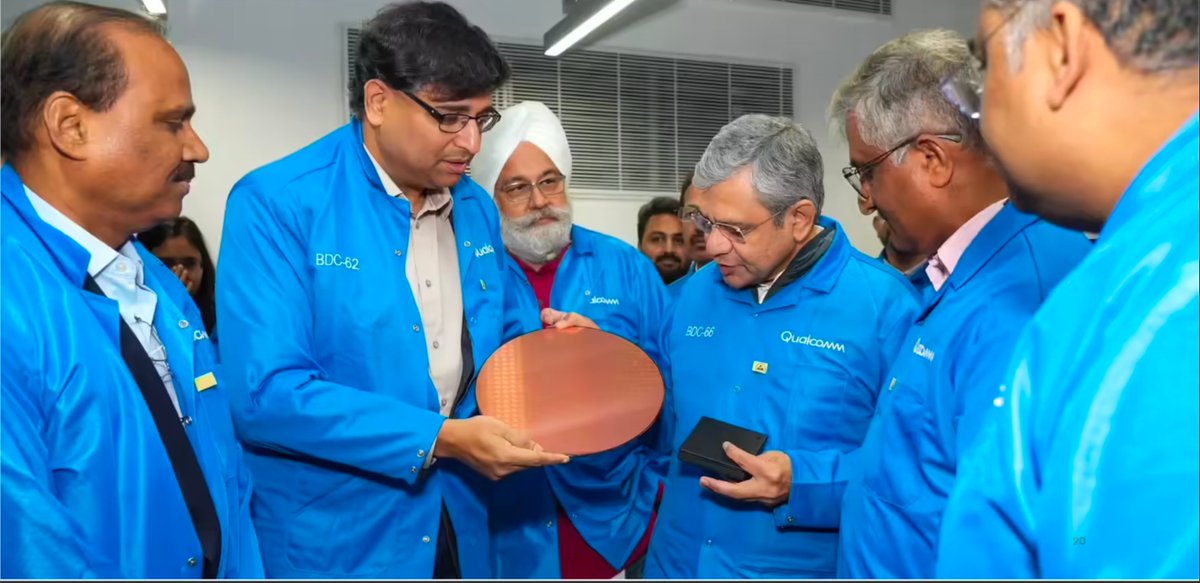
-Drive into Dholera, Gujarat. Across 66 hectares (163 acres) rises India’s crown jewel: a ₹91000 Crore megafab being built by Tata Electronics with technology support from Taiwan’s PSMC.
Construction is in full swing. Once operational, its ultra-clean rooms will fabricate 28 nm (along with 40/55/90/110 nm) power-management ICs and microcontrollers, the central nervous systems of electric vehicles, defence platforms, and 5G towers on 300 mm silicon wafers.
- Today, 99.2% of mobile phones used in India are Made in India, and India stands as the world's 2nd largest mobile manufacturer by volume.
For people asking "Kya hi badla hai desh mein..."...Dikhaata hoon aapko ki kaise with a total budget allocation surging to ₹127500 Crore, India is moving from mere packaging to full-spectrum dominance:
- Indian engineers are now designing 2nm chips. Under the guidance of the NSA & PSA, a high-level committee is carving out proprietary, strategic silicon for defense, compute, and deeptech.
- From raw sand to silicon ingots, to advanced node fabs and specialty gases, India is subsidizing up to 40% of Fab Capex and up to 75% for strategic R&D and talent development.
- 100K+ design engineers are being trained, powered by EDA tools across 315 colleges, ensuring the brainpower stays home.
For people asking "Okay..but kuch value bhi add hoga.."...Let me share kya hoga / expected hai:
- ₹4 Lakh Crore total expected investment unlocked.
- ₹2 Lakh Crore per year in domestic production.
- ₹1 Lakh Crore per year in tech exports back to the world.
Now, I know the usual skeptics will still sit in their AC rooms, sip their tea / some other colorful liquid, and sing the same old cynical raaga: “Oh, but the West is already moving to smaller nanometers, what is India doing?”
Let them talk. Let them doubt.
Because while they talk, our engineers are stepping into dust free cleanrooms, lowering their visors, and forging physical silicon on Indian soil. We are not asking for a seat at their table anymore...we just built our own.
The era of waiting is over. The era of doubt is dead. Bharat karke dikhayega. 🇮🇳🇮🇳
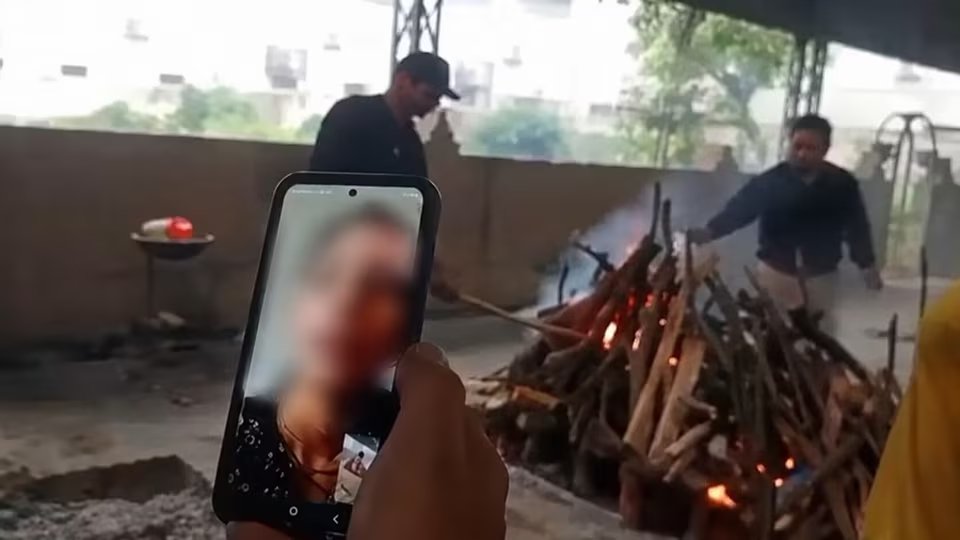
A father in Sonipat passes away alone in an old-age home. He spent his life’s earnings ensuring his daughters received the best education. Yet, his final rites were performed by strangers while his children watched over a video screen, transferring ₹5100 online and asking for a video recording to be sent to their phones.
We often celebrate modern education, global mobility, and financial success as the pinnacle of human achievement. But what happens when intellect grows while the heart shrinks to the size of a smartphone screen?
In the Taittirīya Upaniṣad, the ultimate commandment given to a graduating student stepping into the world is not to accumulate wealth / achieve high status, but:
मातृदेवो भव I पितृदेवो भव I
"Treat your parents as living embodiments of the Divine."
Ancient Indian philosophy defined life through 3 fundamental debts (Ṛṇas), the most unshakeable of which is Pitṛ-Ṛṇa, the debt to one’s parents.
It was not a financial transaction to be settled via a UPI transfer. It was a debt paid through presence, service (Seva), and being there to hold their hand when the eyes grow dim.
In the Mahābhārata, Yudhiṣṭhira is asked by the Yaksha: "What is higher than the heavens, and what is heavier than the earth?"
Yudhiṣṭhira replies:
माता गुरुतरा भूमेः खात् पितोच्चतरस्तथा II
"The mother is greater than the earth, and the father is higher than the sky."
When did we start measuring a parent's lifelong sacrifice against a lack of "travel time"? When did we start confusing "educating" our children with merely teaching them how to earn, while failing to teach them how to love :((
A culture that can outsource a father's last rites to an old-age home administrator and a video call might be economically advancing, but spiritually, it is bankrupt.
Let this incident not just be a viral story we shake our heads at today and forget tomorrow. Let it be a stark warning to look at our own homes, our own parents, and ask ourselves: In our rush to conquer the world, what are we leaving behind?
A few critique are saying: we built a massive module assembly line, but China still owns the silicon core & what we are doing currently is high-throughput screwdriving.
Let me tell you what an Indian startup is doing silently that majority of us are unaware of...
Chasing China by building multi billion dollar Czochralski (CZ) crystal-pulling furnaces to make standard silicon ingots and slicing them into wafers is necessary, but it is playing a 20 yr old game where China has insurmountable economies of scale.
Worse, single-junction silicon cells hit a hard physics brick wall known as the Shockley-Queisser limit (~29-33% theoretical, with practical commercial modules typically in the low to mid 20s %).
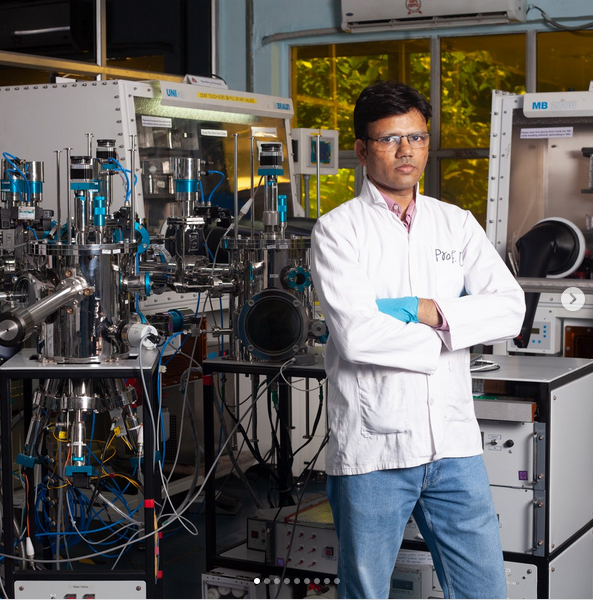
Co-founded by Prof. Dinesh Kabra out of the National Centre for Photovoltaic Research & Education (NCPRE) at IIT Bombay, ART-PV India decided not to simply catch up on conventional silicon wafers. Instead, the team is advancing perovskite-silicon tandem cells.
ART-PV deposits a thin perovskite layer on top of a high-quality silicon base cell.
Standard silicon primarily absorbs the red & near-infrared portion of the solar spectrum; higher-energy blue & green photons are largely wasted as heat.
The wider-bandgap perovskite top cell efficiently captures those high-energy photons, while the silicon bottom cell continues to harvest the lower-energy light that passes through.
In lab devices (primarily 4 terminal tandem configurations), the IIT Bombay / ART-PV team has demonstrated conversion efficiencies of ~29.8% & up to ~30.2%...clearly surpassing typical single-junction silicon practical limits.
In a field where even 0.5% gains are hard-won, this is a significant national milestone achieved inside Indian cleanroom facilities.
Why This Matters for India’s Energy Independence....
By developing high-efficiency tandem technology at IIT Bombay & advancing toward larger-area, commercial-scale solutions, startups such as ART-PV improve the fundamental unit economics of solar power.
A panel that delivers substantially higher power from the same surface area lowers the cost/watt, reduces land requirements & strengthens the case for domestic high-performance cells, reducing long-term reliance on imported conventional silicon wafers.
The assembly era got India to 162 GW of installed solar capacity. The deeptech cell & wafer era pairing advanced tandem research with domestic ingot & wafer capability is what will make the sector truly sovereign.
Veteran BBC journalist Rehan Fazal has revealed how BBC India blocked, delayed or rejected content related to the RSS.
Among the instances he cites are:
��� A documentary on M.S. Golwalkar that was delayed despite prior approval.
• A story on Nathuram Godse’s last day before his execution.
• Multiple articles on the RSS that were reportedly rejected.
If these claims are true, they reinforce what many have long suspected: that editorial gatekeeping was driven less by journalistic judgment and more by ideological preferences.
BBC’s editorial partisanship extends well beyond these examples, we have seen it reflected in its coverage of India over the years. It is significant when someone from within the organisation begins to lift the veil on how editorial decisions were made.
Google is turning Android into a walled garden. Mandatory ID, registration fees, and a 9-step 'advanced flow' for sideloading? That's not security, it's a monopoly move. https://t.co/sxUxw3HZhR @AlteredDeal#KeepAndroidOpen
If you bought your phone, you should own it. Google's new 'developer verification' means they decide what software you're allowed to run on your own property. Join the 100k+ signers opposing this: https://t.co/sxUxw3HZhR #KeepAndroidOpen
Some of you have been asking where CATS Warrior stands in the development cycle, so here’s the comparison:
✅ Ghatak: DAC granted AoN on 27 March 2026 under official designation RPSA (Remotely Piloted Strike Aircraft), for 4 squadrons (~60-80 airframes)
✅ CATS Warrior: technology demonstrator built, no AoN yet
Remember funding in India’s procurement system usually begins at DAC.
In recent times, several mid and senior level scientists have left ISRO, and the response now appears to be tighter restrictions on those seeking to resign.
Retention cannot be built on restrictions. If you want to keep talented scientists, give them meaningful opportunities, greater autonomy, challenging programmes, and clear career prospects. Otherwise, let them move on.
The same principle applies across our strategic R&D ecosystem DRDO, HAL, NAL, and others.
India has an exceptional pool of scientific talent, but too often its potential is constrained by mediocre decision-making.
Technology is sovereignty. The sooner we recognise that, the better.
US Senate’s New Russia Sanctions Bill.
What It Means for India
A bipartisan Senate bill unveiled Tuesday (framed as a tribute to the late Sen. Lindsey Graham) proposes tariffs of up to 100% on the top 5 buyers of Russian oil/gas: China, India, Slovakia, Hungary, Azerbaijan.
✅ White House-backed, Could reach a vote before August per Sen. Blumenthal.
Key mechanics:
✅ Exact tariff rate (0-100%) to be set by USTR, calibrated to “discourage” continued Russian energy purchases
✅ Exemption for countries importing less than 15% of Russia’s total gas exports AND actively reducing that share
✅ Also hits Russia’s shadow fleet, energy projects, financial institutions
Context matters here. This is a softened version of the 2025 Sanctioning Russia Act, which proposed up to 500% tariffs and never got a vote, lacked Trump’s support then. This version has WH backing. That’s the real shift.
India’s Russian crude exposure, recent trend:
✅ June 2026: imports hit a record ~2.35 mbpd (full month), touching 2.6 mbpd on some days : highest ever
✅ Russian share of India’s crude basket: as much as 53.5% in June
✅ Preceded by a dip : share fell below 25% between Dec’25-Feb’26 amid sanctions/payment friction, inflows down to ~1.0 mbpd
Why the June spike: a US sanctions waiver issued in March (has impact or not need to be studied) after Hormuz tensions pushed crude past $100/bbl, let Indian refiners resume Russian purchases at scale. India remains the world’s second-largest buyer of Russian hydrocarbons.
India-US trade exposure (FY26, Apr-Nov’25):
✅ Bilateral trade: $94.39B (record for the period)
✅ India’s exports to US: $58.99B
✅ Trade surplus with US: $23.59B
US is India’s #1 export destination.
India is probably the only major military power that proudly displays Russian tanks, French fighter jets, and Israeli radars as symbols of its strength.
I don’t know if defence audiences is monitoring this but A landmark approval by the cabinet
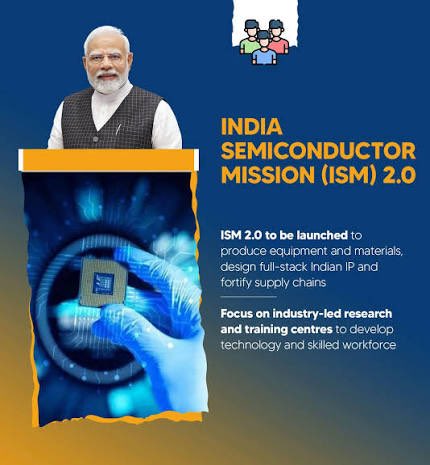
India Semiconductor Mission 2.0 with an outlay of 1,27,500 Crores