🕉🇮🇳 Building platforms @dyson. Ex @cisco. Tweets on Distributed Computing, Containers, GoLang, Cloud, Programming. Tulu. Tweets are my own, not Dyson's.
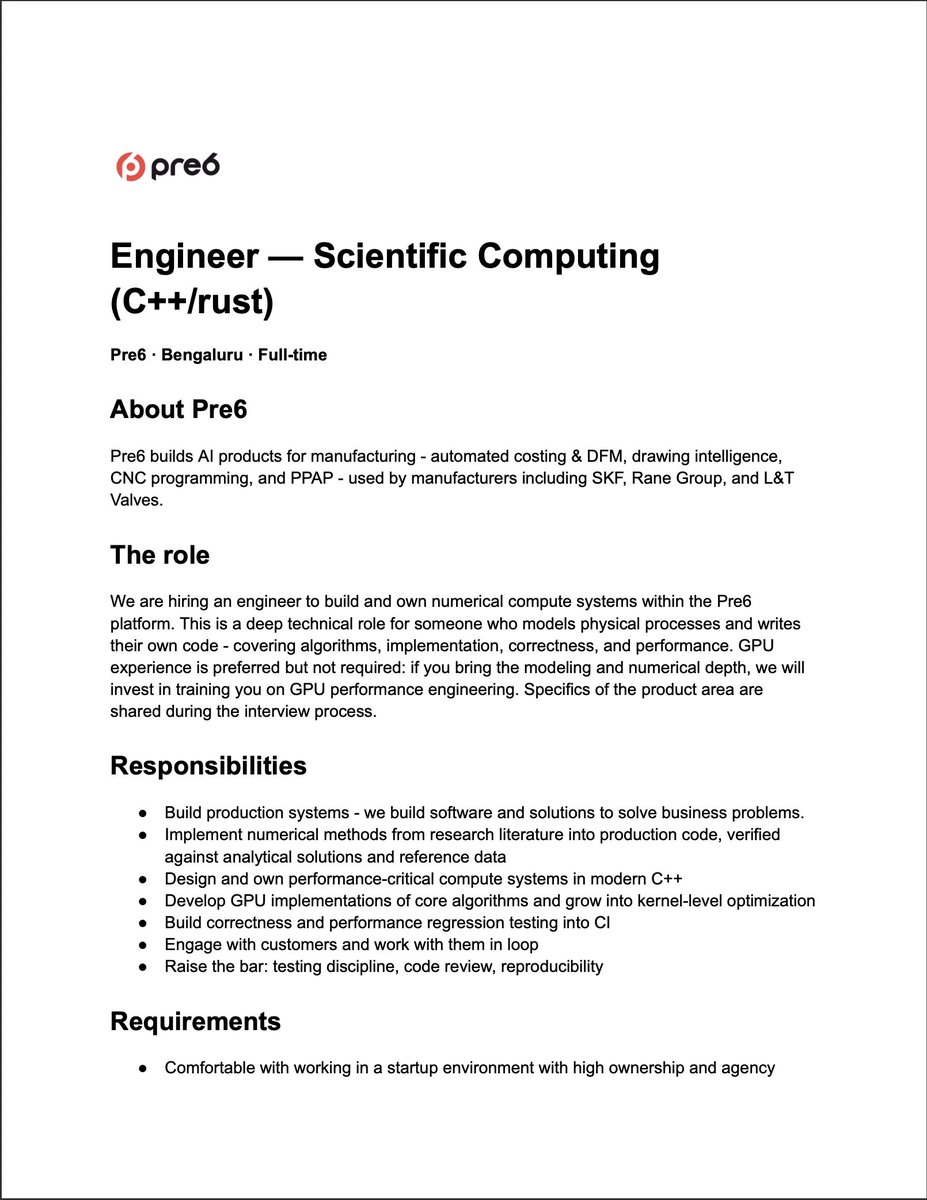
We’re hiring an Engineer - Scientific Computing (C++/Rust) at @pre6ai in Bengaluru.
If you can pick up a CFD/simulation paper, understand the math, and implement it for a new problem from first principles - without vibe coding - we want to talk.
You’ll build numerical compute systems, production solvers, and eventually push them hard on GPUs.
Deep ownership. Small team. 100th percentile salary.
apply - [email protected]
James Dyson is 79 and still finding ways to apply hardcore engineering to random consumer products.
He was in fine form pitching Dyson’s new $499 CameraJet toothbrush:
“The first toothbrush with a camera. The first toothbrush with a jet. The first toothbrush to find the space between the teeth and floss while you brush.”
Dyson says it created an ML algorithm trained on 470,000 mouth images to recognize the gaps to clean with water flossing.
Bangalore, 1924.
3 brothers: Parameshwara, Ganappayya, and Yagnanarayana Maiya, left a small village near Udupi looking for work, and ended up as cooks in private Bangalore households.
In 1924, Parameshwara, backed by his own employer's support, took the leap alongside Ganappayya: a tiny eatery on Lalbagh Fort Road, serving just coffee and idlis.
They called it, plainly, the Brahmin Coffee Club.
5 years later, Parameshwara died...
Yagnanarayana, "Yagnappa" to everyone who knew him, joined in to help Ganappayya run it, and it is here the story actually starts accelerating.
In 1951, Yagnappa made an almost unthinkable move for a small South Indian eatery of that era: he traveled to Europe, purely to study how restaurants there operated.
He came back and rebuilt the place from the inside out, modern sterilization of utensils, an open kitchen customers could actually see into, an obsessive new standard for hygiene that no comparable Bangalore eatery had at the time.
1960. A new address, and a new name.
The restaurant moved to its now legendary location on Lalbagh Road, and Yagnappa renamed it after the neighbourhood it now called home: Mavalli Tiffin Rooms, MTR.
Rava idli, arguably MTR's most famous dish, was born as a wartime workaround, not a planned invention.
When rice, the entire foundation of a traditional idli, grew scarce during World War II, MTR's cooks experimented with roasted semolina instead.
Similar rice-substitution ideas may well have existed elsewhere along the South Canara coast, but it is MTR that took the workaround, refined it, and made it famous enough to become a genuine national breakfast staple.
1975. The Emergency and the day MTR chose to lose money in public rather than lower its standards.
During the Indian Emergency, the government summoned 5 of Bangalore's best known restaurants, MTR among them, and ordered them to sell food at fixed, government-mandated low prices under the new Food Control Act.
Every restaurant had the same choice: comply, and compromise on quality / refuse.
Some paid up.
Others quietly cut corners on ingredients to survive the mandated prices.
MTR did neither....
They kept the food exactly as good as it had always been and instead, put up a board outside the restaurant, visible to everyone walking past, openly stating the day's financial losses.
For 16 straight days, MTR served its usual quality at a mandated loss, refusing to cut a single corner, telling the public exactly what that integrity was costing them in real rupees.
On the 16th day, they closed the doors.
The exile that accidentally built a 2nd empire.
The restaurant stayed shut for 6 years. But to keep the family's staff employed during that gap, they started selling spice blends and roasted flour mixes out of the adjoining grocery store.
That improvised survival move became the seed of an entirely separate business, taking shape as MTR Foods through the mid to late 1970s, even as company histories still trace the brand's true origin back to 1924.
The restaurant itself finally reopened in 1981, the same building, the same standards, the same stubbornness.
Meanwhile, the packaged foods arm, eventually led by Yagnappa's son Sadananda Maiya, kept growing on its own trajectory, expanding beyond Karnataka into Tamil Nadu and Andhra Pradesh by 1984, earning ISO and HACCP certification around 2002, and reaching export markets including Japan and other countries by the mid 2000s.
In 2007, Sadananda Maiya sold MTR Foods to Orkla, a Norwegian conglomerate that, by the time of this deal, was operating as a branded foods player, for ~$80M.
It is a quiet irony sitting at the heart of this story: the packet of MTR rava idli mix sold in an Indian supermarket today is owned by a Norwegian company, while the original restaurant on Lalbagh Road, the place all of it started from, remains entirely family-run, corporately unrelated to the brand printed on the packet, still standing on the same street, still serving the same dishes, over a century after 3 brothers with no money and a borrowed leg up from an old employer decided to open a coffee stall.
- A migrant family from a small coastal village.
- A European study trip that modernized Indian hospitality decades ahead of its peers.
- A wartime rice shortage that turned into a national breakfast staple.
- A government mandate that a family chose to lose money against rather than cheapen their food, in public, on a signboard, for two full weeks.
- And an improvised survival hustle during a forced shutdown that eventually became a bigger business than the restaurant that spawned it.
That is a 100 year lesson in refusing to compromise, told entirely through idli and dose.
This song from Hanuman Ansh parvathi song is so addictive!
The movie is based on Neem Karoli Baba, and I’ve already watched it twice without getting bored once.
I might even go for a third watch tomorrow. Highly recommend it to everyone.....trust me, you won’t be disappointed! #HanumanAnsh #NeemKaroliBaba #JaiHanuman
3 Weeks ago, A Movie Named "Hanuman Ansh" on Neem Karoli Baba got Released on 400 Screens..
1st week Movie collected 80 Lakhs!!
2nd Week, Screens reduced to 200 and the collection was below 2 crores!!
Everyone Declared it a Flop!!
3rd Week the song "Meine toh tere hi bharose Hanuman Sagar mein maiya daar dayi" gets viral and the movie collection reached 8 crores and becomes a blockbuster!!
The Viral song was sung by a Bundelkhandi Boy Suneel Lodhi who can't even see!!
Listen it's a masterpiece!!
Today a gentleman named Ramu visited me. He said, “I am like a son to your father.” Surprised, I asked how he met my father. He said he was a labourer for the contractor who painted our house in Amdavad eight years ago. My father saw he was a young migrant labourer from Bhind, M.P., liked him, took him under his wing and encouraged him to become a painting contractor. He introduced Ramu to friends and acquaintances for more work. Today Ramu owns three flats in Amdavad and has bought a plot. His two children are preparing for IIT and NEET. This is the power of Gujarat’s love and culture, where a migrant labourer can become a landlord and successful businessman. While sipping chai and talking to my mom he said, “Maine Doctor sahab se bahut kuch sikha, aaj agar uncle ji hote to meri safalta ko dekh kar bahut khush hote.” Best tribute to my father from someone met by chance.
Beating the GOAT Magnus Carlsen online and casually going straight to sleep without even waking your parents is absolute peak teenage nonchalance.
Huge congratulations to Vandan Sawai on an unbelievable victory! Scoring a win against Carlsen at this age is a massive statement of fearlessness and raw talent.
Waking up the next morning to realize your kid just dismantled a World Champion has to be the ultimate parenting moment.
The future of Indian chess is not just bright—it's utterly fearless. Keep shining, Vandan! ♟️🔥
#Chess #MagnusCarlsen #VandanSawai #IndianChess