@ank8dev The issue is it’s not my bot 😭 it’s the approver’s bot. I tried to remind humans to please leave conflicts as approval blocker. But there’s a (high) possibility that they just run their agents without monitoring them. Maybe. Idk.
> I open a PR
> someone uses Claude to review. It sets merge conflict as a final blocker for approval (WHY??)
> (anw) I resolve the conflict and request approval
> they take a while to respond, master moves, another conflict, their agent sets it as blocker again
> iterate
> I open a PR
> Coworker uses Claude to review. It requests minor changes.
> I fix the comments and request review
> Coworker takes awhile to respond, then uses Claude to review again. It requests minor changes.
This loop has repeated for *two weeks* on a single PR.
If I ask a human for a review, I want a human’s input.
If I want an AI’s input, I’ll just run it myself.
So, here’s a team rule we just implemented:
“If you’re asked to do a code review, you must do a human review.”
No AI comments allowed.
I'm almost done with my first AI coding project, and I have come to the following conclusions:
- Vibe coding is for retards
- Your AI is retarded
- You still have to think
- Your AI is bad at naming things
- AI code will never be good as artisanal hand-crafted sex code
the entire advantage of llms is they are incredibly flexible
which means they can conform to whatever way you prefer to work and think and build
there's infinite people posting about the best way to use agents. like, first you need to do a plan, and then you need to blah blah blah
but if that doesn't click for you, don't work that way. work however you like
the little bit of advice i'd give is think about ways to keep it fun
it can get boring consuming big chunks of text, ask for a fun video in a crazy voice that gets unhinged over time
The "whiteboard defense:" I should be able to pull you aside at any moment and ask you to explain any customer-facing system you've shipped. You should be able to clearly explain how it works and defend the decisions you made. This is my benchmark for responsible AI usage.
I don't expect line-level familiarity with the code. I don't care if you remember the exact function name or implementation detail. You may not even know it. I don't care.
But if I ask "why did you do X instead of Y?", "what happens if this actor behaves maliciously?", "what data structure did you use here and why?", or "where does this fail?" you should be able to answer confidently.
For PoCs, demos, experiments, whatever: I don't care. Generate 100% of it and understand none of it. Speed over quality every time in those specific scenarios.
But if you're shipping customer-facing work, you can't be shipping things you don't understand at a high level.
Coding agents can turn a two week old repo into a ten year old enterprise codebase.
Null checks for values initialized two lines earlier. Fallback wrappers preserving dead logic nobody calls anymore. Three slightly different copies of the same helper sitting in adjacent packages.
Everything compiles and the whole test suite is green, yet you are already maintaining legacy code before v1 even ships.
I’m scratching my head here.
In the past, we had to do a lot (or “more”) thinking, yes. But personally I don’t want it to change. I still want to do a lot of thinking.
In fact, I’d prefer doing only thinking and the agents do the “doing”.
My prediction is that AI models are going to plateau soon.
We haven't really created that much useful knowledge in the span of recent years. And training on AI slop leads to worse models.
In fact, due to AI, there's now even less incentive to create that knowledge. Why ask on StackOverflow or request help from a specialist if you can just ask your agent?
AI will continue to get better. Fewer mistakes. Better application for niche problems, so that relevant data is not obfuscated.
But I think it's going to be an era of finding more applications of AI rather than improving models. We already see this with Anthropic and OpenAI trying to go after B2B competitors.
Ok. Step back. Clearly the serialization format isn't the difference, its the implications. HTML is a representation of the final transformed output, JSON is just data. So lets lay out some constraints:
1. Data is used in multiple places, ie.. one piece of data multiple places in the HTML
2. Only want to send what is necessary, ask for what is necessary. Only re-render parts of the HTML that relate to changed data ideally, don't request unrelated data.
By far the simplest way to do this is have a shared context that stores the data representation, and can granularly do the rendering. This is basically what client apps do. They don't even necessarily need to manage a cache since they know what they are asking for. Each endpoint is data scoped.
If you are using HTML your endpoints no longer scoped to the data but to the UI shape as you break things apart. You could do this on the server by caching rendered HTML partials that each independent endpoint can read from. But you are losing the information of what has changed by shape. It can be communicated, but now its a special protocol. Also you need to know exactly what UI will update to hit those endpoints. So it isn't as simple as being in the mutation itself and knowing about what data changes. Sure you can say this process updates these sections of the page, but that couples this relationship. If the UI changes you need to update each point rather than basically riding the data graph automatically.
We actually saw this fold out in Realtime with Next.js the past couple years. Why are are they always going on and on about caching. It's because they were the ones who sat juxtaposed closest to the alternative. Where people could feel the perf impact, see the bills on their backend go up.
So while it is doable there is no way I'd consider this simpler once the 2 constraints are in play. I think you could build a really nice system using HTML like this. I've been playing with it, but it isn't something I'm doing out of keeping things easier.
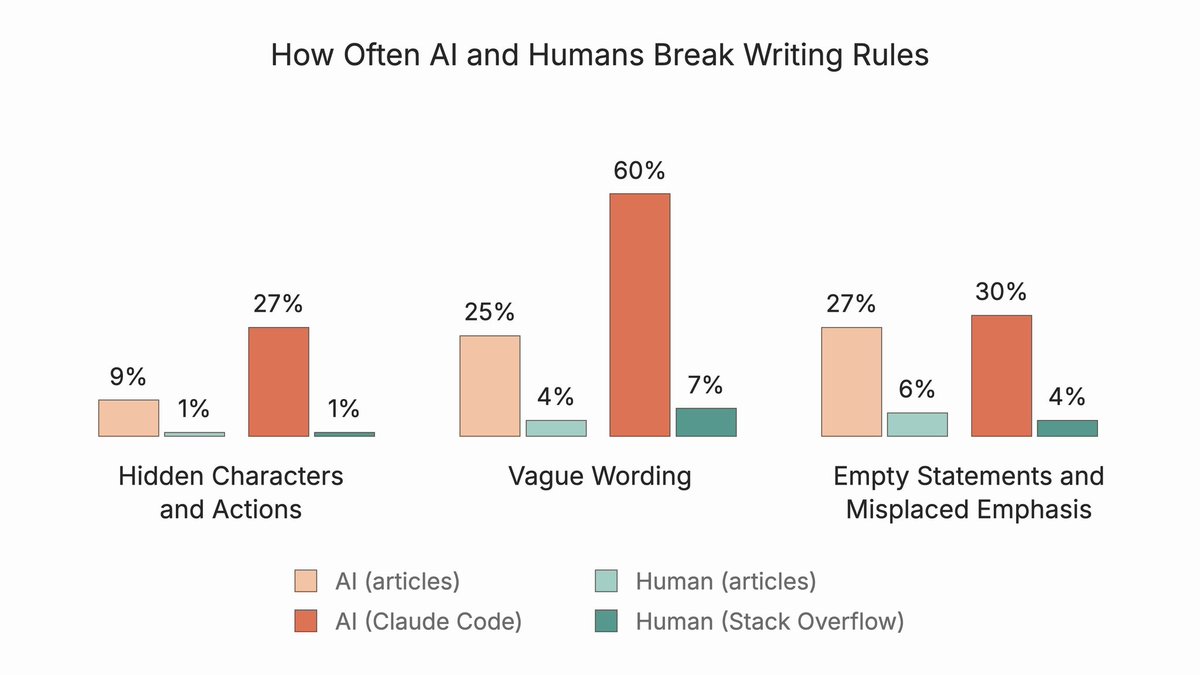
Why is AI slop so frustrating to read?
AI writing often obscures main ideas and invents awkward phrases, making sentences more complex than necessary.
Many of these slop patterns violate writing principles established in English writing books.
In our benchmark, AI writing breaks these principles far more often than human writing, with Claude Code replies by far the worst offenders.
We show examples of the most common slop patterns in this thread
Wait. But in an era saturated with AI slops, wouldn’t it be more refreshing to see posts so human: raw, unfiltered, so opinionated that they’re borderline offensive.
Food for thought: Every edge case we accommodate introduces some degree of complexity, and that complexity can generate new edge cases of its own.
A system can become less reliable in the pursuit of making it more defensive.
Food for thought: Every edge case we accommodate introduces some degree of complexity, and that complexity can generate new edge cases of its own.
A system can become less reliable in the pursuit of making it more defensive.